 Abstract: Antibody-drug conjugates (ADCs), known as “precision missiles” for cancer treatment, can accurately target tumor cells without harming normal tissues. The core of this technology lies inconjugation technology— the method of linking cytotoxic drugs (the warhead) with antibodies (the navigation system). This article starts from the working principle of ADCs, breaking down three major categories of technology: random conjugation, site-specific non-selective conjugation, and site-specific selective conjugation. It details the core logic, advantages, disadvantages, and clinical applications of each technology. Through real-world drug case studies and technical comparisons, readers will understand how conjugation technology affects the efficacy, stability, and safety of ADCs, experiencing the iterations and breakthroughs in anti-cancer technology.
1. Cancer “Precision Missile” ADC: How Does It Achieve Accurate Strikes?
People’s impression of chemotherapy may still linger on the idea of “killing a thousand enemies but losing eight hundred of its own”—the drugs kill cancer cells while also harming normal cells, leading to severe side effects like hair loss and nausea. The emergence of ADCs has completely changed this situation; they act like “precision missiles,” accurately locking onto tumor cells and delivering strikes.The core structure of ADCs consists of three parts: antibodies (responsible for navigation, accurately identifying specific proteins on the surface of tumor cells), cytotoxic drugs (responsible for killing, or the “warhead,” which is highly toxic), and linkers (responsible for connecting the antibody and the drug, ensuring that it does not “explode” prematurely during transport). Conjugation technology is the key process that efficiently and stably links these three components.In simple terms, the quality of conjugation technology directly determines the precision, stability, and lethality of this “missile”: if the connection is not strong, the drug may detach prematurely and damage normal tissues; if the connection site is incorrect, it may affect the antibody’s navigation function; if the structure is heterogeneous after connection, it may lead to fluctuations in efficacy. As of now, 15 ADC drugs have been approved globally, with over 70 in late-stage clinical trials, and the success of these drugs is inseparable from the support of conjugation technology (Table 1).Table 1: Core Information of Approved ADC Drugs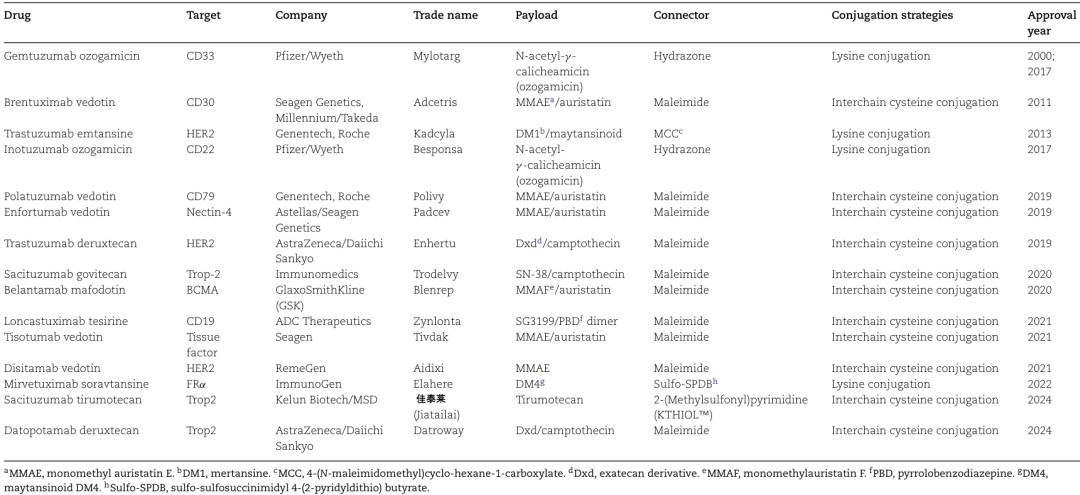
2. Three Categories of Conjugation Technology: From “Random Linking” to “Precise Positioning”
With the development of ADC technology, conjugation technology has gradually evolved from early “random linking” to “precise positioning linking.” Based on the precision and selectivity of the linkage, it can be divided into three major categories, each with its unique logic and application scenarios.
(1) Random Conjugation: Simple and Direct “First-Generation Technology”
Random conjugation is the earliest technology used for ADC preparation, with the core representative being lysine conjugation. There are about 40 lysine residues on the antibody that can interact with solvents, and the amino groups on these residues have high reactivity, allowing them to react with linker-drug complexes (LP) to achieve linkage.The advantages of this technology are obvious: the reaction process is simple, there are few purification steps, product stability is good, and production costs are low, making it easy to scale up. Currently, 5 marketed ADCs use this technology, such as the well-known Kadcyla (trastuzumab emtansine).However, the disadvantages cannot be ignored: due to the random connection sites, the final ADC product structure is heterogeneous—some antibodies are linked to 2 drug molecules, while others are linked to 4 or even more, forming different drug-antibody ratios (DAR). This heterogeneity may lead to rapid clearance of the drug in the body and even increase toxicity. For example, the first marketed ADC, Mylotarg®, was withdrawn in 2010 due to excessive toxicity caused by heterogeneous DAR, and it was only re-approved in 2017 after adjusting the dosage and administration scheme.However, scientists are continuously optimizing random conjugation technology, such as by selecting linkers with lower reactivity to achieve “semi-selective” linking under mild conditions, allowing the drug to primarily link to the lysine residues with the highest reactivity on the antibody surface, thereby improving product uniformity.
(2) Site-Specific Non-Selective Conjugation: Upgraded Control in “Transitional Technology”This technology addresses some pain points of random conjugation, allowing the linkage site to be restricted to specific areas, but it cannot precisely select specific amino acid residues. Core representatives include interchain cysteine conjugation, enzyme-tagged conjugation, and glycan remodeling conjugation.
1. Interchain Cysteine Conjugation: The Most Widely Used “Intermediate Solution”
IgG1 antibodies naturally contain 4 pairs of interchain disulfide bonds. After treatment with reducing agents (such as TCEP, DTT), 8 free thiol groups (-SH) are formed, which can specifically react with maleimide-type linkers to achieve drug linkage (Figure 1).The advantages of this technology are mild reaction conditions, high yields, and fewer linkage sites compared to lysine conjugation, resulting in better product uniformity—most products have a DAR concentrated around 4. Currently, among the 15 marketed ADCs, 10 use this technology, including the domestic ADC drug Aidiqi (vidutolimab).However, it also has shortcomings: the linkage bond formed between maleimide and thiol groups may undergo reverse reactions in vivo, leading to premature drug release, affecting efficacy and safety. To address this issue, scientists have developed new linkers (such as KTHIOL™, P5™) or modified the maleimide structure to enhance linkage stability. Additionally, optimizing reaction conditions (such as performing conjugation at 4°C) can further increase the proportion of DAR4 products and reduce ineffective or toxic impurities.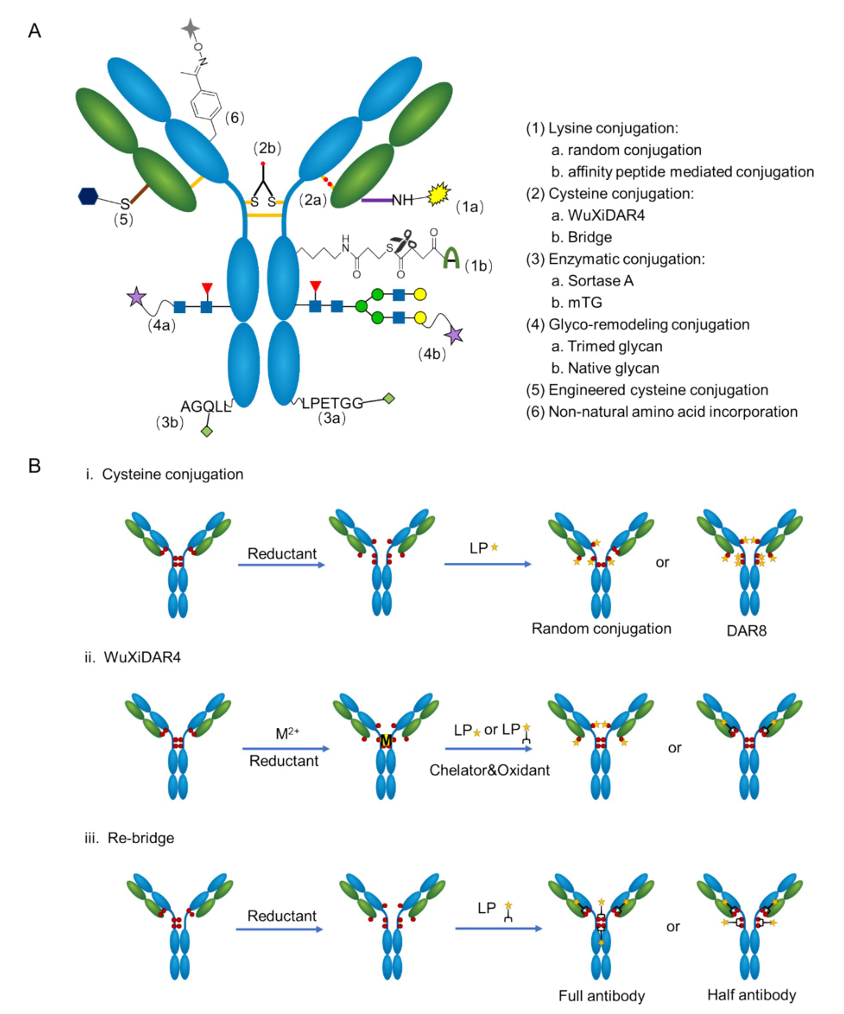 Figure 1: Schematic Diagram of Site-Specific Conjugation Technology and Interchain Cysteine Conjugation Process(A) Schematic diagram of site-specific conjugation technology, highlighting key reaction mechanisms and conjugation sites; (B) Schematic diagram of the interchain cysteine conjugation process, illustrating the specific steps of (i) conventional cysteine conjugation, (ii) WuXiDAR4 technology, and (iii) disulfide bridge technology.
2. Glycan Remodeling Conjugation: Precision Linking Based on “Glycan Chains”
Glycan remodeling conjugation is another important site-specific non-selective technology that does not rely on amino acid residues but achieves linkage by modifying the glycan chains on the antibody. The Fc region of the antibody typically connects to glycan chains, and scientists can first remove the natural glycan chains through enzymatic digestion, then introduce modified glycan chains (such as galactose containing azide), and finally connect the drug to the modified glycan chains through click chemistry.The advantages of this technology are prominent: the linkage site is fixed at the N297 position of the Fc region, resulting in high product uniformity, and it does not affect the antibody’s antigen-binding ability; some studies have also found that ADCs after glycan remodeling exhibit better pharmacokinetic (PK) characteristics and efficacy—for example, ADCs produced using Synaffix’s GlycoConnect™ technology achieved complete remission in 7 out of 7 animal models with a dosage of 1 mg/kg, while traditional ADCs were ineffective at the same dosage.However, the drawbacks of glycan remodeling conjugation are also evident: the reaction steps are complex, usually requiring 2-3 enzymes, leading to high production costs and low yields; moreover, the technical routes of different companies vary significantly, and currently, no ADCs using this technology have been marketed, although several candidate drugs have entered clinical stages (Table 2).Table 2: Summary of Various Glycan Remodeling Conjugation Technologies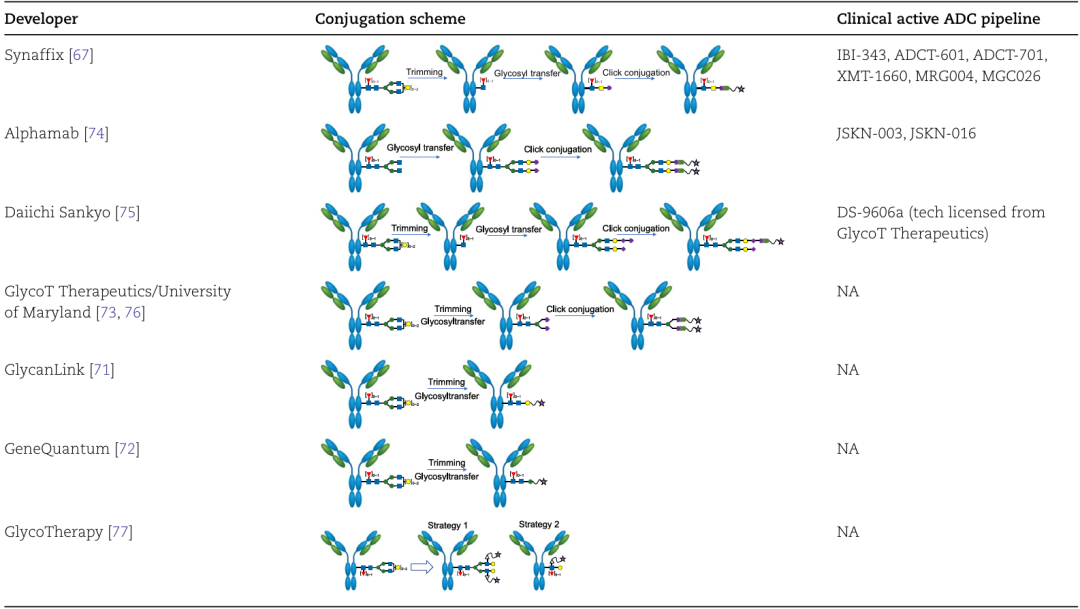
3. Enzyme-Tag Conjugation: Technology Based on Precise Recognition by “Enzymes”
Enzyme-tag conjugation utilizes enzyme specificity to achieve linkage: first, an amino acid sequence that can be recognized by the enzyme (such as the LPXTG sequence recognized by Sortase A) is engineered onto the antibody, and then the enzyme catalyzes the binding of the drug to that sequence. This technology has extremely high uniformity and is applicable to various types of antibodies, but the drawback is that the introduced exogenous sequence may increase immunogenicity risks, requiring additional purification steps to remove enzymes and impurities. Currently, only a few candidate drugs have entered clinical stages.
Figure 1: Schematic Diagram of Site-Specific Conjugation Technology and Interchain Cysteine Conjugation Process(A) Schematic diagram of site-specific conjugation technology, highlighting key reaction mechanisms and conjugation sites; (B) Schematic diagram of the interchain cysteine conjugation process, illustrating the specific steps of (i) conventional cysteine conjugation, (ii) WuXiDAR4 technology, and (iii) disulfide bridge technology.(3) Site-Specific Selective Conjugation: Advanced Technology Precise to “Single Amino Acid”
This is currently the most advanced conjugation technology, capable of precisely selecting specific amino acid residues on the antibody for linkage, achieving “one-to-one” precise conjugation. Core representatives include engineered cysteine conjugation and non-canonical amino acid (ncAA) conjugation.The logic of engineered cysteine conjugation is quite clever: through genetic engineering techniques, a cysteine residue is substituted at a specific position on the antibody (such as a certain amino acid on the light or heavy chain), and this “custom” cysteine becomes the only linkage site, ensuring that each antibody connects a fixed number of drug molecules (usually 2), achieving extreme product uniformity.ADCs produced using this technology exhibit better stability, superior pharmacokinetic (PK) characteristics, and a wider therapeutic window. For example, the ADC drug DCDS0780A, which is in clinical stages, uses the HC-A114C engineered site, with a maximum dosage twice that of traditional non-site-specific ADCs, achieving comparable efficacy but with better safety. However, the challenge of this technology lies in selecting suitable substitution sites—if the site is not chosen properly, it may lead to incorrect antibody folding, affecting its function (Table 3).Table 3: Clinical Stage Engineered Cysteine Conjugation ADCs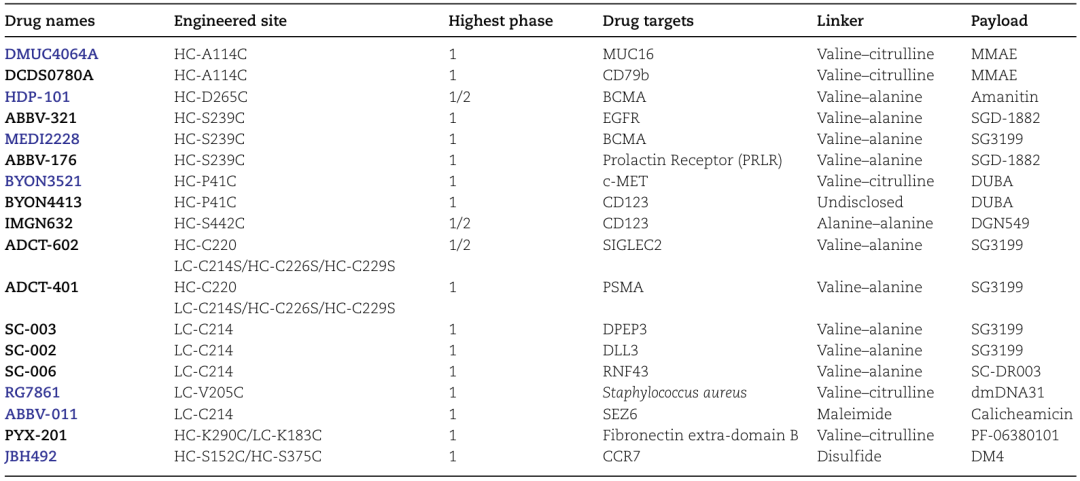 Non-canonical amino acid (ncAA) conjugation is another form of “precise operation”: through codon expansion technology, non-canonical amino acids (such as those containing ketone or azide groups) are inserted at specific positions on the antibody, and these special amino acids can be precisely linked to drugs through bioorthogonal reactions. The advantages of this technology are that the linkage sites are completely controllable, product uniformity is extremely high, and it does not affect the natural structure and function of the antibody.However, ncAA conjugation also faces challenges: the expression efficiency of non-canonical amino acids is relatively low, leading to low antibody yields and increased production costs. Currently, several companies are optimizing expression systems; for example, MedImmune has improved cell lines and culture processes to increase antibody yields to 1.5-2.5 g/L, laying the foundation for the industrialization of this technology.
3. Technical Competition: The Advantages and Disadvantages of Different Conjugation Technologies
Choosing which conjugation technology to use requires a comprehensive consideration of efficacy, safety, production costs, and industrialization difficulties. The table below summarizes the core advantages and disadvantages of mainstream technologies for easy reference:Table 4: Comparison of Advantages and Disadvantages of Various Conjugation Technologies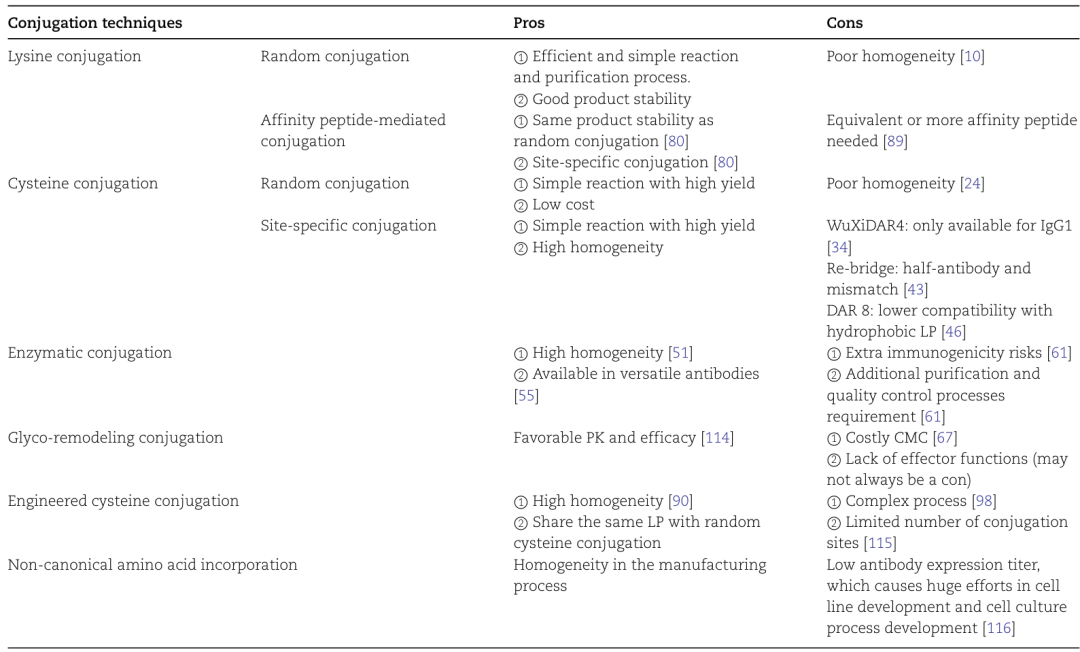 From a clinical application perspective, interchain cysteine conjugation has become the most widely used technology due to its “cost-effectiveness” (balancing uniformity and production costs); while engineered cysteine conjugation and ncAA conjugation, although technologically advanced, are mostly still in clinical stages due to cost and process complexity. However, with technological optimization, they are expected to become mainstream in the future.
4. Future Directions: How Can Conjugation Technology Break Through Bottlenecks?
Although ADC drugs have achieved great success, conjugation technology still faces many challenges: such as how to further improve product uniformity, enhance the stability of linkage bonds, reduce production costs, and avoid immunogenicity risks.Future technological breakthroughs may focus on several directions: first, developing more efficient enzyme-catalyzed conjugation technologies to simplify reaction steps and reduce costs; second, optimizing expression systems for non-canonical amino acids to improve antibody yields; third, designing new linkers to achieve “smart release”—releasing drugs only upon reaching tumor cells, further enhancing the therapeutic window; fourth, exploring conjugation technologies for multi-target ADCs to achieve precise strikes against complex tumors.With these technological breakthroughs, ADC drugs will become safer, more effective, and more accessible, bringing hope to more cancer patients. As the “core framework” of ADCs, conjugation technology will continue to drive the iteration and upgrade of anti-cancer technology.Scan the WeChat QR code to add the editor of the Antibody Circle; eligible individuals can join the Antibody Circle WeChat group!Please indicate: Name + Research Direction!

All articles reprinted by this public account are for the purpose of conveying more information, and the sources and authors are clearly indicated. If any media or individual does not wish to be reprinted, please contact us ([email protected]), and we will immediately delete it. All articles only represent the author’s views and do not represent the position of this site.