Risk stratification is crucial for assessing complications, survival, and guiding treatment in patients with myeloproliferative neoplasms (MPN). This article summarizes internationally recognized scoring systems for risk stratification of MPN patients used in clinical practice.
Note: The prognostic scoring systems related to survival mentioned in this article were developed and validated in populations with a median diagnostic age of 55-64 years, hence they are not applicable to younger MPN (diagnostic age ≤ 40 years).Essential Thrombocythemia (ET)
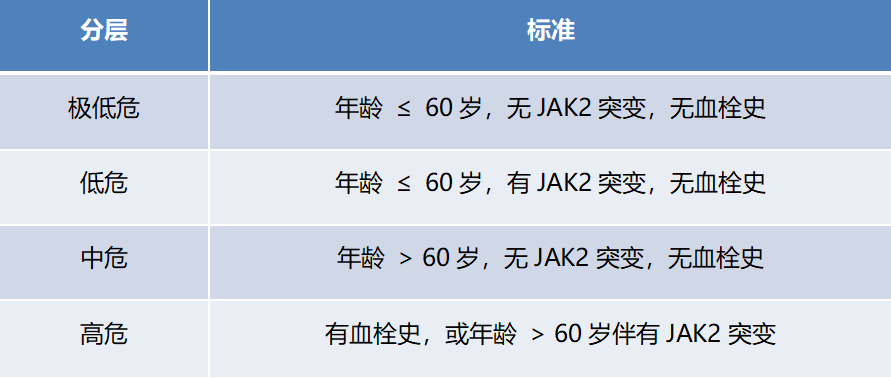
1. Revised International Prognostic Score for Thrombosis in ET (IPSET-thrombosis(revised)) [1] [2]
2. International Prognostic Score for Survival in ET [3]
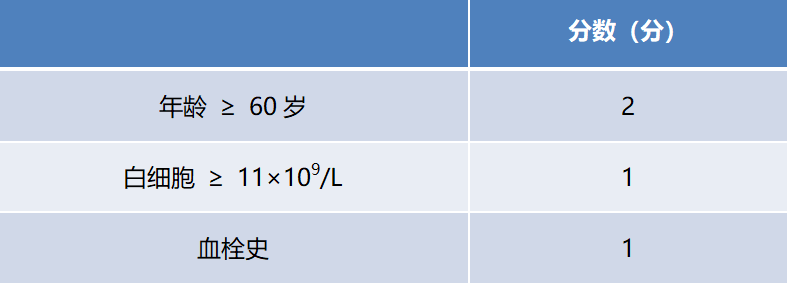
Groups based on cumulative score:① Low risk (0 points), median survival not reached;② Intermediate risk (1-2 points), median survival 25 years;③ High risk (≥3 points), median survival 14 years.3. MIPSS-ET (including genetic mutation characteristics) [4]
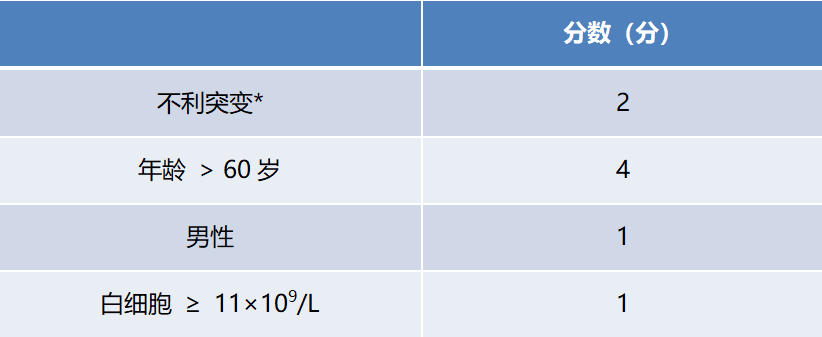
*Includes SRSF2, SF3B1, U2AF1, TP53.Groups based on cumulative score:① Low risk (0-1 points), median survival 34.4 years;② Intermediate risk (2-5 points), median survival 14.1 years;③ High risk (≥6 points), median survival 7.9 years.Polycythemia Vera (PV)1. PV Thrombosis Score [2, 5]Group based on age and thrombosis history:① Low risk: age ≤ 60 years, no history of thrombosis;② High risk: age > 60 years, or with a history of thrombosis.2. PV Survival Prognostic Score [6]
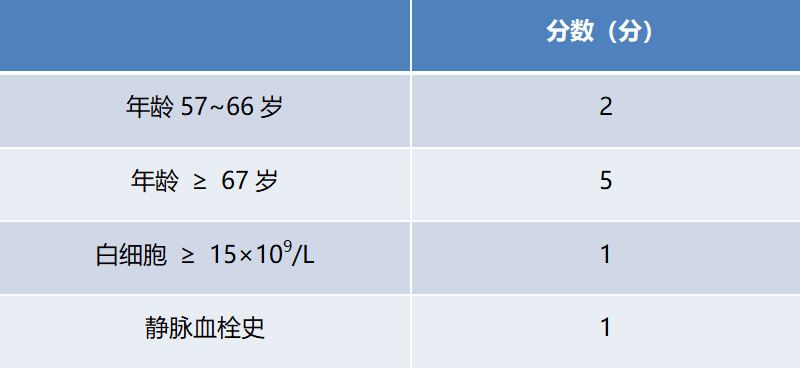
Groups based on cumulative score:① Low risk (0 points), median survival 28 years;② Intermediate risk (1-2 points), median survival 19 years;③ High risk (≥3 points), median survival 11 years.3. MIPSS-PV (including genetic mutation characteristics) [4]
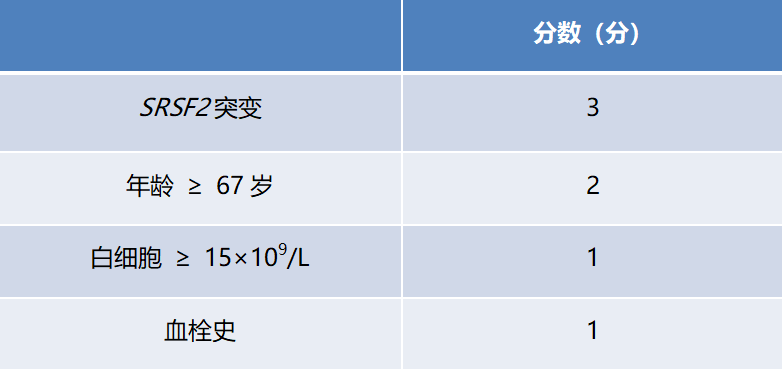
Groups based on cumulative score:① Low risk (0-1 points), median survival 24 years;② Intermediate risk (2-3 points), median survival 13.1 years;③ High risk (≥4 points), median survival 3.2 years.
Myelofibrosis (MF)
1. International Prognostic Score System (IPSS) [7]
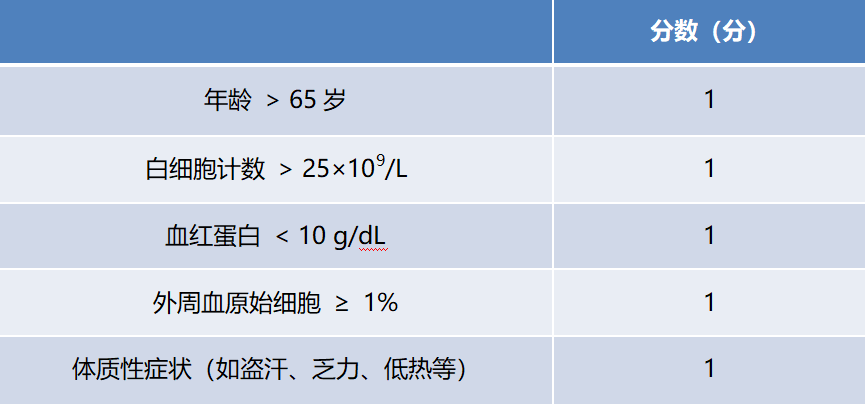
Groups based on cumulative score:
① Low risk (0 points), median survival 11.3 years;
② Intermediate risk-1 (1 point), median survival 7.9 years;
③ Intermediate risk-2 (2 points), median survival 4 years;
④ High risk (≥3 points), median survival 2.3 years.
2. Dynamic International Prognostic Score System (DIPSS) [2, 8]
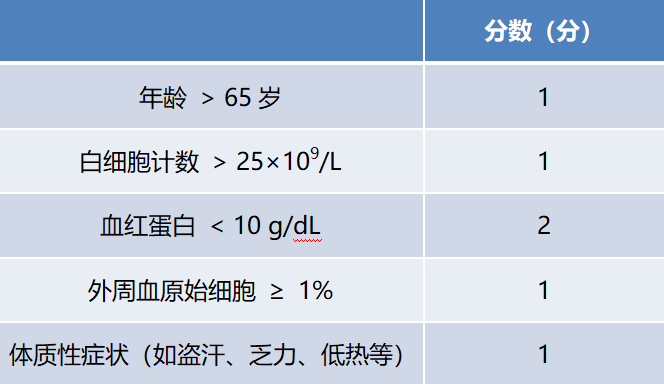
Groups based on cumulative score:① Low risk (0 points), median survival not reached;② Intermediate risk-1 (1-2 points), median survival 14.2 years;③ Intermediate risk-2 (3-4 points), median survival 4 years;④ High risk (5-6 points), median survival 1.5 years.3. DIPSS-Plus Prognostic Scoring System [2, 9]
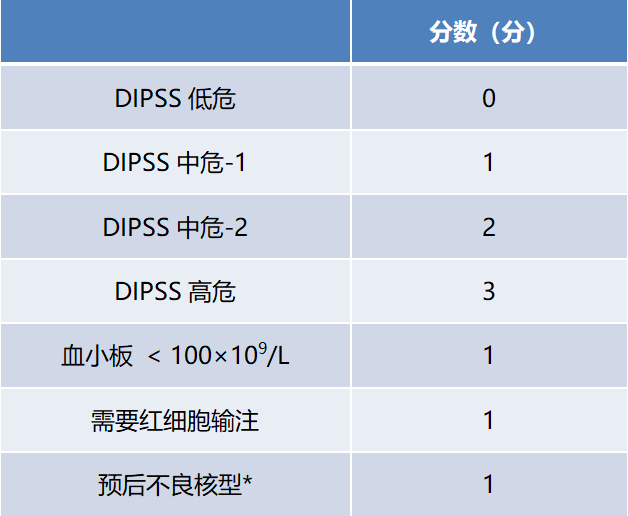
*Includes complex karyotypes or single or two abnormalities involving +8, -7/7q-, i(17q), -5/5q-, 12p-, inv(3) or 11q23 rearrangements.
Groups based on cumulative score:
① Low risk (0 points), median survival 15 years;
② Intermediate risk-1 (1 point), median survival 6.7 years;
③ Intermediate risk-2 (2-3 points), median survival 2.9 years;
④ High risk (4-6 points), median survival 1.3 years.
4. MIPSS-70 (including genetic mutation characteristics) [2, 10]
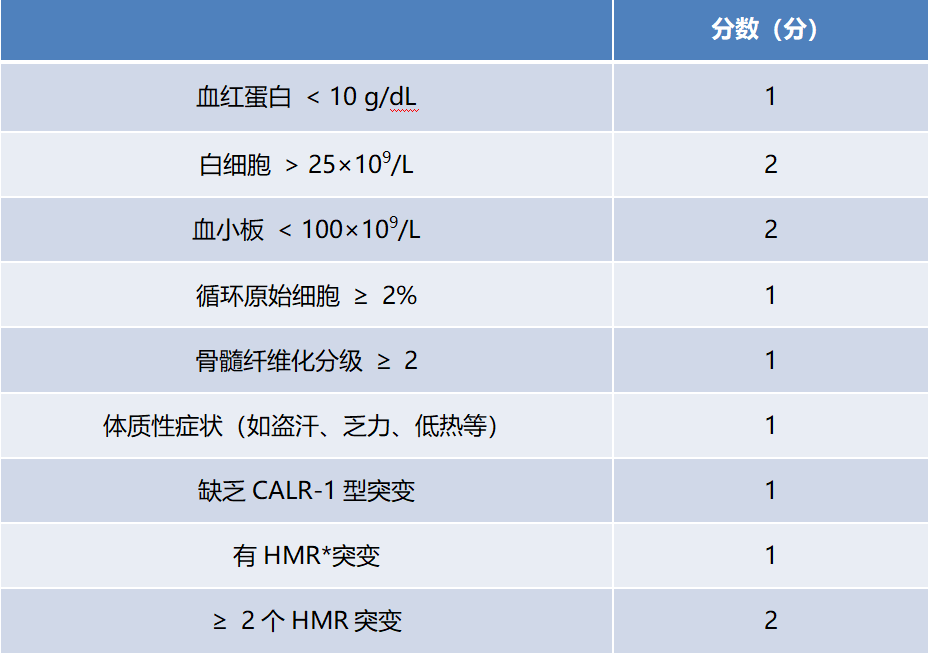
*Includes ASXL1, EZH2, SRSF2, IDH1/2.
Groups based on cumulative score:
① Low risk (0-1 points), median survival 27.7 years;
② Intermediate risk (2-4 points), median survival 7.1 years;
③ High risk (≥5 points), median survival 2.3 years.
5. MIPSS-70+ Version 2.0 (including cytogenetic and genetic mutation characteristics) [2, 11]
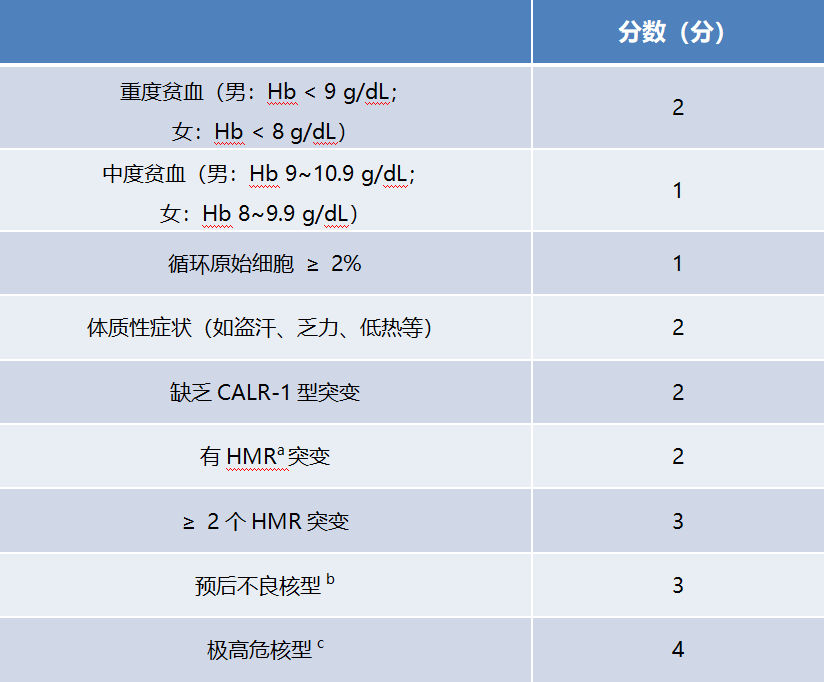
a: Includes ASXL1, EZH2, SRSF2, U2AF1 Q157, IDH1/2;
b: Includes complex karyotypes or single or two abnormalities involving +8, -7/7q-, i(17q), -5/5q-, 12p-, inv(3) or 11q23 rearrangements;
c: Includes -7, i(17q), inv(3)/3q21, 12p-/12p11.2, 11q-/11q23, and single or multiple abnormalities of abnormal trisomy (excluding +8/+9, such as +21, +19).
Groups based on cumulative score:
① Very low risk (0 points), median survival not reached;
② Low risk (1-2 points), median survival 16.4 years;
③ Intermediate risk (3-4 points), median survival 7.7 years;
④ High risk (5-8 points), median survival 4.1 years;
⑤ Very high risk (≥9 points), median survival 1.8 years.
6. Prognostic Model for Secondary Myelofibrosis in ET and PV (MYSEC-PM) [2, 12]
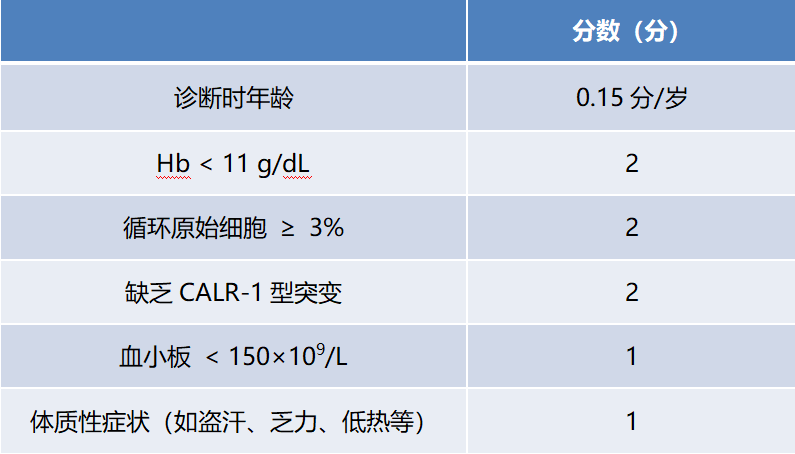
Groups based on cumulative score:
① Low risk (<11 points), median survival not reached;
② Intermediate risk-1 (≥11 points, <14 points), median survival 9.3 years;
③ Intermediate risk-2 (≥14 points, <16 points), median survival 4.4 years;
④ High risk (≥16 points), median survival 2 years.
 ENDReferences (scroll down)
1. Barbui T, Vannucchi AM, Buxhofer-Ausch V, De Stefano V, Betti S, Rambaldi A, et al. Practice-relevant revision of IPSET-thrombosis based on 1019 patients with WHO-defined essential thrombocythemia. Blood Cancer Journal. 2015 Nov;5
2. Myeloproliferative Neoplasms V, NCCN Clinical Practice Guidelines in Oncology. www.nccn.org/patients.
3. Passamonti F, Thiele J, Girodon F, Rumi E, Carobbio A, Gisslinger H, et al. A prognostic model to predict survival in 867 World Health Organization-defined essential thrombocythemia at diagnosis: a study by the International Working Group on Myelofibrosis Research and Treatment. Blood. 2012 Aug 9;120(6):1197-201.
4. Tefferi A, Guglielmelli P, Lasho TL, Coltro G, Finke CM, Loscocco GG, et al. Mutation-enhanced international prognostic systems for essential thrombocythaemia and polycythaemia vera. Brit J Haematol. 2020 Apr;189(2):291-302.
5. Tefferi A, Barbui T. Polycythemia vera and essential thrombocythemia: 2021 update on diagnosis, risk-stratification and management. Am J Hematol. 2020 Dec;95(12):1599-613.
6. Tefferi A, Rumi E, Finazzi G, Gisslinger H, Vannucchi AM, Rodeghiero F, et al. Survival and prognosis among 1545 patients with contemporary polycythemia vera: an international study. Leukemia. 2013 Sep;27(9):1874-81.
7. Cervantes F, Dupriez B, Pereira A, Passamonti F, Reilly JT, Morra E, et al. New prognostic scoring system for primary myelofibrosis based on a study of the International Working Group for Myelofibrosis Research and Treatment. Blood. 2009 Mar 26;113(13):2895-901.
8. Passamonti F, Cervantes F, Vannucchi AM, Morra E, Rumi E, Pereira A, et al. A dynamic prognostic model to predict survival in primary myelofibrosis: a study by the IWG-MRT (International Working Group for Myeloproliferative Neoplasms Research and Treatment). Blood. 2010 Mar 4;115(9):1703-08.
9. Gangat N, Caramazza D, Vaidya R, George G, Begna K, Schwager S, et al. DIPSS Plus: A Refined Dynamic International Prognostic Scoring System for Primary Myelofibrosis That Incorporates Prognostic Information From Karyotype, Platelet Count, and Transfusion Status. Journal of Clinical Oncology. 2011 Feb 1;29(4):392-97.
10. Guglielmelli P, Lasho TL, Rotunno G, Mudireddy M, Mannarelli C, Nicolosi M, et al. MIPSS70: Mutation-Enhanced International Prognostic Score System for Transplantation-Age Patients With Primary Myelofibrosis. J Clin Oncol. 2018 Feb 1;36(4):310-18.
11. Tefferi A, Guglielmelli P, Lasho TL, Gangat N, Ketterling RP, Pardanani A, et al. MIPSS70+ Version 2.0: Mutation and Karyotype-Enhanced International Prognostic Scoring System for Primary Myelofibrosis. J Clin Oncol. 2018 Jun 10;36(17):1769-70.
12. Passamonti F, Giorgino T, Mora B, Guglielmelli P, Rumi E, Maffioli M, et al. A clinical-molecular prognostic model to predict survival in patients with post polycythemia vera and post essential thrombocythemia myelofibrosis. Leukemia. 2017 Dec;31(12):2726-31.
 Jiang Qian
National Center PI , Professor
Chief Physician, Doctoral Supervisor
National Clinical Research Center for Hematological Diseases
Peking University People’s Hospital
Peking University Institute of Hematology
 Zhang Mengyu
Undergraduate Student (Eight-Year Program) Class of 2018
National Clinical Research Center for Hematological Diseases
Peking University People’s Hospital
Peking University Institute of Hematology
Compiled & Written | Zhang Mengyu, Jiang Qian
Reviewed | Jiang Qian
Source | Myeloma Encounter
Gathering Experts, Focusing on Clinical Practice
Follow the CCMTV Clinical Channel – Hematology!