Click the blue text to follow us
Follow and star our public account for exciting content delivered daily.

Source: Online materials
The Xilinx 7 series chips are widely used, characterized by low cost, strong performance, and mature stability. Currently, Xilinx (AMD) has extended the lifecycle of this series of chips at least until 2035.
This article mainly introduces the knowledge and characteristics of Xilinx 7 series FPGA chips.
1. Process Level of 7 Series Chips
The Xilinx 7 series FPGA chips are manufactured using a 28nm process technology, mainly divided into four series: Spartan, Artix, Kintex, and Virtex.
The performance, density, and price of the Xilinx 7 series improve with each series.
The Spartan-7 series, as the entry-level product of the 7 series, has the lowest price, power consumption, and size, making it suitable for low-end applications.
The Artix-7 series adds serial transceivers and DSP capabilities compared to the Spartan-7 series and has a larger logic capacity, suitable for slightly more complex mid-range applications.
The Kintex-7 series is the cost-performance king of the 7 series, excelling in the number of hard cores and logic capacity, suitable for mid-range and some high-end applications.
The Virtex-7 series is the flagship product of the 7 series, used only in high-end applications, making it overqualified for mid-range applications.
2. Naming Convention of 7 Series Chips
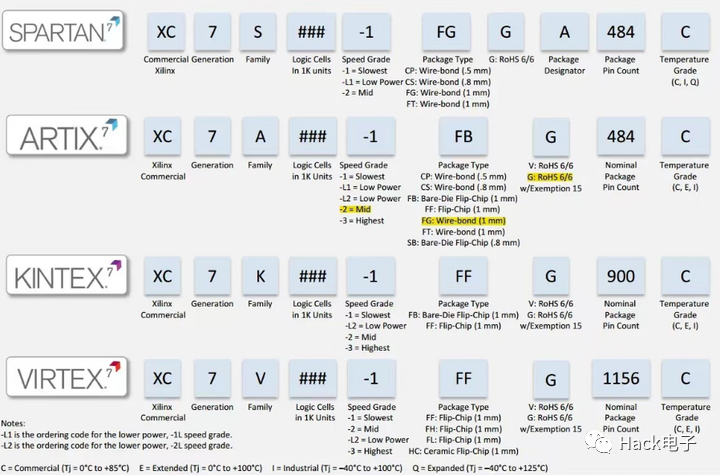
Explanation:
XC: Xilinx Commercial;
7: 7 series;
S: SPARTAN series, A: ARTIX series, K: KINTEX series, V: VIRTEX series.
###: Number of logic resources (logic cells);
-1: Speed grade (the larger the number, the higher the speed grade);
FG/FF: Package type;
900: Number of pins;
C/I/Q: Temperature grade.
3. Spartan Series
The Spartan series is an entry-level product that uses a small package and offers an excellent performance-to-power ratio to meet the most demanding requirements. These devices include the MicroBlaze soft processor, with a running rate exceeding 200 DMIPS, and support for 800Mb/s DDR3 based on 28nm technology.
Additionally, Spartan 7 devices can provide integrated ADC, dedicated security features, and Q grade (-40°C to +125°C) across all commercial devices. These devices are ideal for industrial, consumer, and automotive applications, including arbitrary connectivity, sensor fusion, and embedded vision applications.
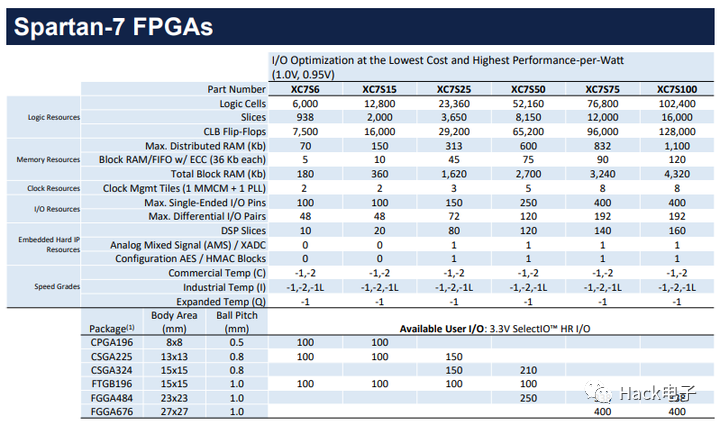
Main advantages:
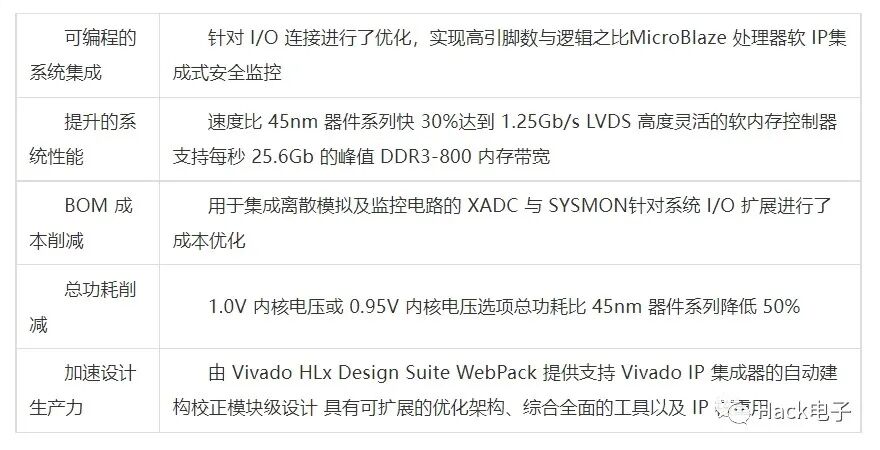
4. Artix 7 Series
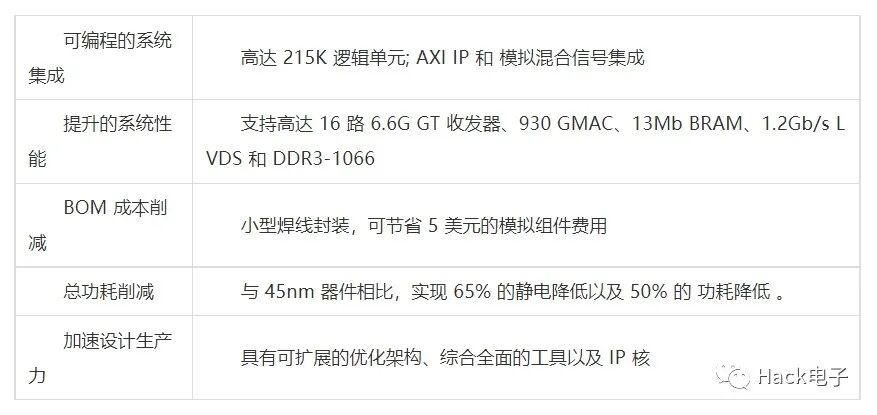
The Artix 7 series devices provide a high-performance power-to-cost ratio architecture, transceiver line speed, DSP processing capability, and AMS integration in a single cost-optimized FPGA. Including the MicroBlaze soft processor and 1,066Mb/s DDR3 technology support, this series offers maximum value for various cost-sensitive applications, including software-defined radio, machine vision cameras, and low-end wireless backhaul.
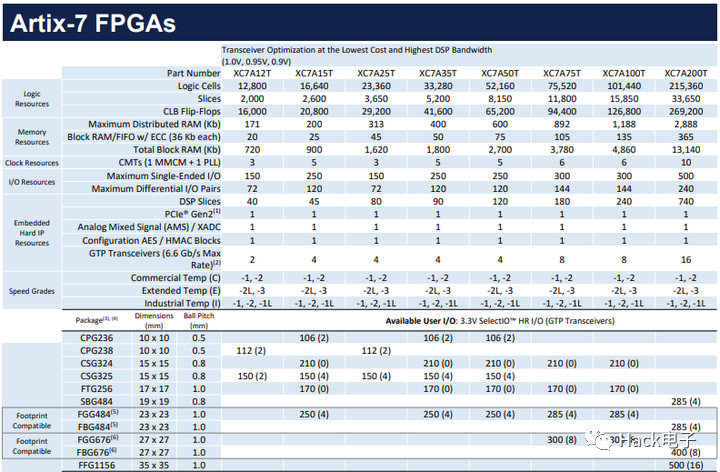
Main advantages:
5. Kintex 7 Series
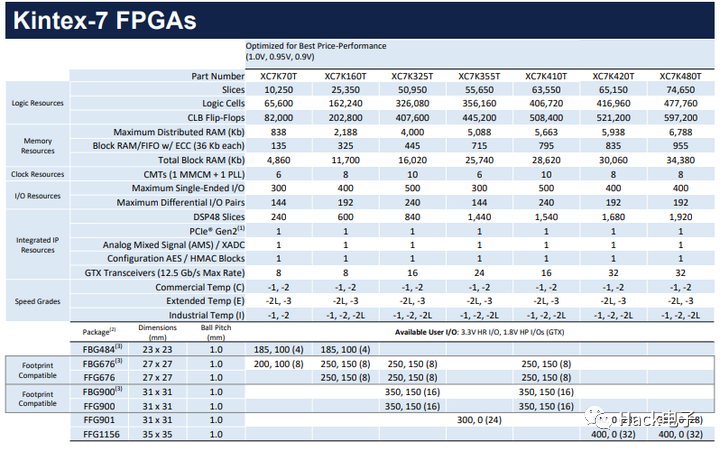
The Kintex 7 FPGA achieves an excellent cost/performance/power balance for your designs at the 28nm node, while providing high DSP rates, cost-effective packaging, and support for mainstream standards such as PCIe Gen3 and 10 Gigabit Ethernet.
The Kintex 7 series is ideal for applications such as 3G/4G wireless, flat panel displays, and video over IP solutions.
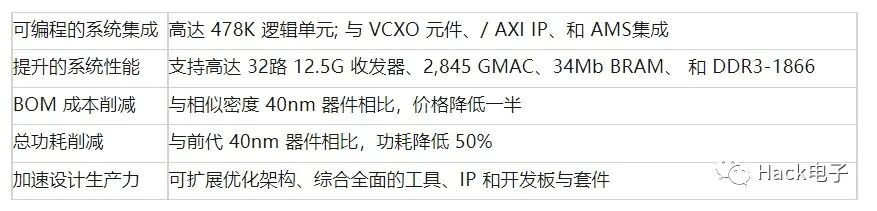
Main advantages:
6. Virtex 7 Series
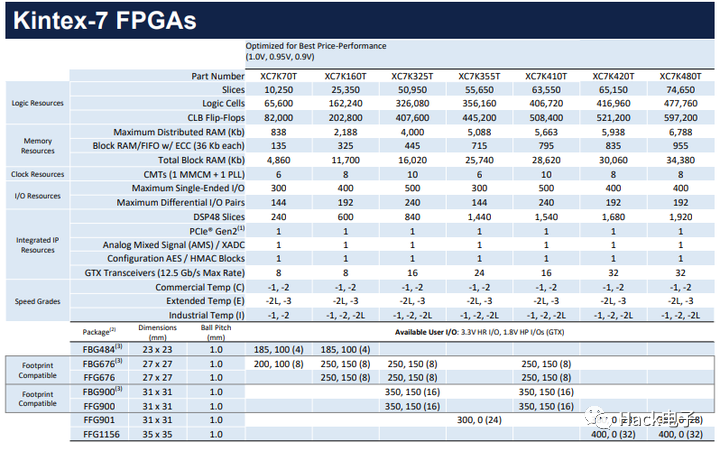
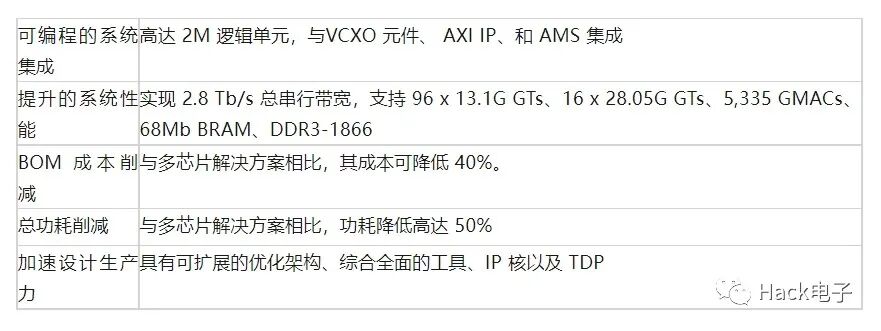
The Virtex series devices are the highest performance products in the 7 series, and of course, they are also the most expensive. This series can be used in various applications such as 10G to 100G networking, portable radar, and ASIC prototyping.
Main advantages:

Want to learn about FPGAs? Here are some example shares, ZYNQ designs, follow our public account to explore.