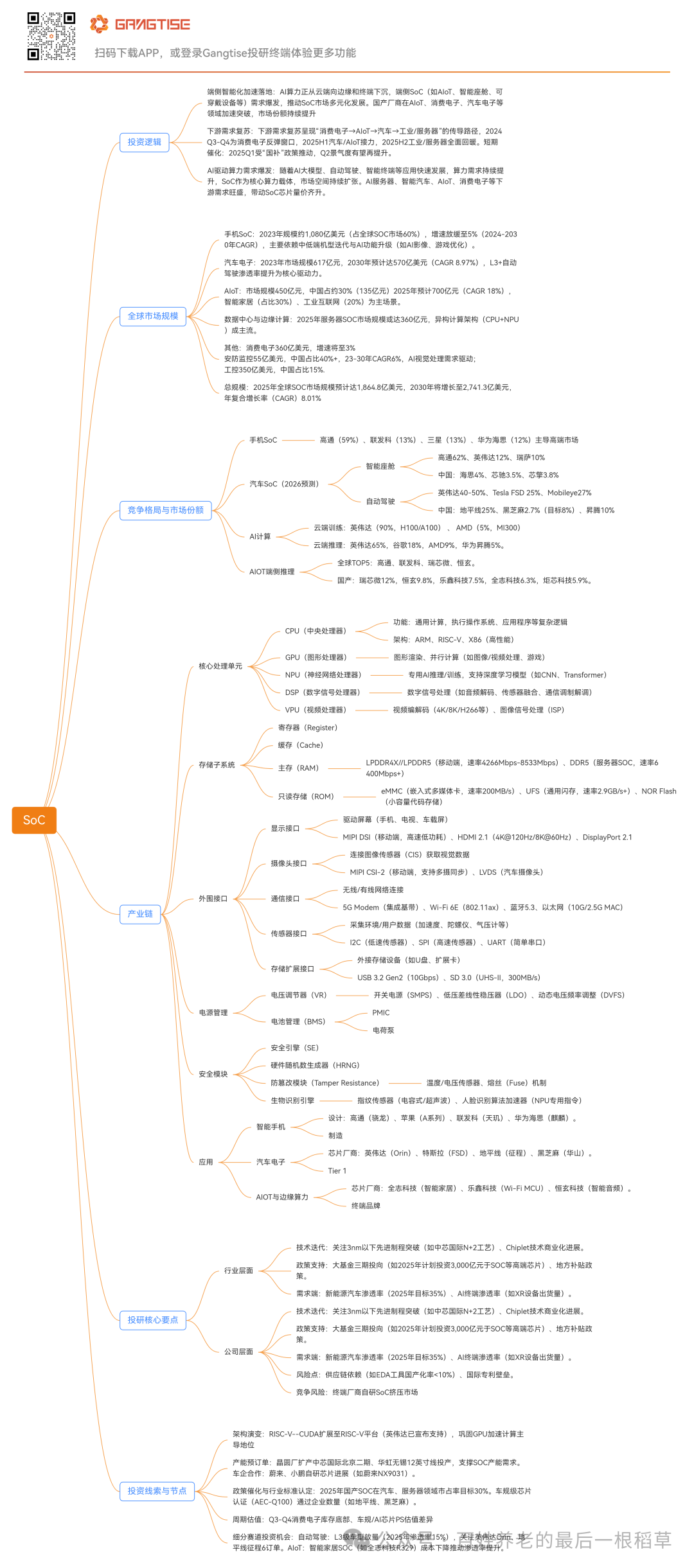
From smartphones to smart cars, from smart homes to the industrial internet, a small chip is becoming the core driver of intelligent everything — it is the digital SoC. 1. What is SoC? SoC (System on a Chip) is a highly integrated chip design approach that combines multiple system components such as processors, graphics units, memory controllers, power management modules, and neural processing units (NPU) into a single chip. Its advantages include:
- High performance and low power consumption: especially suitable for mobile devices and embedded scenarios;
- Miniaturization: greatly saves space and promotes device lightweighting;
- Low cost: reduces dependence on external components, lowering overall system costs.
2. Why has SoC become a key carrier in the AI era? With the rapid development of technologies such as AI large models, autonomous driving, and edge computing, the demand for computing power is shifting from the cloud to end devices. As the “computing heart” of end devices, SoC undertakes critical tasks such as real-time data processing and intelligent decision-making. For example:
- In smart cockpits, SoC enables multi-screen interaction, voice recognition, and autonomous driving assistance;
- In AloT devices, SoC supports local intelligence for smart homes and the industrial internet;
- In smartphones, SoC drives upgrades in AI imaging, game rendering, and multi-tasking experiences.
3. The SoC market is exploding According to industry forecasts, the global SoC market size is expected to reach $186.48 billion by 2025 and is projected to exceed $274.1 billion by 2030, with a compound annual growth rate of over 8%. In the segmented market:
- AloT: The Chinese market size is expected to reach 70 billion yuan by 2025, with smart homes and the industrial internet as the main scenarios;
- Automotive electronics: The market size is expected to reach $57 billion by 2030, with L3+ autonomous driving as the core driving force;
- Smartphone SoC: Still holds the largest share, but growth is shifting towards mid-to-low-end iterations and AI function upgrades;
- Servers and edge computing: Heterogeneous computing (CPU + NPU) is becoming mainstream, with the market size expected to reach 36 billion yuan by 2025.
4. Domestic SoCs are rising In fields such as AIoT, consumer electronics, and automotive electronics, domestic chip companies like Huawei HiSilicon, Rockchip, and Allwinner Technology are accelerating technological breakthroughs and gradually increasing their market share. Policy promotion and the recovery of downstream demand will further boost the industry’s prosperity.
5. Conclusion Digital SoC is not only a product of technological integration but also the core driving force behind the evolution of intelligent terminals. As edge intelligence accelerates its implementation, SoC will play the role of the “brain” in more scenarios, becoming one of the most noteworthy tracks in the technology industry over the next decade. The data in this article is sourced from industry research reports and market forecasts. If you are interested in chips, artificial intelligence, or hard technology investments, feel free to follow us for more in-depth content.