Follow “Electronic Engineering Magazine” and add the editor’s WeChat
Regional groups are now open. Please send a message with 【Shenzhen】【Shanghai】【Beijing】【Chengdu】【Xi’an】 to the public account
It is easy to overlook a fact: there is a miniature speaker hidden in your smartwatch——not to mention that smart glasses are also equipped with one. As we gradually enter the era of AI assistants that are “always online,” glasses and watches are becoming important alternatives to earbuds, achieving truly hands-free and ear-freeAI interaction.
However, the current most advanced smart glasses and watches still struggle to match the design, thinness, and weight of traditional glasses and watches, which will largely limit their widespread adoption. One key constraint is that the “miniature“ speakers in today’s smart devices must fit the product’s weight, shape, and dimensions——and this is no easy task.
Traditionally, speakers require a certain amount of space(even a tiny gap) to produce audible sound beyond a beeping tone. At the miniaturization level, existing speakers are nearly at the physical limit, severely restricting product design freedom and functional integration. Many smart glasses adopt thick frames styled like “pilots“ or “travelers“ not out of aesthetic preference, but to accommodate current miniature speakers and other electronic components.
However, this situation is expected to change with the advent of new ultra-small, ultra-lightweight, all-silicon structure MEMS speakers. To push these more compact speakers into the consumer market and apply them to more types of smart devices, it is necessary to rethink the working principles of miniature speakers.
The coil is the bottleneck
So far, the main challenge in integrating high-quality audio systems into emerging electronic devices such as smartwatches, smart glasses, and AR headsets is how to balance the stylish appearance of the device with high-performance acoustic performance. The greater contradiction is that speakers with excellent sound quality often come with additional bulk.
Currently, most miniature speakers are still based on a century-old dynamic driver structure, relying on coils and magnets to operate. To compress them to the thickness suitable for the next generation of watches or glasses(about3 millimeters), significant compromises must be made in performance——especially in sound quality. Even so, this 3-millimeter thick miniature speaker still limits the flexibility of industrial design.
The truly ideal choice is a miniature speaker that is as small as possible within the limits of technology while still providing rich, natural sound——one that is not constrained by the size and weight of traditional coils and magnets. Specifically, it is a MEMS speaker that can be mass-produced using silicon processes in high-capacity wafer foundries.
Although many manufacturers have introduced MEMS speaker prototypes over the years, only a few have achieved mass production, and there are very few large-scale commercial users. Most MEMS speakers still use traditional “push air” piston transducer mechanisms, similar to traditional dynamic speakers. However, because the diaphragm displacement of the MEMS structure is far less than that of dynamic units, its sound pressure output capability is limited.
Therefore, the vast majority of current MEMS speakers are only used as high-frequency “tweeters” in wireless earbuds or smart glasses, with limited functionality. For applications like glasses and watches that require full-frequency audio output in open spaces, most MEMS speakers are still inadequate. To achieve high-quality full-frequency response in free-field environments, fundamental innovation in audio transduction mechanisms is necessary——breaking free from reliance on large displacement mechanical motion.
This is clearly not an easy task. The ideal MEMS speaker must be small enough to be integrated into any product while generating sufficient sound pressure to effectively transmit sound in the near-field air between the device and the human ear. The goal is clear: to unleash “big volume” from the smallest physical space. Only in this way can manufacturers pursue extreme thinness and aesthetics without worry in their designs, as high-quality full-frequency audio has become a default configuration.
Solid-state miniature speakers utilizing ultrasonic sound
Recently, leading audio engineers have developed an open near-field MEMS speaker with a thickness of only 1mm, which generates sound through ultrasonic air pulses rather than through piston coils and magnetic structures(as shown in the figure). As it is a semiconductor MEMS speaker, its inherent characteristics as a microchip enable it to enhance advanced DSP functions such as privacy mode and transparency mode, achieving better and more consistent inter-device performance than traditional coil architectures. What it does is convert ultrasonic pulses, which are imperceptible to the human ear, into full-bandwidth, high-fidelity audio.
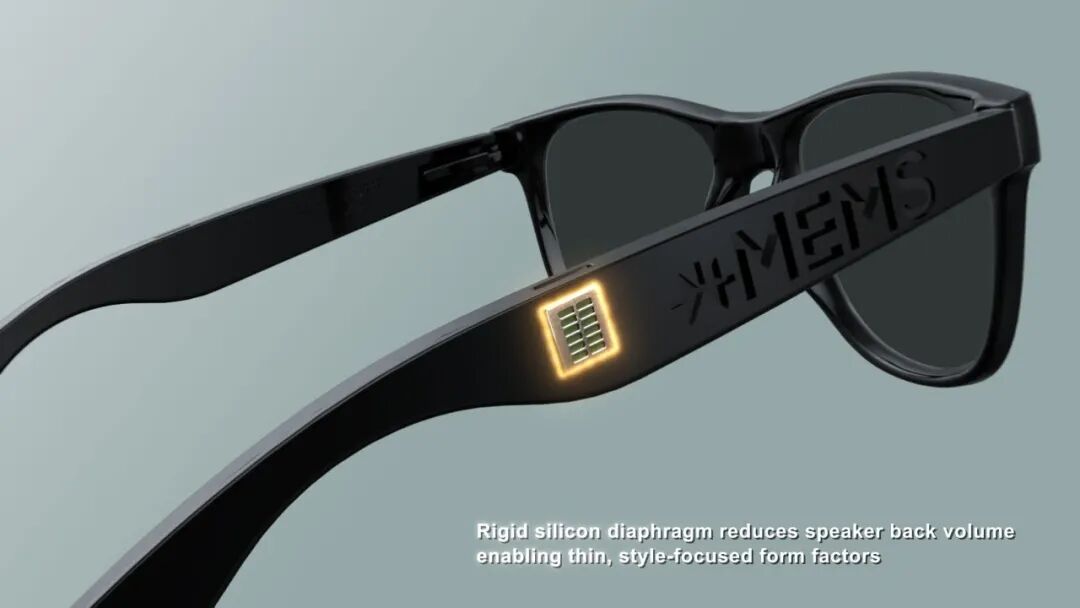
Figure: Compared to existing dynamic driver units, this open MEMS speaker is only one-third its thickness and one-seventh its overall size, making it very suitable for the growing demand for thin and lightweight wearable devices.(Source: xMEMS)
Compared to existing dynamic driver units, this open MEMS speaker is only one-third its thickness and one-seventh its overall size, making it very suitable for the growing demand for thin and lightweight wearable devices. Because it is a solid-state structure(with no moving parts), this speaker has excellent durability and meets the IP58 dust and water resistance standards, fully satisfying the stringent environmental requirements of wearable electronics.
This technology has been tested in various forms such as smart glasses, smartwatches, and open wireless headphones (OWS), achieving sound pressure levels (SPL) in both high and low frequency ranges that are equal to or even better than existing products, with significantly improved bass performance(at 40Hz, the sound pressure level is 11dB higher than mainstream OWS headphones, and at 5kHz, it is about 15dB higher).
The solid-state design brings faster transient response and near-zero phase shift characteristics, making the output full-frequency audio clearer, more delicate, and precise. The extremely high consistency of the devices also ensures that the phase between the left and right channels is highly consistent, which helps enhance the effectiveness of DSP functions in smart glasses and OWS headphones——for example, enhancing privacy mode, effectively reducing sound leakage, and protecting user privacy.
Other application scenarios for solid-state MEMS speakers
The open solid-state MEMS speaker has even broader application prospects. Achieving strong high-frequency output in near-field miniature speakers has always been a technical challenge. Thanks to its ability to output at least 90dB sound pressure at the highest frequencies, this technology is particularly suitable for applications such as “tweeters” in smartphones, providing smaller and lighter receiver speakers.
We believe that MEMS near-field miniature speakers that can work in open spaces rather than closed ear canals represent a significant technological breakthrough. They not only solve the acoustic integration challenges of lightweight, wearable smart devices but also provide electronic product manufacturers with unprecedented design freedom——allowing users to enjoy high-quality audio experiences while enjoying stylish appearances.
Author:xMEMS Labs Vice President of Marketing and Business DevelopmentMike Housholder
(Editor: Franklin)
THE END
Follow “Electronic Engineering Magazine” and add the editor’s WeChat
Regional groups are now open. Please send a message with 【Shenzhen】【Shanghai】【Beijing】【Chengdu】【Xi’an】 to the public account