FPGA-Based Electronic Quiz Buzzer Design Verilog Code Quartus Simulation

FPGA-Based Electronic Quiz Buzzer Design Verilog Code Quartus Simulation

Name: FPGA-Based Electronic Quiz Buzzer Design Verilog Code Quartus Simulation Software: Quartus Language: Verilog Code Function: FPGA-Based Electronic Quiz Buzzer This design is an FPGA-based four-channel intelligent quiz buzzer, featuring system reset, a 30-second countdown, and digital tube display functions. The buzzer is implemented through four main modules: debouncing, control, score management, and display control, … Read more

From FPGA to RF Transceiver: Unveiling the Technical Highlights Behind the Silvus SL4200 Radio

From FPGA to RF Transceiver: Unveiling the Technical Highlights Behind the Silvus SL4200 Radio

1. The StreamCaster LITE 4200 (SL4200) launched by Silvus Technologies is a MANET (Mobile Ad Hoc Network) radio, operating frequency bands include: L-band: 1350–1440MHz; S-band: 2200–2500MHz; Federal C-1 band: 4400–4940MHz. This radio combines low SWaP (Size, Weight, and Power) with cost advantages, complies with NDAA and U.S. Department of Defense cybersecurity standards, and has been … Read more

Lattice FPGA Ensures Future Security for Servers

Lattice FPGA Ensures Future Security for Servers

Servers are the backbone of modern computing infrastructure. They host sensitive data, AI models, and core workloads, making them prime targets for increasingly complex network threats. As server architectures become more modular and distributed, integrating various CPUs, network interface cards, accelerators, SCM modules, and with enterprises’ growing reliance on these distributed systems, the complexity of … Read more

Design Scheme for a 20G High-Speed Acquisition System Based on FPGA

Design Scheme for a 20G High-Speed Acquisition System Based on FPGA

1. System Core Specifications and Requirements Analysis (Specification) Sampling Rate: Maximum real-time sampling rate of 20 GSample/s. For a single channel, the ADC sampling rate needs to reach 20GSPS. For multi-channel interleaving, such as 4 channels, each channel ADC needs to reach 5GSPS. Resolution: Typically between 8-bit and 12-bit. The resolution directly affects the data … Read more

FPGA vs ASIC: How Should We Choose?

FPGA vs ASIC: How Should We Choose?

Source: Content from Semiconductor Industry Observation (ID: icbank) translated from eejournal, thank you. Ates Berna, General Manager and Managing Partner of ElectraIC in Istanbul, Turkey, recently published a comparative summary chart on LinkedIn, showcasing the differences between FPGA and ASIC. While this is not a detailed chart, I believe it serves as a great icebreaker … Read more

Understanding Logic Analyzers in FPGAs

Understanding Logic Analyzers in FPGAs

Click the blue text to follow, grateful for your support Welcome friends to follow the “Hao Xushuang Electronic Design Team” public account. This account will regularly update relevant technical materials, software, etc. Friends who are interested can browse other “modules” of this public account, hoping that everyone can gain something they desire from this public … Read more

Lighting, Lenses, and FPGA Logic

Lighting, Lenses, and FPGA Logic

Introduction FPGAs are widely used in various image processing applications, including medical and scientific imaging, space imaging, automotive, and defense fields. No matter which solution is used, the advanced algorithms may differ, but the fundamental parts are the same: they all need to connect to an image sensor or camera, process the captured images, and … Read more

Understanding the Core Differences Between CPU, MCU, MPU, SoC, DSP, ECU, GPU, and FPGA

Understanding the Core Differences Between CPU, MCU, MPU, SoC, DSP, ECU, GPU, and FPGA

“ In today’s highly digital world, we are surrounded by countless smart devices. From smartphones to autonomous vehicles, from IoT sensors to large-scale data centers, these technologies rely on various processing chips. However, faced with the dizzying abbreviations of CPU, MCU, MPU, SoC, DSP, ECU, GPU, and FPGA, even industry professionals can sometimes feel confused.” … Read more

Hardware Testing of FPGA-Based 16PSK with Convolutional Encoding and Viterbi Decoding, Including Frame Synchronization, Channel, and Bit Error Statistics, with Configurable SNR

Hardware Testing of FPGA-Based 16PSK with Convolutional Encoding and Viterbi Decoding, Including Frame Synchronization, Channel, and Bit Error Statistics, with Configurable SNR

🔍See the article below for program acquisition methods 🔍The project includes complete programs, comments, references, and operation videos ⚡️Algorithm Simulation Effect Preview The simulation test results using Vivado 2022.2 are as follows (217 convolution encoding and decoding Verilog development, without using IP cores): 🚀System Overview 1.16PSK 16-Phase Shift Keying (16PSK) is a digital modulation technique … Read more

Output, Control, Display, and Sound: A Versatile FPGA Signal Experiment Platform

Output, Control, Display, and Sound: A Versatile FPGA Signal Experiment Platform

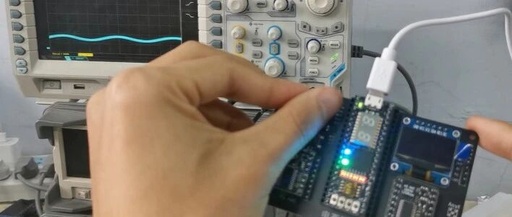
Click the blue text to follow us “From signal to melody, all it takes is a palm-sized FPGA signal generator.” This project is not just an electronic practice piece, but a miniature experimental platform that can “produce sound.” It is based on the “Little Foot” FPGA, capable of outputting sine waves, triangle waves, and square … Read more