
1. Introduction
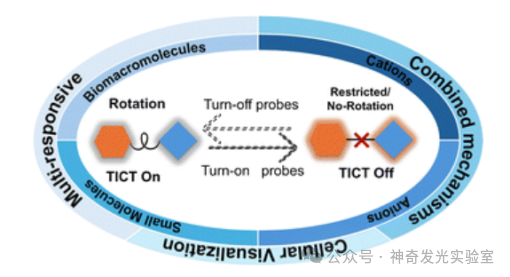
Since Sir George Gabriel Stokes proposed the concept of fluorescence in 1845 and subsequent reports of fluorescence observed in natural compounds, the modern theoretical understanding of fluorescence has begun to form and continues to develop to this day. The characteristic features of fluorescence make it a potential tool for the visual detection of target analytes, especially under dark background conditions. Meanwhile, the structure of fluorescent probes can be diversified to facilitate the control of excitation and emission wavelengths, chemical reactivity, and localization, thus achieving a detection method for target analytes that is highly selective and easy to observe. Therefore, in the past few decades, fluorescent probes have been widely used in chemical biology, biochemistry, pharmacology, environmental science, and medical diagnostics due to their low cost, ease of operation, high sensitivity, non-invasiveness, and ability to monitor biological processes in situ. Typically, the most commonly utilized fluorescence mechanisms in the design of fluorescent probes include PeT (photoinduced electron transfer), ICT (intramolecular charge transfer), FRET (Förster resonance energy transfer), AIE (aggregation-induced emission), and ESIPT (excited-state intramolecular proton transfer). This review focuses on fluorescent probes based on TICT (twisted intramolecular charge transfer) or combined mechanisms (AIE/TICT and PeT/TICT) for the detection of species that are important in biological and/or environmental contexts.
1.1 Fluorescence of DMABN
Half a century ago, Lippert et al. discovered that 4-(dimethylamino)benzonitrile (DMABN) exhibits dual fluorescence emission, consisting of two spectral bands: a longer wavelength “anomalous” A band (L1) and a shorter wavelength “normal” B band (Lb). This dual fluorescence can be fine-tuned by using solvents of different polarities. In non-polar solvents, DMABN only emits B band fluorescence. When dissolved in more polar solvents, the A band appears and experiences a red shift with increasing solvent polarity. At the same time, the fluorescence intensity ratio of the A band to the B band increases.
1.2 TICT Mechanism
Subsequently, Grabowski et al. studied DMABN and proposed the TICT mechanism. DMABN is excited from the ground state (GS) to the locally excited state (LE) under light excitation. In non-polar solvents, the molecule tends to maintain a coplanar conformation stabilized by electronic conjugation, thus only the B band can be observed. In contrast, in polar solvents, due to the unstable coplanar conformation, the dimethylamino group undergoes twisting, causing the dihedral angle between the benzonitrile part and the dimethylamino part to change from planar to perpendicular. Due to this structural change, the ICT process is facilitated. At the same time, electrons will transfer from the dimethylamino (electron donor) to the benzonitrile part (electron acceptor). There exists a distribution between the two geometric conformations, ultimately leading to dual fluorescence: the fluorescence emission of the B band is produced by a radiative transition from the LE/ICT state to the GS, while the other fluorescence emission of the A band is produced by a radiative transition from the TICT state to the GS’. Alternatively, the molecule may relax from the TICT state to GS’ through non-radiative decay, which would lead to quenching of the A band fluorescence. In TICT fluorescence, the quasi-planar emitting state is defined as the “LE” state in non-polar molecules, while it is defined as the “ICT” state in dipolar molecules. Due to the geometric structural change from the ground state to the TICT state, the emission from the TICT state typically experiences a red shift, resulting in a large Stokes shift. Moreover, this emission shift can be utilized to generate systems that exhibit near-infrared emission, which is helpful for in vivo detection and tracking. Since the intramolecular charge transfer is influenced by solvent polarity, fluorescent groups based on TICT are very sensitive to their local environment. Importantly, the dual emission of fluorescent groups based on TICT enables ratio-type detection. It is worth noting that ratio-type fluorescent probes, with their built-in calibration function, can avoid interference and ensure more reliable and accurate results. On the other hand, the non-radiative decay from the TICT state to GS’ contributes to increased heat generation, which can lead to applications in photothermal therapy (PTT). However, due to non-radiative transitions, the fluorescence quantum yield of fluorescent groups based on TICT may be low.
1.3 Design of TICT-based Fluorescent Probes
Typically, the most common methods for developing TICT-based fluorescent probes rely on two design strategies: fluorescence on and fluorescence off. Both designs involve an electron donor, a molecular rotor, a linking group, and an electron acceptor. On-type probes will undergo intramolecular twisting motion in the excited state and initiate the TICT process, leading to a weak or non-fluorescent signal. Upon exposure to a specific analyte, the molecular rotor will be blocked or removed to suppress the TICT, resulting in strong fluorescence output. On the other hand, off-type probes adopt the opposite design approach. This type of probe initially exhibits temporarily restricted molecular rotation. Then, after interaction with the target analyte or environmental conditions, the rotor will be released, and the TICT process will resume. This may lead to a fluorescence signal changing from strong to weak. Meanwhile, this design can also be used to utilize non-radiative relaxation for PTT therapy.
This review discusses the latest advancements in the development of TICT-based fluorescent probes. It highlights probes designed to detect important species in environmental or biological contexts. The main working mechanisms and limitations of these probes are discussed. Additionally, perspectives on these probes are provided. Finally, the challenges and future opportunities facing the development of TICT-based fluorescent probes are outlined.
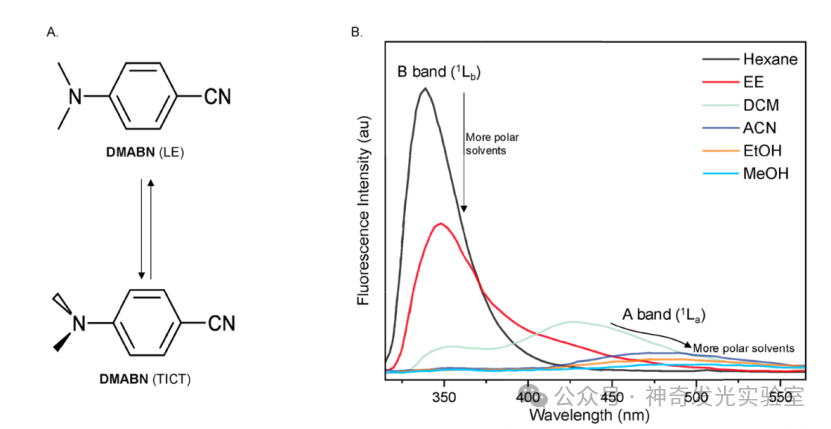
Figure 1: Excited state equilibrium of DMABN
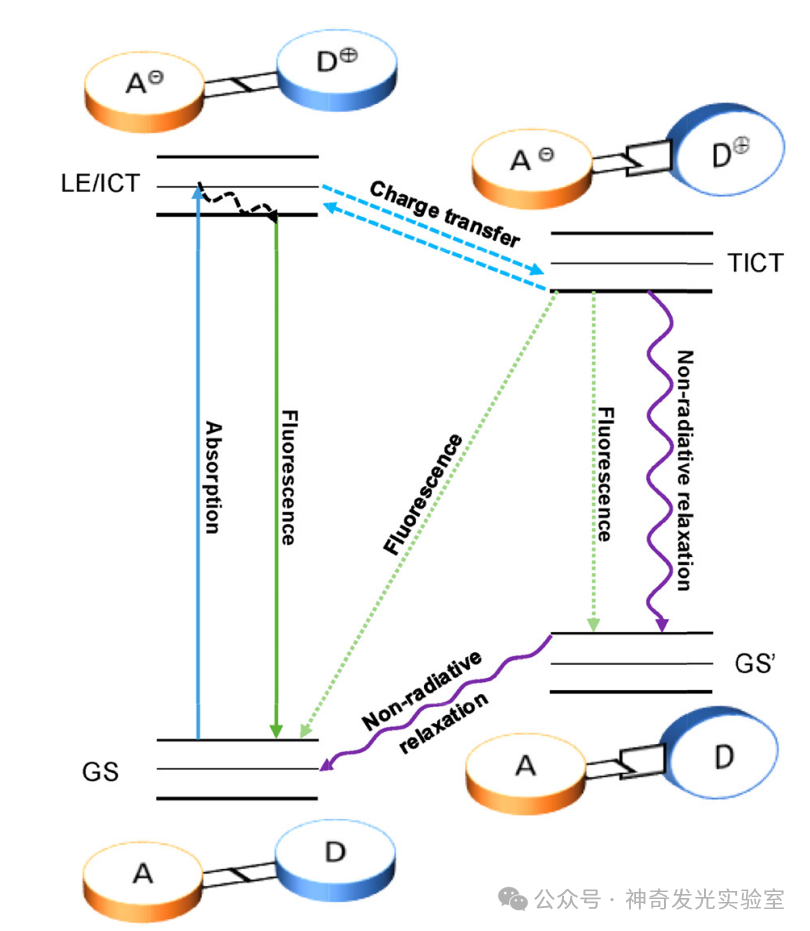
Figure 2: Jablonski diagram of the dynamics of twisted intramolecular charge transfer (TICT)
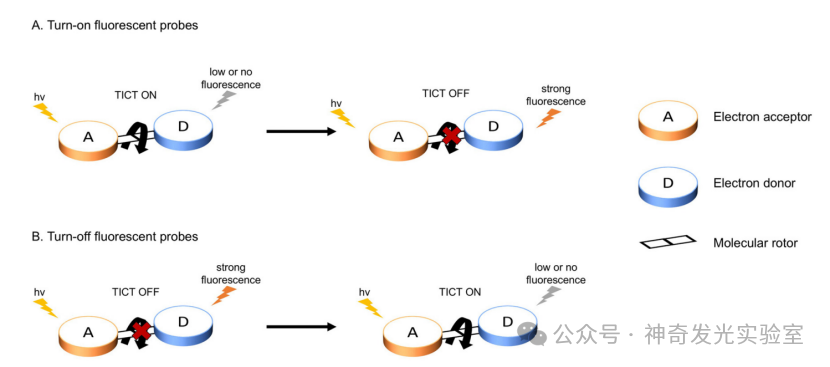
Figure 3: Schematic diagram of the most common strategies for on (A) and off (B) designs of TICT-based fluorescent probes.
[Reference Details] Yueci Wu, Han-Min Wang, Xi-Le Hu, Yi Zang, Jia Li, Hai-Hao Han, Xiao-Peng He, Simon E. Lewis, Hanafy M. Ismail and Tony D. James. Twisted intramolecular charge transfer (TICT) based fluorescent probes and imaging agents. Chem. Soc. Rev., 2025, https://doi.org/10.1039/D3CS01118F