This series of articles is based on the scenario initiated by American telecom giant Verizon, British Telecom BT Group, and UAE Telecom Etisalat, focusing on the TMF Catalyst project: Unleash the potential of GenAI-powered 5G network slicing.
As the commercial deployment of 5G deepens, network slicing, as a core technology, provides customized network services for vertical industries (such as smart ports, ultra-high-definition live broadcasting, and autonomous driving). However, ensuring end-to-end SLA for these slices is a significant challenge. Traditional NOCs (Network Operation Centers) rely on domain-segmented, static threshold-based monitoring systems, leading to alarm storms, slow fault localization, and inefficient cross-team communication, making it difficult to meet dynamic and stringent SLA requirements.
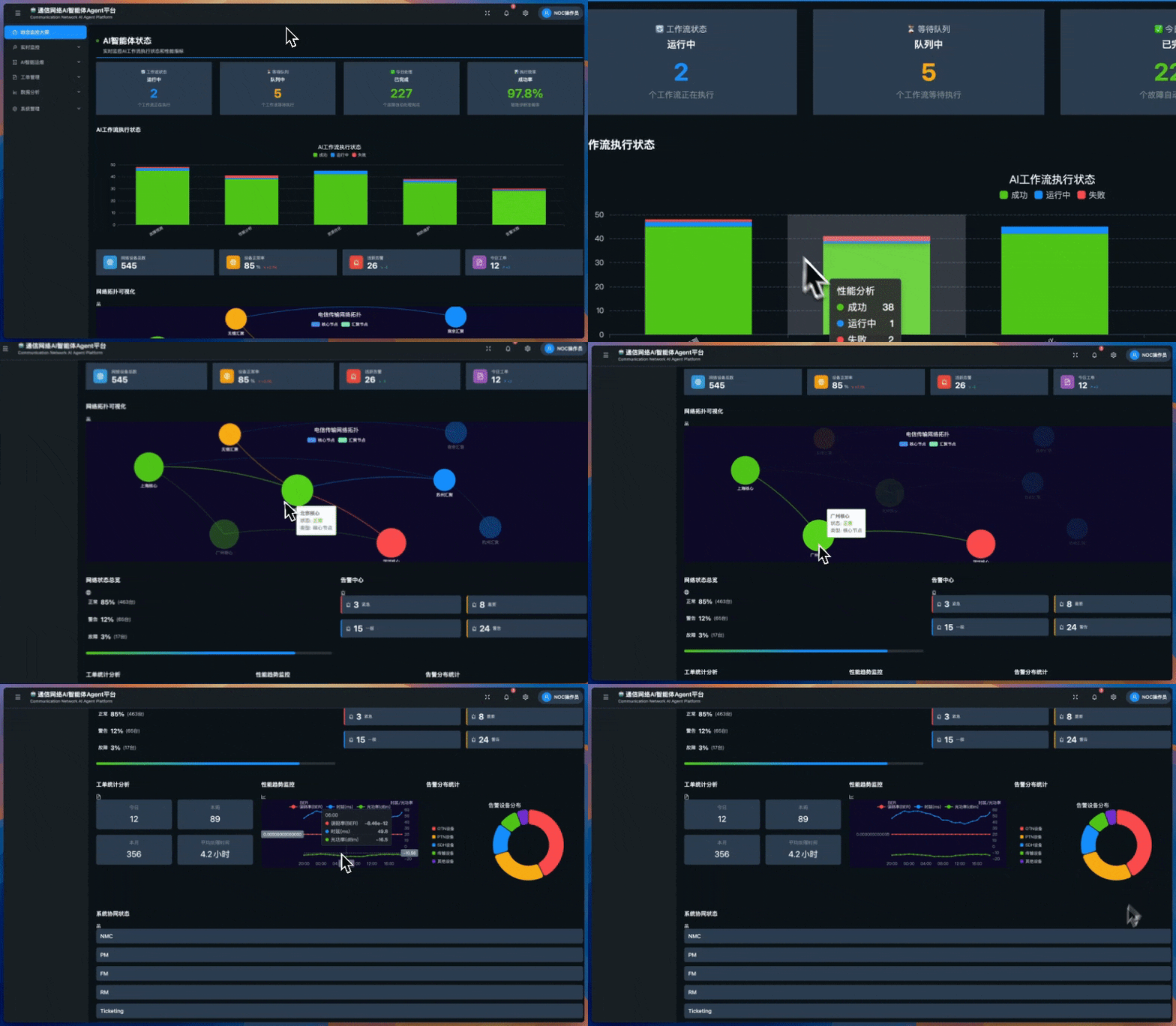
5G slicing technology, as a key to achieving “one network with multiple capabilities, customized on demand,” aims to provide differentiated and guaranteed service level agreements (SLAs) for diverse scenarios such as enhanced mobile broadband (eMBB), ultra-reliable low-latency communication (uRLLC), and massive machine-type communication (mMTC).
However, in real operations, especially in scenarios where resource demands change dramatically, traditional domain-segmented, passive operational support systems (OSS) and manual operation modes are already overwhelmed.
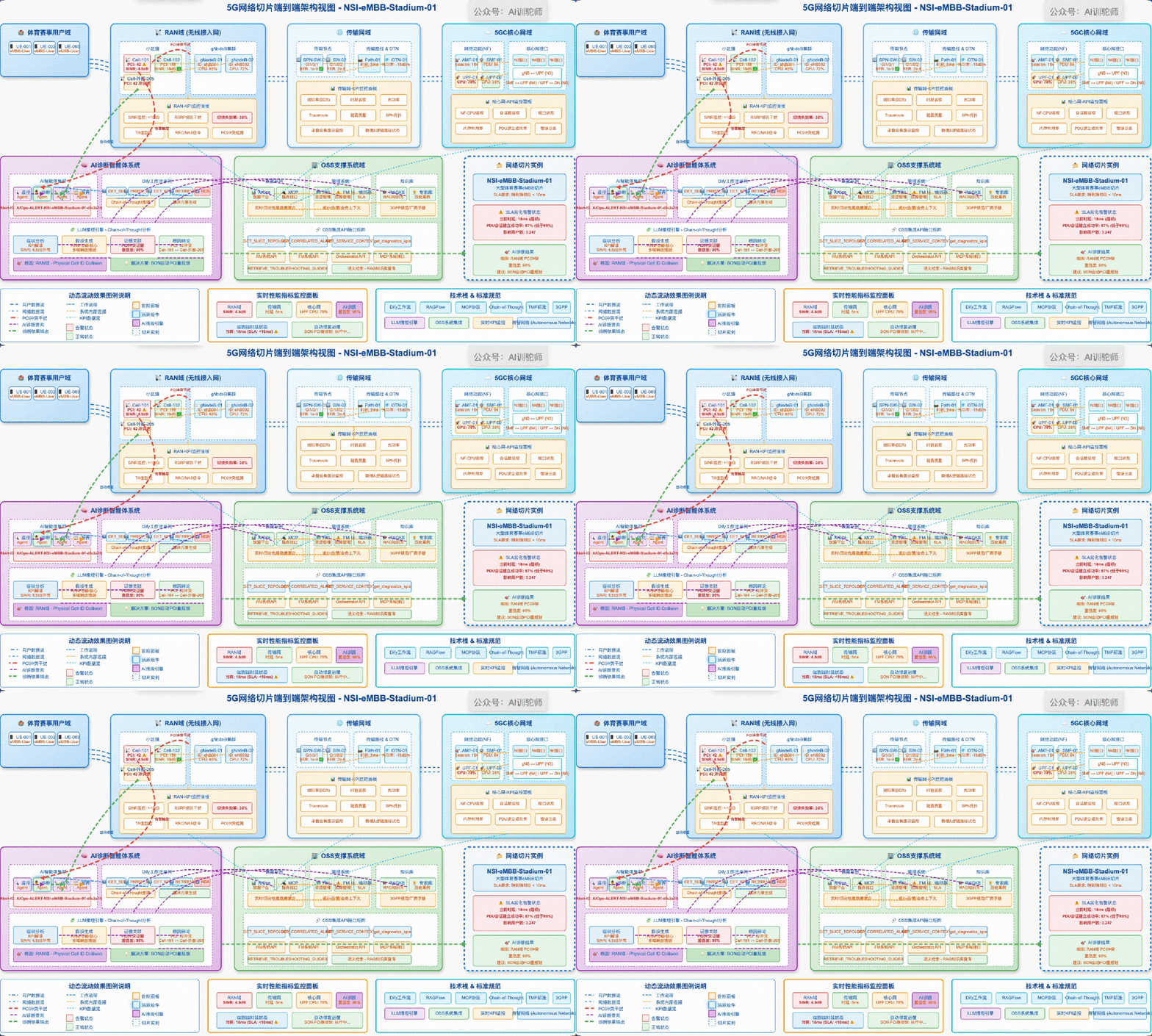
This article will delve into a highly challenging scenario—dynamic quality of service (QoS) assurance for eMBB slices in large-scale sports events—and propose a solution that deeply aligns with the concept of “self-intelligent networks.” We will explain how to adopt a new AI+OSS paradigm driven by a large language model (LLM) as the “cognitive core,” with multiple specialized AI agents collaborating to achieve a revolutionary transformation from passive “fault repair” to proactive, autonomous “experience assurance,” ultimately paving the way for the large-scale commercial implementation of 5G slicing.
Scenario: Dynamic QoS Assurance for eMBB Slices in Large Sports Events
Imagine a globally watched football final taking place in a modern stadium. A telecom operator provides tiered 5G network services for over fifty thousand spectators on-site:
-
High-end eMBB slices providing 4K live streaming and AR interactive experiences for paying users
-
uRLLC slices serving event broadcasting and security teams
-
A basic public network covering everyone
As the match enters a penalty shootout, tens of thousands of users simultaneously start HD live streaming, putting immense pressure on the eMBB slices. At this moment, the drawbacks of traditional operation modes become glaringly apparent:
- 1. The gap between SLA and user experience (QoE): The network-side KPIs (such as cell utilization) may not have reached the alarm threshold, but the user-side video has already started buffering and stuttering. Traditional OSS systems lack the capability for real-time end-to-end SLA assessment centered on user perception, leading to delayed problem detection.
- 2. Rigidity and risks in resource allocation: Even if operation personnel realize that eMBB slice resources are tight, it is difficult to make decisions within seconds: which reserved resource pool to borrow from, and how much spectrum resource to dynamically “borrow” from which adjacent low-load slice (such as the public network)? How to ensure that the allocation process does not affect the “lifeline” level uRLLC slices? Manual decision-making is slow and risky.
- 3. Finding root causes across domains is like searching for a needle in a haystack: Performance bottlenecks may originate from any link—are the physical resource blocks (PRB) on the RAN side exhausted? Is there congestion in the bearer network SPN? Or is the core network user plane function (UPF) reaching its processing capacity? Operation engineers need to manually correlate data across multiple independent OSS systems in wireless, transmission, and core networks, a process that takes hours, which is almost useless for the rapidly changing live broadcast business.
- 4. Cognitive overload under alarm storms: The surge in traffic triggers a massive number of alarms, most of which are secondary or irrelevant. This not only drowns out critical problem signals but also causes engineers in the network operation center (NOC) to suffer from “alarm fatigue,” significantly reducing troubleshooting efficiency.
Solution: LLM-Driven Multi-Agent System
To address the above challenges, we have built an AI+OSS platform that aligns with the self-intelligent network (AN) L4 level (highly autonomous) goals. This platform uses Apache Airflow as the workflow engine and LangChain as the agent development framework, with the core being a multi-agent collaboration system driven by a large model LLM.
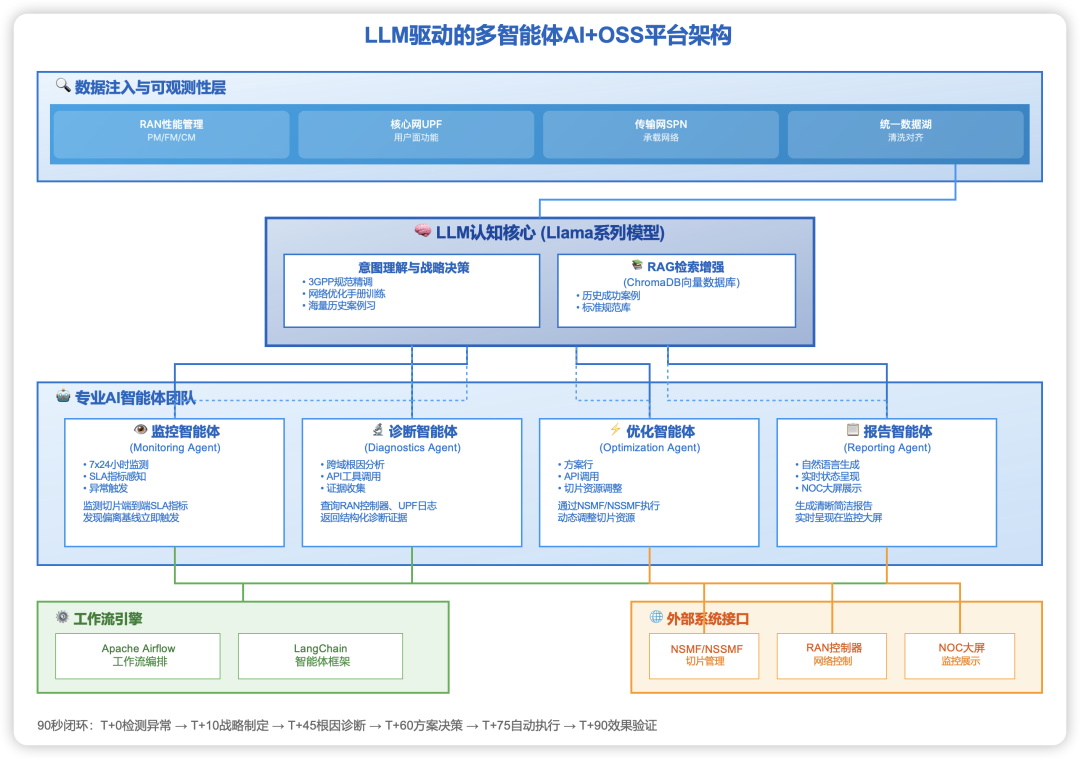
- 1. Data injection and observability layer: The platform aggregates real-time data from multiple domains, including RAN performance management (PM), fault management (FM), configuration management (CM), core network UPF, and transmission network through standardized data connectors. All data is cleaned, aligned, and input into a unified data lake, providing high-quality “fuel” for AI analysis.
- 2. Large modelLLM as the “cognitive core”: Utilizing the Llama series models fine-tuned with 3GPP specifications, network optimization manuals, and a vast number of historical operation cases. It can not only analyze data but also understand operational intentions (such as “ensuring AR experience for VIP users during the final”) and formulate high-level strategies based on complex network situations. The application of RAG (retrieval-augmented generation) technology allows it to query historical successful cases and standards stored in a vector database (ChromaDB), ensuring the professionalism and accuracy of decisions.
- 3. Specialized AI agent team: Each agent is an autonomous program with specific skills and tools (MCP API calls), working collaboratively under the unified scheduling of the LLM:
- •
<span>Monitoring Agent</span>: As the perceiver of the network’s pulse, it autonomously monitors the end-to-end SLA metrics of the slices (such as latency, jitter, packet loss rate, video buffering rate) 24/7. Once it detects deviations from the preset baseline or potential violation risks, it immediately triggers the analysis process. - •
<span>Diagnostics Agent</span>: Acting as the network detective. Under the instructions of the LLM (e.g., “investigate the high latency issue of the eMBB slice in the south stand”), it can autonomously call MCP tools to query RAN controllers, UPF logs, transmission network probes, etc., perform cross-domain root cause analysis, and return structured diagnostic evidence to the large model LLM. - •
<span>Optimization Agent</span>: The “surgeon” of the network. It receives optimization plans assessed for risk from the LLM and translates them into specific MCP API calls, executing them through network slice management functions (NSMF/NSSMF) or RAN controllers, such as dynamically adjusting slice resources, optimizing QoS policies, etc. - •
<span>Reporting Agent</span>: As a communication bridge, it generates reports in clear, concise natural language for the entire event handling process—from problem discovery, diagnostic analysis to optimization execution and effect verification—displayed in real-time on the NOC monitoring screen.
Workflow: Understanding How Agents Collaborate Step by Step
Let’s return to the football final and see how this team of agents resolves a potential network avalanche in 90 seconds:
- 1. [T+0 seconds] Problem Discovery:
<span>Monitoring Agent</span>detects that in the eMBB slice in the south stand area, the initial buffering delay of over 15% of users’ 4K live streams has surged from 500ms to 3000ms, severely deviating from the SLA baseline. It immediately reports this anomaly, along with affected user groups, geographical location, slice ID, and other contextual information, to the large model<span>LLM cognitive core</span>. - 2. [T+10 seconds] Strategy Formulation: The LLM receives the alert, quickly inferring that there is an 85% probability of RAN-side resource congestion based on the current business context of “major event assurance.” It immediately dispatches the
<span>Diagnostics Agent</span>with the instruction: “Investigate the PRB utilization of the relevant cells in the south stand and compare it with the load of adjacent public network cells.“ - 3. [T+45 seconds] Root Cause Diagnosis: The
<span>Diagnostics Agent</span>queries data through the RAN PM connector MCP, returning the conclusion in seconds: “The PRB utilization of the target eMBB slice cell has reached 98%, while the average load of the adjacent public network slice cell is only 40%. The SINR (Signal-to-Noise Ratio) indicator is normal, ruling out external interference.“ - 4. [T+60 seconds] Plan Generation and Decision Making: The LLM receives conclusive evidence, confirming the diagnosis. It immediately generates an optimization plan: “Execute dynamic spectrum sharing, temporarily reallocating 10MHz of spectrum resources from the public network slice to the eMBB slice.” At the same time, it conducts a risk assessment: this operation has minimal impact on the public network and no impact on the uRLLC slice, and the plan is approved.
- 5. [T+75 seconds] Automated Execution: The instruction is given to the
<span>Optimization Agent</span>. This agent immediately calls the MCP API of the slice orchestration system, issuing resource adjustment instructions to the RAN-NSSMF, completing the dynamic reallocation of spectrum resources. - 6. [T+90 seconds] Effect Verification and Reporting: The
<span>Monitoring Agent</span>reports that the initial buffering delay of the video in the target area eMBB slice has been restored to 450ms. The<span>Reporting Agent</span>pushes a message on the NOC screen: “The congestion issue of the south stand eMBB slice has been proactively resolved. SLA restored through dynamic spectrum sharing, with no user complaints generated.“
The entire process from problem occurrence to resolution took only 90 seconds, with no human intervention required.
Multi-Agent Collaborative Architecture
In the multi-agent collaborative architecture, the Master Agent, also known as the Orchestrator Agent, plays a crucial role as the project manager or commander. It does not directly execute specific monitoring or repair tasks but is responsible for the end-to-end orchestration, state management, task delegation, and decision validation of the entire fault handling lifecycle.
How does the Master Agent coordinate the four sub-agents to address the scenario of “SLA degradation of the eMBB slice during a sports event”?
Core Responsibilities of the Master Agent
The Master Agent can be understood as the “brain” and “central nervous system” of the entire AIOps process, with core responsibilities including:
- 1. State Management: Maintaining a complete lifecycle state of an incident from “detected” to “diagnosing,” “pending remediation,” “resolved,” and finally “closed.”
- 2. Task Delegation: Smartly deciding which sub-agent to call based on the current state of the incident and providing accurate input and context.
- 3. Data Flow Orchestration: Ensuring that the output of the previous sub-agent can be correctly parsed, validated, and used as input for the next sub-agent, forming a complete data link.
- 4. Decision Validation & Human-in-the-Loop: At critical decision points (such as before executing high-risk optimization operations), the Master Agent can pause the automation process and request approval from human experts, achieving human-machine collaboration.
Workflow Practice Under Master Agent Coordination
Let’s take the sports event scenario as an example to see how the Master Agent directs its “expert team”:
Step 1: The Starting Point of the Incident — Receiving and Validating Alerts from the “Sentinel”
- 1. Receiving Alerts: The
<span>Monitoring Agent</span>detects signs of SLA degradation and generates a preliminary alert<span>AIOps-ALERT-NSI-eMBB-Stadium-01-dfc2a198</span>. It does not directly contact other agents but sends this structured alert report to the Master Agent. - 2. Creating and Initializing: Upon receiving the alert, the Master Agent immediately creates a new incident instance (Incident ID:
<span>INC-20250813-001</span>) and marks the state as “Detected”. It parses the alert content, confirming the completeness of the information (such as slice ID, abnormal metrics, timestamp, etc.), completing the initialization of the incident.
Step 2: Task Delegation — Dispatching the “Detective” for In-Depth Investigation
- 3. Delegating Diagnostic Tasks: The Master Agent determines that root cause analysis is needed, so it calls the
<span>Diagnostics Agent</span>. It does not pass raw KPI data but a clear task instruction: “Please conduct a comprehensive root cause analysis (RCA) for incident<span>INC-20250813-001</span>(related alert ID:<span>AIOps-ALERT...</span>).“ - 4. Waiting and Monitoring: At this point, the Master Agent updates the incident state to “Diagnosing” and begins waiting for the
<span>Diagnostics Agent</span>to respond. It can set a timeout monitor, and if the diagnostic process takes too long, it will automatically alert human experts.
Step 3: Receiving and Evaluating the “Detective” Report
- 5. Receiving Diagnostic Reports: The
<span>Diagnostics Agent</span>completes the analysis and returns a structured RCA report (including root cause, evidence chain, confidence level, etc.) to the Master Agent. - 6. Evaluation and Decision Making: The Master Agent parses this report.
- • High Confidence Scenario (like this case): The report indicates that the root cause is a PCI conflict, with a confidence level of 95%. The Master Agent assesses that the conclusion is clear and the evidence is solid, so it decides to proceed to the next step of the “optimization” process.
- • Low Confidence Scenario (hypothetical): If the confidence level of the RCA report is below a certain threshold (e.g., 60%), the Master Agent may decide to escalate the incident, pause the automation process, and notify human experts through a collaboration platform (like Teams): “The diagnosis conclusion for incident
<span>INC-20250813-001</span>is unclear, with a confidence level of only 55%, please intervene for analysis.”
Step 4: Task Delegation — Authorizing the “Engineer” to Develop an Action Plan
- 7. Delegating Optimization Tasks: After confirming the diagnostic conclusion, the Master Agent updates the incident state to “Pending Remediation”. It then calls the
<span>Optimization Agent</span>and issues the instruction: “Please generate a detailed optimization action plan (MOP) for incident<span>INC-20250813-001</span>based on the RCA report<span>RCA-NSI-eMBB...</span>.” It provides the complete, validated RCA report as input, ensuring that the<span>Optimization Agent</span>plans based on the correct conclusions.
Step 5: Review and (Optional) Execute the “Engineer”‘s Plan
- 8. Receiving MOP: The
<span>Optimization Agent</span>returns a detailed MOP, which may include both automated and manual operation suggestions. - 9. Human-Machine Collaboration Approval: This is the most critical collaboration point.Master Agent executes preset strategies based on the risk assessment level in the MOP:
- • Low-Risk Operations (like triggering SON): The strategy may allow for automatic execution. The Master Agent will directly pass the execution instruction to the
<span>Optimization Agent</span>or relevant executors. - • Medium/High-Risk Operations (like manually modifying parameters): The strategy requires human approval. The Master Agent will present the MOP on the NOC operation interface and send an approval request to the responsible engineer: “The optimization plan for incident
<span>INC-20250813-001</span>has been generated, please review.” Only after obtaining explicit authorization from humans will the process continue.
<span>Optimization Agent</span> to execute and updates the incident state to “Remediating”. It will continuously obtain the latest KPI data from the <span>Monitoring Agent</span> to verify the effectiveness of the remediation.Step 6: Task Delegation — Commissioning the “Historian” for Post-Mortem Summary
- 11. Confirming Resolution: The
<span>Monitoring Agent</span>reports that the SLA has returned to normal. The Master Agent updates the incident state to “Resolved”. - 12. Delegating Reporting Tasks: At this point, the Master Agent initiates the knowledge retention process. It calls the
<span>Reporting Agent</span>and issues the instruction: “Please generate a complete post-incident review report (PIR) for incident<span>INC-20250813-001</span>.” It also packages all key data from this incident, including:
- •
<span>Monitoring Agent</span>‘s initial alert. - •
<span>Diagnostics Agent</span>‘s RCA report. - •
<span>Optimization Agent</span>‘s MOP and execution logs. - • Comparison data of KPIs before and after the incident.
Step 7: Knowledge Retention and Closure
- 13. Receiving and Distributing Reports: After the
<span>Reporting Agent</span>generates the PIR report, it returns it to the Master Agent. The Master Agent automatically distributes the report to the technical team and management based on preset rules. - 14. Knowledge Base Update: The Master Agent extracts the “lessons learned” and “improvement suggestions” sections from the PIR report, calling the knowledge base (RAGKB) API to convert this practical experience into retrievable knowledge entries for the future.
- 15. Closing the Incident: After all processes are completed, the Master Agent finally marks the incident state as “Closed” and archives all related data.
Core Value of Multi-Agent Coordination
The existence of the Master Agent transforms the four functionally independent sub-agents into an efficient team with aligned goals, clear processes, and coordinated actions. It is not just a simple task scheduler but an intelligent, stateful process engine that ensures the orderliness, traceability, and continuous learning capability of the entire AIOps process. It is through this model of “commander + expert team” that we have truly achieved the leap from simple tool automation to intelligent operational decision-making.
Flowchart:<span>Monitoring Agent</span> → Master Agent (Create Incident) → <span>Diagnostics Agent</span> → Master Agent (Evaluate RCA) → <span>Optimization Agent</span> → Master Agent (Approve MOP) → (Execute) → <span>Reporting Agent</span> → Master Agent (Distribute Report, Update Knowledge Base, Close Incident)
Improving Quality and Efficiency
The value of this AI+OSS agent solution goes far beyond technical prowess; it brings tangible business returns to operators, highly consistent with data in industry reports:
- • Revolutionary operational efficiency and cost savings: By reducing mean time to repair (MTTR) from hours to minutes (speeding up by 90%), human intervention is reduced by 60%-80%, significantly lowering OpEx. Additionally, spectrum utilization increases by 15%-25%.
- • Excellent service quality and customer experience: SLA violation incidents have significantly decreased by 40%-70%, with latency for critical services (like uRLLC) reduced by up to 30%, directly translating to a 10%-25% reduction in customer churn rate and a 5 to 15 points increase in net promoter score (NPS).
- • Opening a New Revenue Growth Engine: Reliable SLA assurance capabilities enable operators to confidently launch high-value slicing service products, driving an average revenue per user (ARPU) increase of 10%-20%. At the same time, automation capabilities have shortened the time to market for new slice products by 50%-70%, seizing market opportunities.
Conclusion
The commercial implementation of 5G network slicing ultimately depends on the ability to provide “promises kept” SLA assurance. The AIOps solution based on LLM and AI agents proposed in this article is key to turning this commitment into reality. It empowers the network with the ability to “cognize” and “act autonomously,” interpreting the core concept of self-intelligent networks as “self-configuring, self-repairing, and self-optimizing,” pushing network operations towards the ultimate goal of providing customers with “zero wait, zero faults, and zero contact” services.
As technology evolves, the role of experts will shift from being the exhausted “firefighters” to becoming the “commanders” and “strategists” of AI agent teams. They will focus on defining business intentions, designing optimization strategies, and supervising AI decisions, thus investing their wisdom and energy into more valuable network planning and business innovation, ultimately building a competitive advantage in the vast seas of 5G and even 6G.
The following articles will introduce the four agents involved in this article one by one and provide detailed implementation plans.
Selected Previous Articles
Innovative Points and Implementation Directions of AI Intelligent Operations Research in Telecom NetworksRevealed: Why ChatGPT is Becoming More ‘Understanding’ of You? The Answer to Why AI Assistants Suddenly Become Smarter Lies in These 5 StepsNew Play of AI Multi-Agent Collaboration: Closed-loop Automation from Monitoring → Diagnosis → Optimization → Reporting(Source Code Attached) First Public Disclosure! Complete Technical Solution for 5G Slice Automated Repair Based on AI AgentHow to Build an AI Diagnostic Agent to Ensure 5G Network Information Communication for Sports EventsDesign Methodology and Case Studies of AI Agents in AIOps for Communication NetworksFrom American Telecom Giant Verizon to Middle Eastern Digital Carrier Etisalat, Global Operators are Replicating the 5G Slice AI Agent Monitoring Paradigm(Source Code Attached) Dify+RAGFlow Building Intelligent Optimization AI Agent for Communication Transmission Network, Quickly Achieving Network Fault Prediction and Automated OperationsWhen AI Agents ‘Understand’ 3GPP Specifications, 5G Network Optimization Experts PanicFrom Ticket-Driven to AI-Driven Paradigm Shift, Huawei’s AI Innovation Empowers the Evolution of OSS in the 5G EraBuilding AI+OSS Agent Platform Compliant with TMF for Communication Network Quality Optimization, Quickly Generating Business Performance Optimization Plans, Achieving Intelligent Transformation from Passive Response to Proactive Prediction(Source Code Attached) Dify+RAGFlow Building Industrial Internet MCP Services and AI Agent, Quickly Achieving Predictive Maintenance for Pump Enterprises[50,000-Word Long Article, Including Cases] Based on DeepSeek Private Deployment RAGFlow Industry Knowledge Base and Intelligent Agent, Perfectly Achieving Knowledge Graph and Low-Code Development