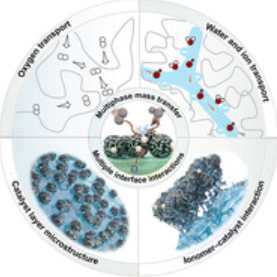
Polymer electrolyte fuel cells are a key technology for achieving carbon neutrality, with the membrane electrode assembly being the core component. The ionomer in the assembly serves a dual function as both the ion exchange membrane and the binder for the catalyst layer. This review focuses on the ionomer as a binder for the catalyst layer, a critical component that significantly affects the performance and durability of the fuel cell.
The article systematically elaborates on the role of the ionomer in facilitating multiphase material transport, optimizing molecular structure design principles, and interacting with the catalyst. It also discusses the mechanisms of chemical degradation and physical aging, along with strategies to address these challenges. Through a comprehensive analysis of the relationship between the ionomer’s functions, structure, and performance, this review aims to provide guidance for the development of more efficient and durable ionomers, with insights applicable to emerging electrochemical devices such as water electrolyzers and carbon dioxide electrolyzers.
Reference:
Yu, W., Luo, F., Liang, X., Jiang, C., Xu, Y., Liu, Z., An, Q.-F., Guiver, M. D., Wu, L., & Xu, T. (2025). Ionomeric binders in polymer electrolyte fuel cells: Roles, challenges, and advances. Chemical Society Reviews. Advance online publication. https://doi.org/10.1039/D5CS00406C