As a powerful tool for understanding key life processes, molecular imaging enables rapid, non-invasive, real-time visualization of biological events in vivo. Its outstanding performance in various biomedical fields demonstrates broad application potential. Currently, technologies based on fluorescence imaging, magnetic resonance imaging (MRI), and positron emission tomography (PET) have achieved significant breakthroughs in the study of biological events from cells to whole organisms. However, these traditional imaging techniques are often limited by factors such as ionizing radiation, limited tissue penetration depth, spatial resolution, and insufficient sensitivity, making it difficult to meet the demands for high-resolution dynamic imaging under in vivo conditions.
Photoacoustic (PA) imaging is an emerging hybrid modality that uniquely combines the high contrast of optical imaging with the deep tissue penetration advantages of ultrasound. This innovative approach overcomes the depth limitations of pure optical imaging and improves the lack of molecular specificity in traditional ultrasound, enabling cross-scale visualization from microscopic cellular structures to macroscopic organs. Compared to traditional imaging techniques, photoacoustic imaging offers several significant advantages: it provides deeper tissue penetration (up to 10 centimeters) while maintaining micron-level spatial resolution; it can obtain rich optical and molecular-level information, enhancing the data dimension of traditional ultrasound; and it poses no risk of ionizing radiation. These characteristics make photoacoustic imaging revolutionary in fields such as early tumor detection, brain function monitoring, and pharmacokinetic tracking.
Early photoacoustic imaging primarily utilized endogenous chromophores such as deoxyhemoglobin and oxyhemoglobin for tissue structure visualization. In recent years, the development of molecular photoacoustic probes has significantly expanded the scope of photoacoustic imaging from structural imaging to molecular imaging, enhancing its functional application breadth. By rationally designing organic small molecules, inorganic nanomaterials, and semiconductor polymers as probes, researchers have achieved disease-specific targeting (e.g., tumors, inflammation), tunable absorption spectra, and optimized photoacoustic conversion efficiency, thereby improving the signal-to-noise ratio. Importantly, some photoacoustic probes also integrate therapeutic functions such as drug delivery or photothermal therapy (PTT), providing innovative diagnostic and therapeutic integration solutions for precision medicine.
Among various photoacoustic probes, small molecule probes have gained increasing attention due to their clear structure, high synthetic controllability, and good in vivo clearance efficiency. Although their photostability may be lower than that of other systems, their practical application potential is enormous. Over the past decade, small molecule photoacoustic probes have made significant progress in the detection of biologically relevant species, disease diagnosis, and treatment, strongly promoting the development of photoacoustic imaging technology. However, their rational molecular design and in vivo application still face numerous challenges, particularly in achieving efficient transmembrane transport, reducing endogenous signal interference, and enhancing spatial resolution. Although review articles have summarized the development of photoacoustic probes, most focus on specific probe types or application fields, lacking a systematic discussion of their structural characteristics and functional mechanisms.
Given the immense potential of this field and the ongoing technical challenges, a comprehensive and systematic review of small molecule photoacoustic probes is timely and necessary. This article aims to summarize the latest advancements in small molecule photoacoustic probes for in vivo imaging, focusing on their design strategies, spectral characteristics, and response mechanisms. The authors further categorize and summarize their applications in imaging biological targets such as metal ions, reactive oxygen/nitrogen species, thiols, and enzymes, extracting key photophysical and biological parameters from representative studies. Finally, the current challenges and future directions in this field are discussed, with the hope of providing insights and guidance for researchers in interdisciplinary fields such as chemistry, chemical biology, materials science, and medicine.
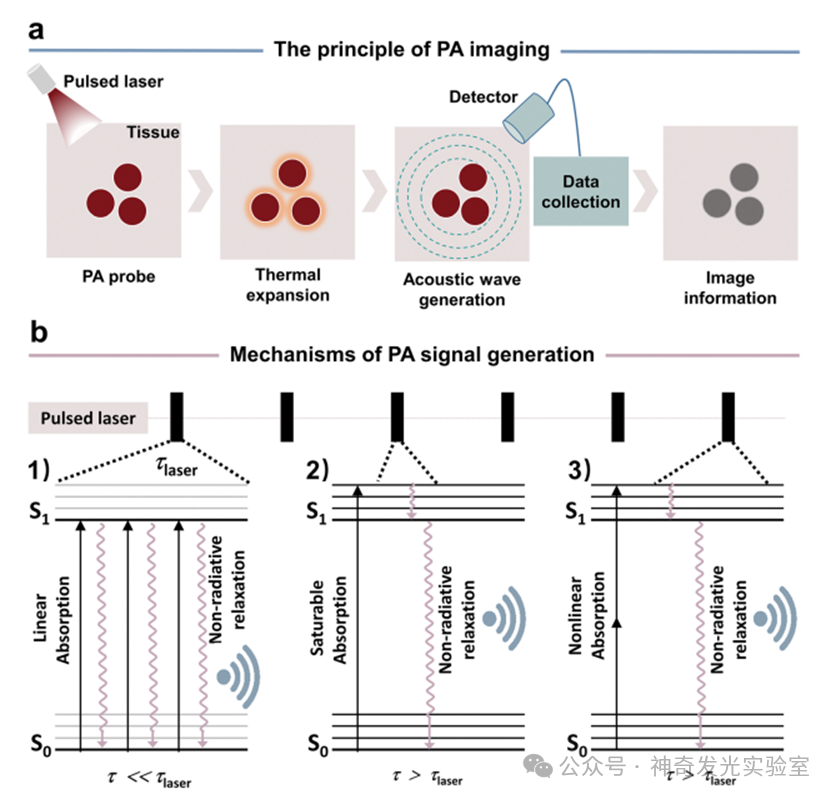
Figure 1 (a) PA imaging principle. (b) PA signal generation mechanism.
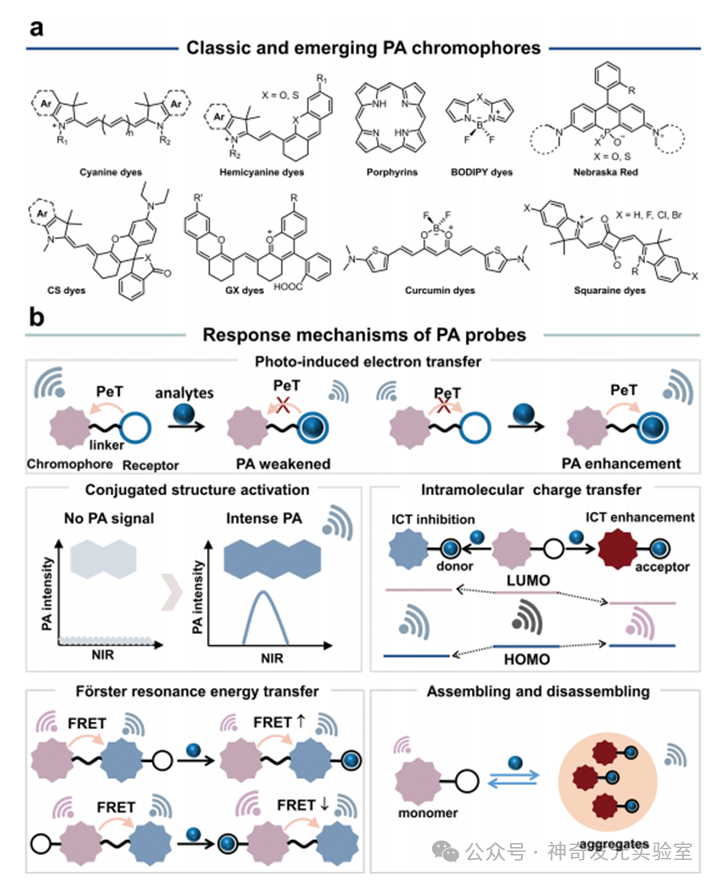
Figure 2 (a) Molecular platforms for PA probe design. (b) Five response mechanisms of PA probes.
[Reference Details] Xiaoqing Wang, Beibei Cui, Qian Sun, Hang Liu, and Zhipeng Liu. Small-molecule photoacoustic probes for in vivo imaging. Chem. Soc. Rev.,2025, https://doi.org/10.1039/D5CS00745C