Unveiling the Power Behind the SOC 201 Course Release: From Threat Hunting to Cognitive Leap
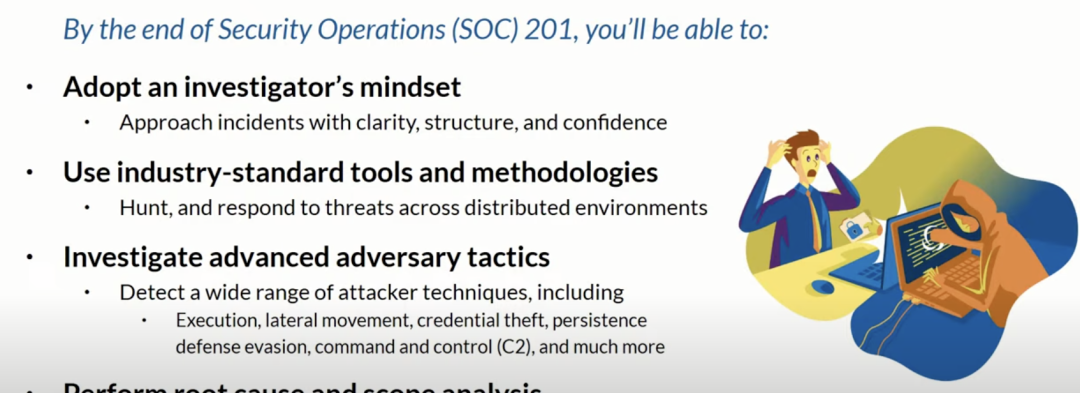
In the field of cybersecurity, the SOC (Security Operations Center) course has always been a key to enhancing practical skills. The release of the SOC 201 course not only detailed the course content but also demonstrated the entire process of threat hunting through real-world cases, allowing learners to transition from theory to practice and truly understand the core of modern enterprise security operations.
Course Highlights and Core Content
The SOC 201 course focuses on three pillars: threat hunting, incident response, and digital forensics, emphasizing how to scale responses to advanced persistent threats (APT), ransomware groups, and nation-state attackers in complex distributed enterprise environments. The speaker pointed out that the attack surface of modern enterprises is constantly expanding, with cloud services, remote work, and a multitude of endpoint devices presenting unprecedented challenges. However, defenders can also evolve by leveraging new technologies and methods.
The course emphasizes that attackers are human, and their behaviors and patterns leave traceable marks. Understanding these behavioral patterns can help security personnel predict and detect intrusions. The course not only teaches tool usage but also focuses on establishing methodologies and thinking models, enabling learners to maintain independent analysis and response capabilities when facing unfamiliar environments and tools.
Practical Demonstration: The Entire Process of Threat Hunting
The speaker used PowerShell execution tracing as an example to demonstrate how to narrow down suspicious events step by step through Sysmon, Windows event logs, and PowerShell logs, ultimately pinpointing abnormal behavior. The entire process emphasized the importance of data transformation and iterative querying:
🌈
“We started with thousands of events, and through aggregation and filtering, we were left with only six key events. At this point, analysts can visually inspect each one to identify abnormal paths and behaviors.”
During the analysis, the speaker discovered a PowerShell process running in the syswow64 directory, while most normal processes were in the system32 directory. This anomaly triggered further investigation, ultimately confirming the presence of a malicious remote execution tool through hash value comparison and virus database queries.
🌈
“Attackers are often lazy and predictable; if a 32-bit payload works, they won’t upgrade. It is these human patterns that give us the opportunity to detect intrusions.”
The entire hunting process relies not only on technical means but also on keen insight and systematic thinking. The speaker continually emphasized that every indicator can become a fulcrum for further investigation, helping security personnel move from point solutions to holistic tracing.
Course Structure and Learning Recommendations
The course content covers the complete process from environment setup, data collection, incident response to threat hunting. The speaker suggested that learners with a foundational knowledge of SOC 101 can seamlessly transition to the 201 course to further enhance their practical skills. The course heavily utilizes virtual machines and open-source tools, emphasizing hands-on practice and data-driven analysis methods.
For beginners, the speaker recommended first mastering basic IT and networking knowledge before gradually delving into various aspects of security operations. The course also includes a PowerShell 101 module to help students without relevant experience quickly get started.
Highlights from the Dialogue
🌈
“Which do you think is harder, SOC 101 or SOC 201?”“Definitely SOC 201. Because we have to deal with scaled data and attacks, the difficulty increases exponentially, but it is also more interesting.”
🌈
“Is the data in the course simulated?”“All of it is real attack data. We track the attack chain and collect all relevant telemetry information, allowing students to experience the real threat hunting process.”
Methods for Cognitive Enhancement and Reflection
- Establish Thinking Models: Do not rely solely on tools; first understand the essence of attack and defense, forming your own analytical framework. When facing new environments, thinking models can help you adapt and respond quickly.
- Data-Driven Decision Making: Learn to speak with data, discovering anomalies and patterns through aggregation, filtering, and statistics. Every query is an iteration of cognition.
- Critical Thinking: Maintain skepticism towards every anomaly, questioning “why” and continuously digging into the underlying reasons and connections. Make good use of the “hypothesis-verify-adjust” cycle.
- Cross-Disciplinary Learning: Security operations involve not only technology but also human behavior and organizational management. Pay more attention to fields like sociology and psychology to enhance your insight into attacker behavior.
- Proactive Practice: After theoretical learning, be sure to engage in hands-on practice. Set up experimental environments, reproduce attack chains, and personally analyze logs and data to truly master skills.
Conclusion
The SOC 201 course is not only a technical upgrade but also a leap in cognition and thinking methods. Through real-world cases and systematic methodologies, learners can establish their own defense systems in complex and ever-changing security environments. Whether you are a beginner or an experienced security professional, you can gain new insights and growth from this course.