First Author: Matthew J. Liu (Stanford University)Corresponding Author: William A. Tarpeh (Stanford University)
Research BackgroundElectrochemical nitrate reduction (NO₃RR) can convert wastewater NO₃⁻ into NH₃, which is considered an important route for the distributed production of green ammonia. Current metal-nitrogen doped carbon (MNC) strategies have achieved high NH₃ selectivity with catalysts such as Fe, Co, and Cu, but there are two major bottlenecks:
-
Negatively charged NO₃⁻ requires “electron-deficient sites” on the cathode for effective adsorption, which traditional MNC designs do not adequately consider;
-
Titanium (Ti) has low electronegativity and high NO₃RR activity, making it highly promising, but its strong affinity for oxygen has led to the reporting of only TiO₂ nanoparticles, with no successful synthesis of atomic-level TiNx sites, leaving their performance unknown.
Research ObjectiveTo construct for the first time a titanium and nitrogen co-doped carbon flower (TiCF) containing atomically dispersed TiNx sites, systematically elucidating how the low electronegativity of Ti promotes the multi-bond adsorption and conversion of NO₃⁻, achieving high NH₃ selectivity and high current density under alkaline conditions in NO₃RR.
Experimental MethodsUsing polyacrylonitrile radical polymerization + air oxidation stabilization + N₂/CO₂ 800 °C carbonization process, Ti precursors were introduced into a nitrogen-rich carbon flower framework; Ti chemical states were analyzed through SEM/HAADF-STEM, EELS/EDS, XRD, XPS, XAS, and linear combination fitting (LCF); CV, chronoamperometry, and product quantification were conducted in 0.1 M NaOH + 0.45 M Na₂SO₄ + 0.1 M NaNO₃; DFT calculations were performed to analyze the free energy landscape of TiN₄ fragments, comparing the monodentate/bidentate NO₃⁻ adsorption pathways.
Main Findings
-
TiCF is a mixed phase: ~¼ Ti exists as atomic-level TiNx, while ¾ exists as TiO₂ nanoparticles; this is the first experimental confirmation that TiNx sites can stably exist.
-
Under alkaline conditions at −0.7 V vs RHE, the Faradaic efficiency for NH₃ is 61 ± 7 %, with an NH₃ partial current density of 14 ± 5 mA cm⁻², which is a 60-fold improvement over bulk Ti foil.
-
DFT indicates that TiN₄ can significantly lower the formation energy barrier of *NO₂ through multi-bond adsorption, providing a mechanism distinct from Fe/Co/Cu based on “low electronegativity-multi-bond” interactions.
Figure Interpretation
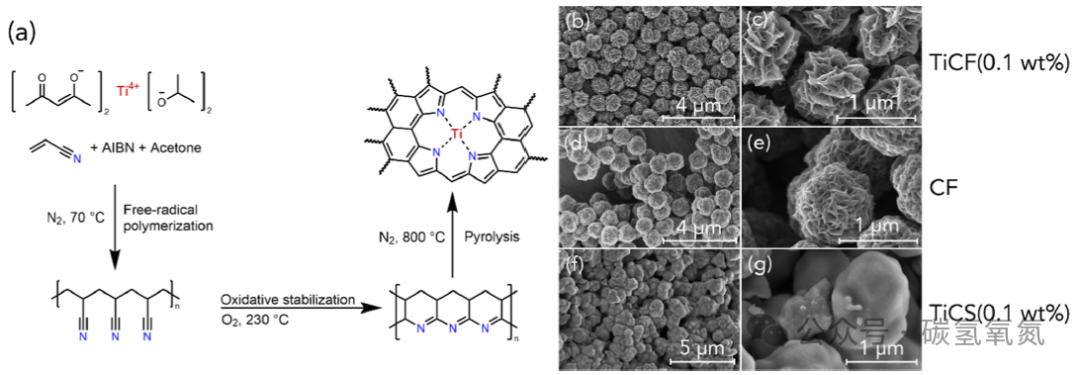
Figure 1 | Synthesis and Morphologya Schematic of synthesis: radical polymerization → oxidation stabilization → carbonization → CO₂ pore formation, illustrating TiN₄ sites;b,c TiCF (0.1 wt %) SEM: maintaining flower-like 1 μm structure;d,e CF without Ti shows consistent morphology;f,g TiCS (0.1 wt %) spherical comparison, indicating that air stabilization determines flower-like morphology.
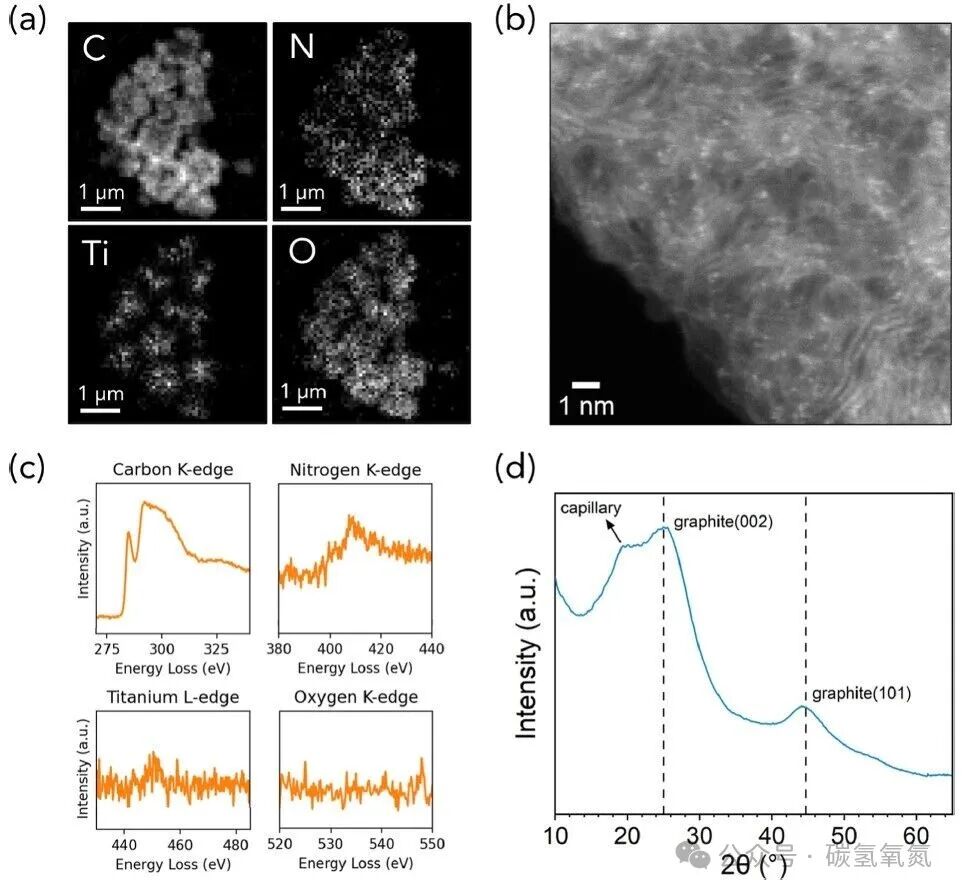
Figure 2 | Atomic-Level Ti Evidencea EDS elemental mapping: uniform distribution of Ti, O, N, C;b HAADF-STEM: bright spots at petal edges indicate single atom Ti;c EELS point spectrum: Ti-L and N-K coexist, with no O-K, confirming TiNx;d XRD: broadening of flower-like graphite diffraction peaks, with no TiO₂/TiC crystalline phases, suggesting particles <2 nm or atomic-level.
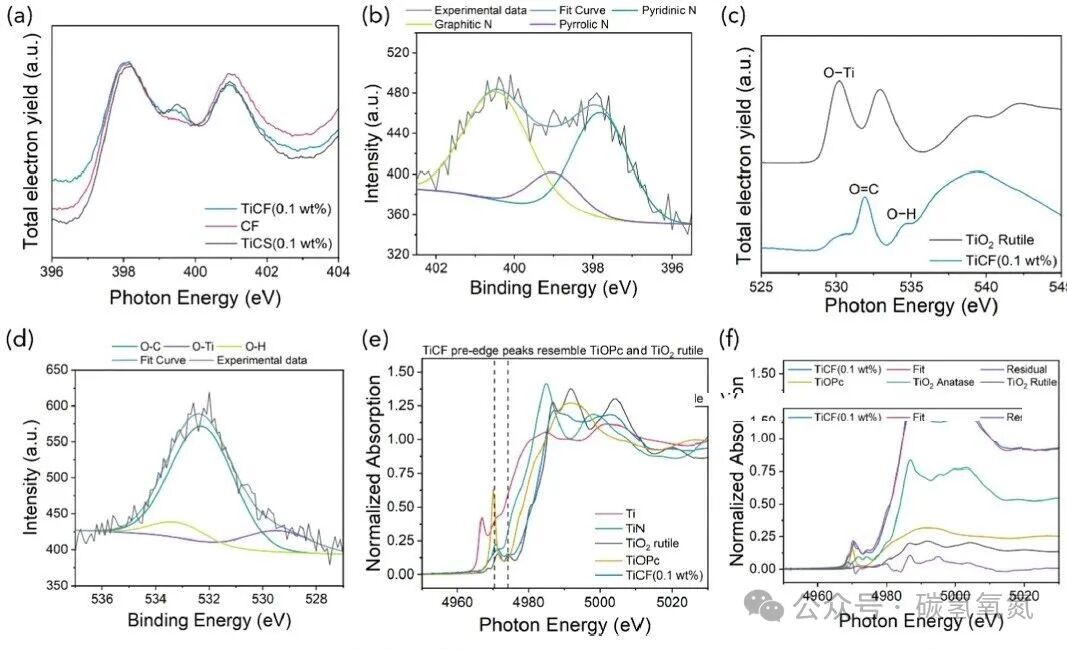
Figure 3 | X-ray Spectroscopya N K-edge XAS: 398.2/399.5/401.0 eV correspond to pyridine, pyrrole, and graphite nitrogen, respectively;b N 1s XPS peaks: pyrrole nitrogen 12 %, speculated to be coordinated with Ti;c O K-edge 530.2 eV Ti-O shoulder peak;d O 1s XPS: 529.5 eV Ti-O accounts for 14 %;e Ti K-edge XANES: pre-peak similar to TiO₂;f LCF: 24 % TiOPc-like + 17 % rutile + 56 % anatase, quantified as ~¼ atomic-level Ti.
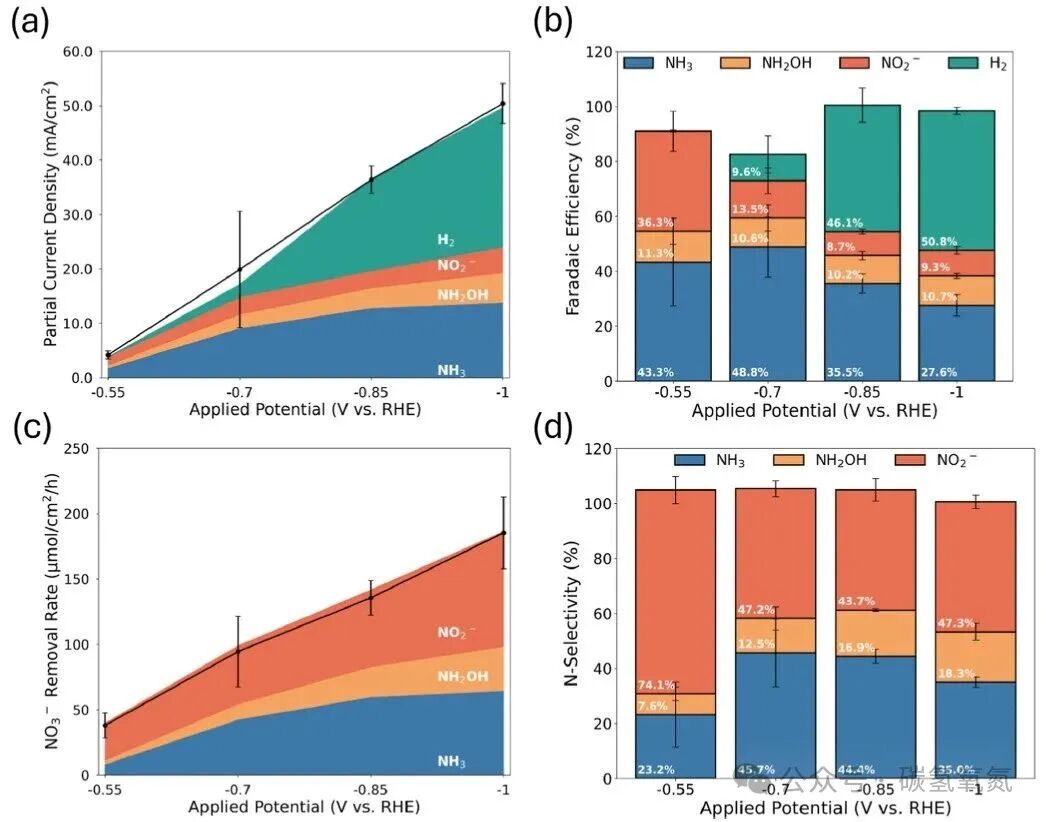
Figure 4 | Electrolyte Screeninga–c CV: Alkaline NO₃RR starts at −0.45 V, current peak 62.5 mA cm⁻² > neutral/acidic;d At −0.7 V, alkaline Na₂SO₄ system NH₃ FE 49 ± 11 %, HER only 6 %, outperforming NaClO₄, confirming that salt anions can regulate product distribution.
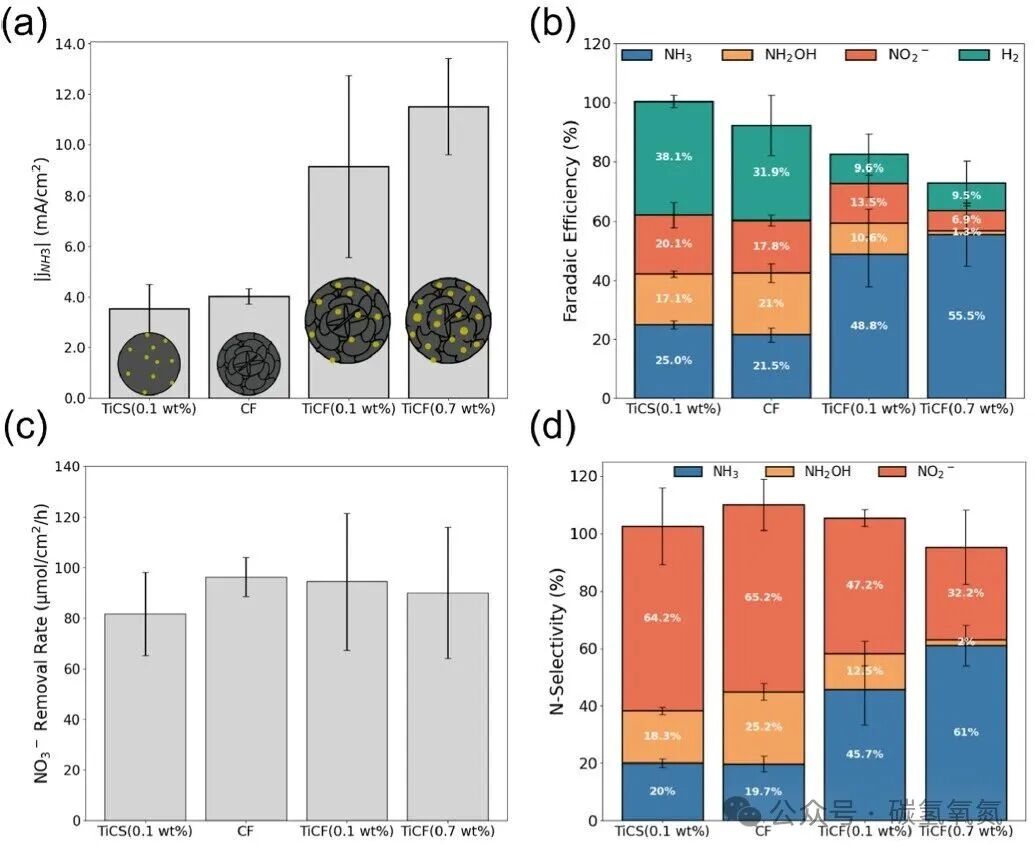
Figure 5 | Potential-Dependent Performancea Partial current density: NH₃ reaches a plateau at −0.7 V, HER only becomes significant after −0.85 V;b FE: NH₃ 49 % @ −0.7 V, NO₂⁻ 36 % @ −0.55 V;c Nitrate removal rate 200 μmol cm⁻² h⁻¹ @ −1.0 V;d N-selectivity: NH₃ 46 % @ −0.7 V, increasing with more negative potential as NH₂OH rises.
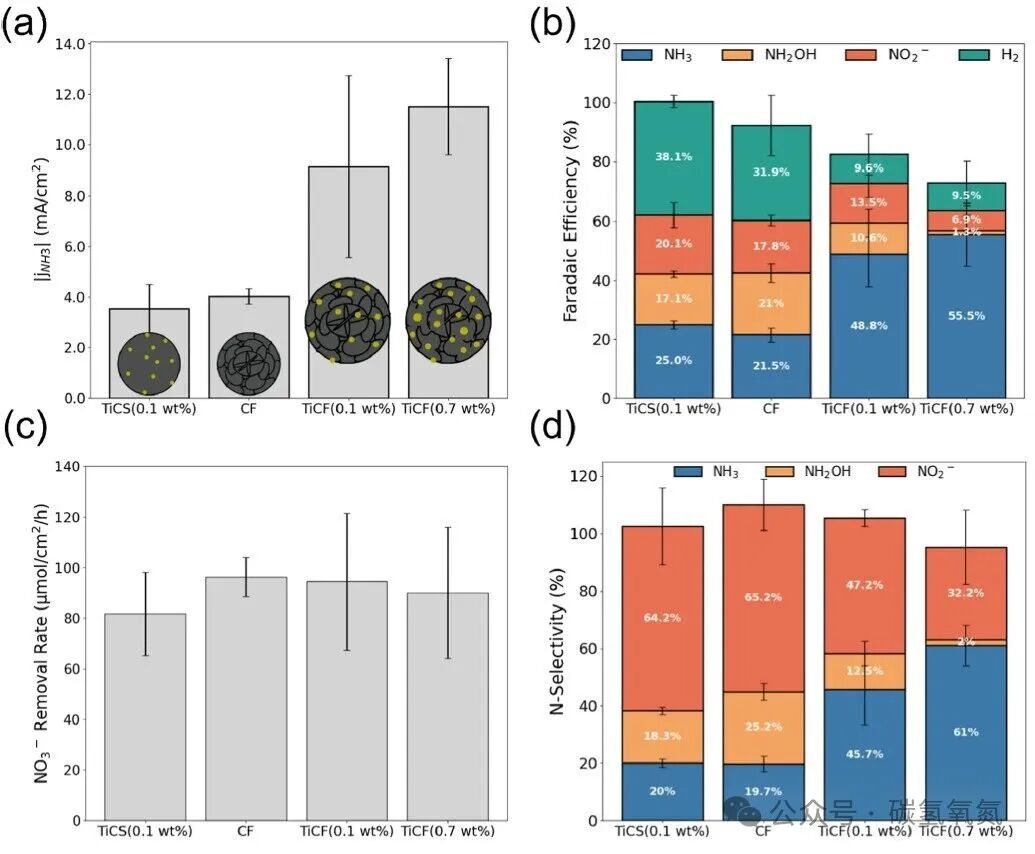
Figure 6 | Morphology and Ti Synergistic Effectsa NH₃ partial current: TiCF (0.1 wt %) 9.1 mA cm⁻² > CF 4.0, TiCS 3.6;b FE: TiCF 49 % > CF/TiCS ~25 %;c Removal rates are similar among the three, verifying the synergy of morphology + Ti sites;d N-selectivity: TiCF (0.7 wt %) reaches 61 %, further confirming that TiNx sites dominate activity.
Conclusion and OutlookThis work achieves the controlled preparation of atomic-level TiNx sites for the first time, demonstrating that they achieve 61 % NH₃ selectivity and a yield of 0.06 mmol h⁻¹ cm⁻² in alkaline NO₃RR due to their low electronegativity and multi-bond adsorption capability, placing their performance among the top of MNCs. Future work can further reduce overpotential and overcome mass transfer bottlenecks by adjusting the TiNx/TiO₂ ratio, optimizing flower-like porosity and flow systems, providing a new paradigm for wastewater-green ammonia integration.
Reference: Liu, M. J., Fernández Otero, C. A., Uruchurtu Patino, D., Gong, H., Hossain, M. D., Matthews, J. E., Williams, K. S., Vargas, A., Zachman, M. J., Hoffman, A. S., Nordlund, D., Bajdich, M., Bare, S. R., Burke Stevens, M., Jaramillo, T. F., Bao, Z., & Tarpeh, W. A. (2025). Titanium-, Nitrogen-Doped Carbon Flowers Catalyze Electrochemical Nitrate Reduction Reaction to Ammonia. Journal of the American Chemical Society, 147, 29026–29041. https://doi.org/10.1021/jacs.5c07334