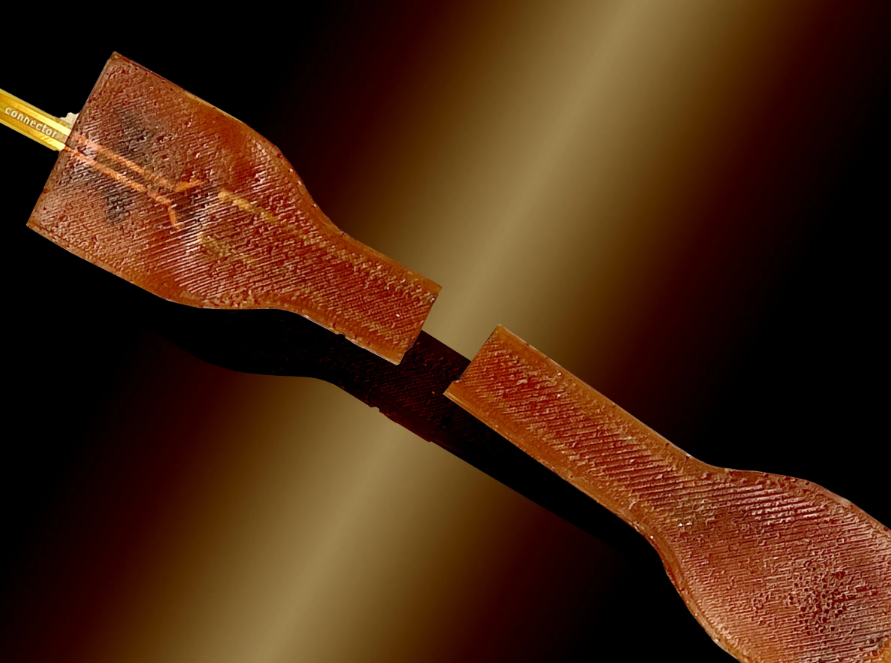
 Original images: Rathul Nengminza Sangma, Seppe Terryn, et al.
This article is part of our exclusive IEEE Journal Watch series in partnership with IEEE Xplore
https://spectrum.ieee.org/collections/journal-watch/.
Stretchable sensors have practical value in various fields, including human health monitoring and artificial muscles in soft robotics. However, these sensors face a significant issue: their lifespan is not long when subjected to twisting, stretching, or other forms of deformation.
Recently, a research team from Belgium has developed a highly durable stretchable sensor that possesses remarkable self-healing capabilities—able to repair itself even when completely cut in half, with performance remaining largely unaffected and still functioning normally. The related research findings were published on July 16 in the IEEE Sensors Journal.
https://ieeexplore.ieee.org/document/11082470.
The first author of the study, Rathul Sangma, a PhD student at the Université libre de Bruxelles and affiliated with the Belgian Microelectronics Research Center, stated that the team developed this reliable stretchable sensor for use in health monitoring, rehabilitation, and sports tracking, as “these systems often endure repeated stress or accidental damage. Existing stretchable sensors may fail under such conditions, leading to unreliable systems and waste.”
Self-Healing Polymer Sensors for Wearable Devices
To create this durable sensor, Sangma and his colleagues decided to use a polymer with a “Diels–Alder crosslinking” chemical bonding mechanism. This type of chemical bond is reversible, meaning they break when the material is damaged, but can reform when the broken parts come back into contact. Sangma explained, “When the material is cut, the broken chemical bonds become reactive, and under proper alignment, they reconnect, restoring the polymer’s original structure.”
In experiments, researchers found that this polymer could self-repair within approximately 24 hours at room temperature after being cut in half. If the sensor is placed in an oven at 60 degrees Celsius, the repair process can be shortened to just 4 hours.
Even when stretched to the point of breaking and then repaired six times, the sensor can still maintain 80% of its performance.
A liquid metal called “Galinstan” is embedded within the polymer, serving as a conductor. One might think that this liquid metal would leak out when the polymer is severely damaged, but researchers found that the loss of Galinstan is minimal. They speculate that when exposed to air, the liquid metal oxidizes, forming a thin oxide layer that acts as a protective barrier, preventing the liquid metal from spilling out. When the two parts of the sensor are mechanically reconnected, this oxide layer is disrupted.
Sangma stated, “This mechanism is very similar to the process of blood clotting in the human body to prevent further blood loss after a blood vessel ruptures. Here, the oxide layer acts like a temporary seal, maintaining the integrity of the system until the repair is complete.”
In a series of tests, researchers explored the performance of intact sensors versus damaged sensors in terms of the “drift” phenomenon—where the sensor’s signal gradually changes during prolonged stretching and relaxing. The results showed that the intact sensor exhibited less than 5% signal drift after 800 cycles of repeated stretching; whereas the repaired sensor, after being cut in half, showed less than 10% signal drift in the same number of stretching tests.
Sangma remarked, “The dual repair capability of both structure and electrical function is the standout feature of our design.”
Tests also indicated that when the device ultimately reaches the end of its lifespan, its materials can be recycled with high efficiency. Sangma noted, “Over 95% of the sensor materials can be recycled and reprocessed—this is an important step towards environmentally friendly wearable devices.”
The research team is actively exploring commercialization opportunities for this sensor, aiming to apply it in medical rehabilitation, sports performance monitoring, and soft robotics systems. They have established a spin-off company named “Valence Technologies” specifically to handle the commercialization of these materials.
Looking ahead, researchers plan to scale up the sensor improvements to enable full-body motion tracking; they also hope to conduct long-term durability tests in real-world environments, such as observing the sensor’s performance when in contact with sweat.
Source: IEEE Institute of Electrical and Electronics Engineers
IEEE Spectrum
IEEE Spectrum
Official WeChat Public Platform
 PreviousRecommendationsCan grapes also help in the manufacture of quantum sensors?Micro-lasers open the door to chip-sized sensorsPioneers of micro-sensors and systems receive honorary medals