Keywords:ADC drug conjugates, process optimization, impurity control, synthesis, chromatographic purification, crystallization purification
This article analyzes the synthesis route of ABBV-154 (an immunology ADC drug conjugate), aiming to address the low yield and multiple chromatographic purification steps of the first-generation route. Through systematic process optimization, stable production at hundreds of grams scale is achieved, providing key technical support for the industrial production of ADC drugs.

Process Optimization Analysis
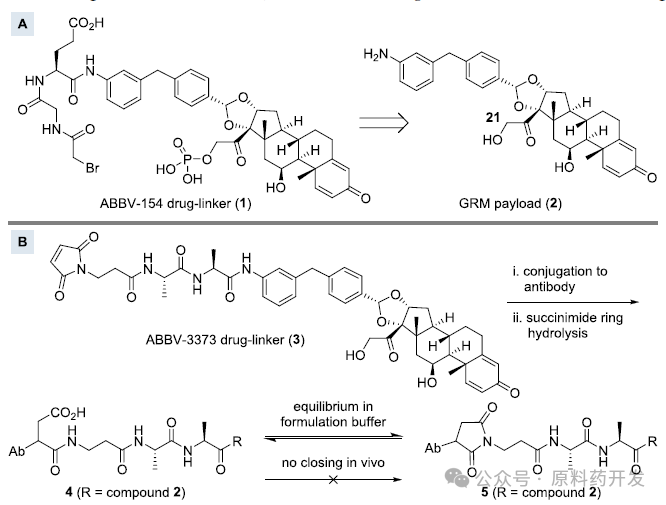
Comparison of ABBV-154 Drug Conjugate with ABBV-3373 Structure
·Bottleneck of Existing Route:The first-generation route relies on multiple chromatographic purifications, resulting in low overall yield, making it difficult to meet large-scale production demands.
·Optimization Strategy:By clarifying key differences through structural comparison, focus on optimizing the stability of the hemiacetal structure and phosphate groups to avoid degradation pathways similar to ABBV-3373.
Scheme 4: Synthesis of Biologically Active Hemiacetal 2 and Control of Impurity Profile
·Bottleneck Issue:The initial route using HClO₄ led to oxidative side reactions, and the product was a thermodynamic equilibrium mixture (~88:12), containing non-target isomer (S)-hemiacetal 14 (12-15%).
·Process Innovation:
1.Acid System Replacement:Using TfOH (triflic acid) instead of HClO₄ to avoid oxidative side reactions.
2.Solvent Optimization:Using a 15:1 CH₃CN/THF mixed solvent to improve reactant solubility.
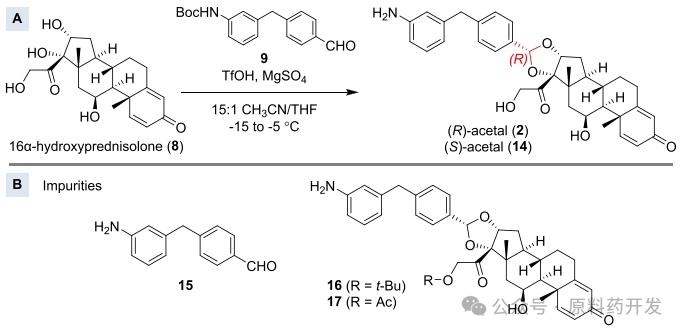
3.Temperature Control:Initial temperature during TfOH addition was lowered to -15°C to accelerate the reaction process.
4.Impurity Control:
§Aniline 15 (8-10%):Reduced the feed amount of N-Boc aniline (1.14→0.98 equivalents) to 2-3%.
§Tert-butyl ether 16 (10-12%):Extended reaction time (3-4 hours) and purged with nitrogen to remove isobutylene, reducing to 1-2%.
·Purification Breakthrough:Developed a PTSA (p-toluenesulfonic acid) salt crystallization method, replacing reversed-phase chromatographic purification, successfully removing (S)-hemiacetal 14 (from 11.8% to <0.5%), with product purity >97%.
Dipeptide Coupling Parameter Screening
·Bottleneck Issue:The carboxylic acid coupling of glutamic acid led to undesired isomerization (~10%), and there was an over-acylation impurity 19 of α-keto hydroxyl.
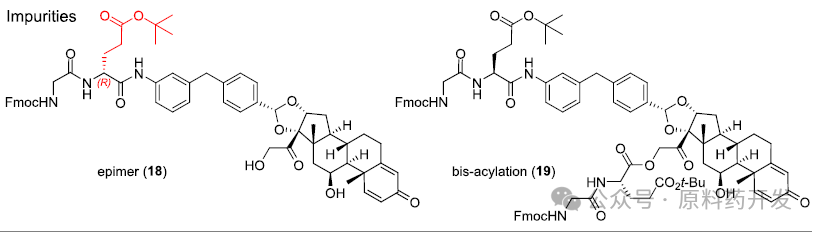
·Optimization Strategy:
1.Coupling Reagent:EDAC·HCl (1-Ethyl-3-(3-dimethylaminopropyl)carbodiimide hydrochloride) is superior to T3P (propylphosphonic anhydride) and EEDQ.
2.Additive Optimization:HOPO (2-pyridinol 1-oxide) increased from 1.1 equivalents to 1.5 equivalents, completely inhibiting undesired isomerization.
3.Feed Control:Dipeptide linker 7 strictly controlled at 1.01 equivalents, balancing conversion rate and over-acylation risk.
·Results:Scaled up production (4.54 kg aniline 2) achieved 96% assay yield, purity 95.6%.
Phosphate Installation Process
·Bottleneck Issue:Tert-butyl group loss of phosphate 11 during silica gel purification.
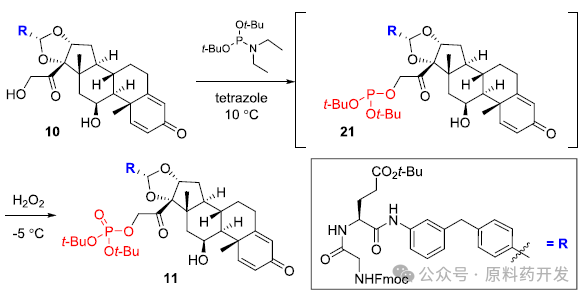
·Innovative Solution:
1.Stationary Phase Replacement:Using YMC-Pack Diol-80-FC silica gel (25μm, 80Å) to avoid acidic degradation.
2.Elution Agent Optimization:Using a mixed system of CH₃CN/n-heptane/CH₂Cl₂ to reduce product retention time.
3.Crystallization Isolation:Developed a reverse precipitation method (2-MeTHF/n-heptane→n-heptane) to obtain a filterable solid.
·Results:Achieved stable preparation of hundreds of grams of phosphate 11.
Fmoc Deprotection and Continuous Extraction Technology
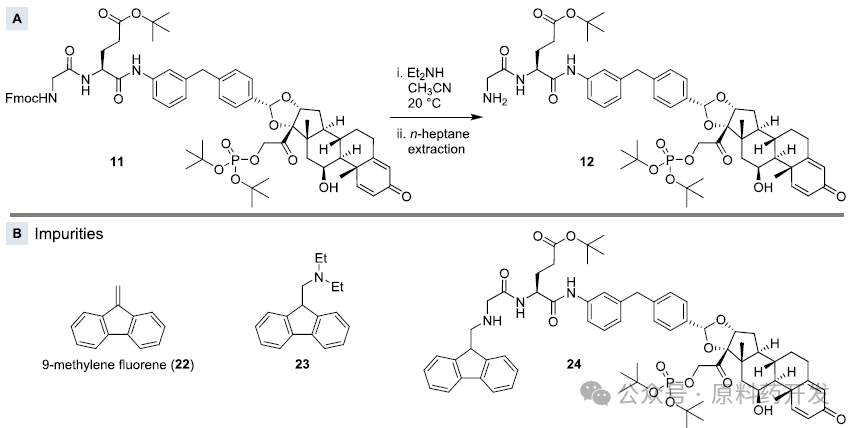
·Bottleneck Issue:Piperidine deprotection produced 9-methylene-9H-fluoren-9-yl-piperidine adduct (solid precipitate), making filtration difficult.
·Optimization Strategy:
1.Amine Reagent Replacement:Using diethylamine (DEA) instead of piperidine to avoid adduct formation and facilitate easy removal.
2.Continuous Extraction Innovation:Developed a n-heptane/CH₃CN continuous liquid-liquid extraction system to effectively remove 9-methylene-9H-fluorene byproduct.
3.Kinetic Control:After 3 hours of extraction, the impurity concentration in the CH₃CN layer was reduced to below 20% of the initial level.
·Results:430 g scale deprotection followed by direct continuous extraction, avoiding intermediate separation and improving efficiency.
Global Deprotection and Final Purification
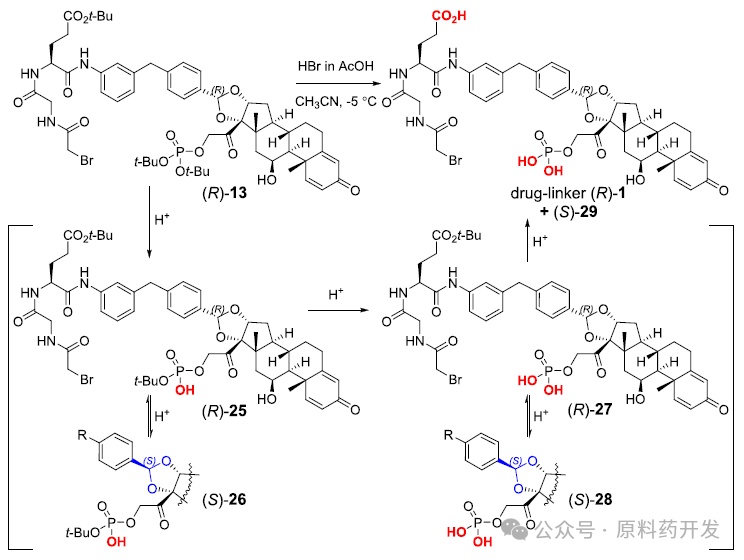
·Bottleneck Issue:TFA/CH₂Cl₂ conditions led to undesired isomerization of hemiacetal and incomplete conversion.
·Optimization Strategy:
1.Acid System Replacement:HBr/AcOH reaction in CH₃CN with low product solubility (0.2 mg/mL) to inhibit isomerization.
2.Reversed Feed Order:Adding the starting material solution to HBr to avoid intermediate encapsulation leading to purity loss.
3.Condition Optimization:8 equivalents of HBr, -5°C, rapid addition, balancing conversion rate and isomerization control (Table 3).
·Purification Innovation:
oSolvent Optimization:Using a 3:4 v/v THF/H₂O mixture instead of DMF/H₂O to avoid chromatographic peak distortion.
oDegradation Control:Hydrolysis impurity 30 (Figure 11) suppressed by low-temperature storage (<10°C) (Figure 12).
oIsolation Process:Chromatographic fractions extracted with 2-MeTHF/i-PrOAc, followed by reverse precipitation (THF→i-PrOAc) to obtain easily filterable solids.
·Results:Final product purity 98.2%, overall yield increased from 1.1% to 18%, and chromatographic purification steps reduced from 4 to 2.

Conclusion
This article successfully transformed the synthesis route of ABBV-154 drug conjugate from inefficient laboratory scale to hundreds of grams scale through innovative approaches such as reaction condition optimization, impurity profile control, crystallization purification replacing chromatography, and continuous extraction technology, providing key technical support for the industrial production of ADC drugs.
https://doi.org/10.1021/acs.oprd.4c00142
Acronym Annotations:
·ADC:Antibody-Drug Conjugate
·CMC:Chemistry, Manufacturing, and Controls
·TfOH:Triflic Acid
·PTSA:p-Toluenesulfonic Acid
·EDAC·HCl:1-Ethyl-3-(3-dimethylaminopropyl)carbodiimide Hydrochloride
·HOPO:2-Pyridinol 1-Oxide
·T3P:Propylphosphonic Anhydride
·Fmoc:Fluorenylmethyloxycarbonyl
Original Statement:This article is deeply analyzed by the “API Development” team, and reprinting requires authorization and citation. Follow us for more process development insights!