

Currently, the wave of “software-defined vehicles” is reshaping the soul and framework of automobiles—the electronic and electrical architecture—with unprecedented force. A profound transformation from distributed control to centralized control has already begun, and high-performance, high-safety, and high-reliability automotive-grade MCUs are indispensable “intelligent control cornerstones” in this transformation.
However, in the core power domain and highly integrated regional controller areas that determine vehicle performance and safety, high-end MCUs have long been a “hidden pain” for the domestic supply chain. Especially in light of the recent geopolitical fluctuations that have triggered a chip supply crisis, the industry has been alerted—the autonomy and controllability of the supply chain have shifted from a strategic option to a survival necessity.
Against this backdrop, domestic chip company Xinchip Technology has announced significant breakthroughs: its flagship intelligent control MCU E3650, designed for the next generation of automotive architecture, has achieved large-scale mass production as scheduled; the E3620P, designed for new energy power systems, and the E3620B, aimed at regional/body domain control MCUs, have both begun customer sampling.
This dual breakthrough of “one mass production and one sample delivery” not only marks Xinchip Technology’s continued leadership in product development but also demonstrates its industrial strength in transforming cutting-edge technology into stable, deliverable products, establishing a solid milestone on the path to autonomous and controllable Chinese automotive chips.
Architectural Transformation Reshapes Automotive MCUs: The Time for Domestic Chips to Break Through
“The first half is electrification, the second half is intelligence.” 2025 is considered a critical time node for the automotive industry to transition from electrification to intelligence.
However, these two transformations are not isolated or simply additive paths; they deeply intersect and empower each other in the profound transformation of the automotive “nervous system”—the electronic and electrical architecture, jointly giving rise to an explosive demand for high-end automotive-grade MCUs, which are the cornerstone of core computing power in vehicles.
At the same time, this transformation is tearing open a gap in the chip battlefield long dominated by overseas giants, bringing unprecedented historical opportunities to agile domestic chip companies.
To understand why MCUs have become so critical, one must first recognize the fundamental change in the attributes of automobiles.
In the past, automobiles were essentially “mechanical bodies with electronic assistance,” and their electronic and electrical architecture (EEA) resembled a functionally fixed “feature phone,” with each ECU performing its specific task. In contrast, future intelligent electric vehicles will be a “mobile intelligent terminal” or “wheeled robot” that integrates transportation, energy, communication, and computing.
This role shift requires automobiles to possess a powerful “digital heart” and a highly developed “nervous network,” which is the core of the electronic and electrical architecture transformation and the root cause of the explosive demand for high-end MCUs.
In this paradigm revolution, two clear and interwoven trends are reshaping the competitive landscape of automotive chips with unprecedented force.
First, the electronic and electrical architecture is gradually shifting from distributed to centralized.
Traditional distributed electronic and electrical architectures resemble “feudal fragmentation,” with dozens or even hundreds of independent ECUs controlling specific functions, leading to system complexity, lengthy wiring, and low collaborative efficiency. The future trend is towards a “centralized” architecture, focusing on achieving a higher degree of functional integration with fewer, more powerful core controllers.
Currently, the industry is evolving along two mainstream paths: one is a fully regionalized architecture of “central computing + multiple cross-domain integrated regional controllers”; the other is a semi-regionalized architecture of “central computing + regional controllers + power/chassis functional domains.” Regardless of the path, the core demand is to achieve a higher degree of integration with fewer, more powerful controllers.
In the face of this complex technical trend, Xinchip Technology’s E3650, which has achieved large-scale mass production, precisely targets the core pain points of architectural transformation. With its powerful multi-core real-time processing capabilities, rich I/O resources, and high-bandwidth communication performance, it has become the “universal solution” and “optimal solution” for the aforementioned two mainstream architectural paths.
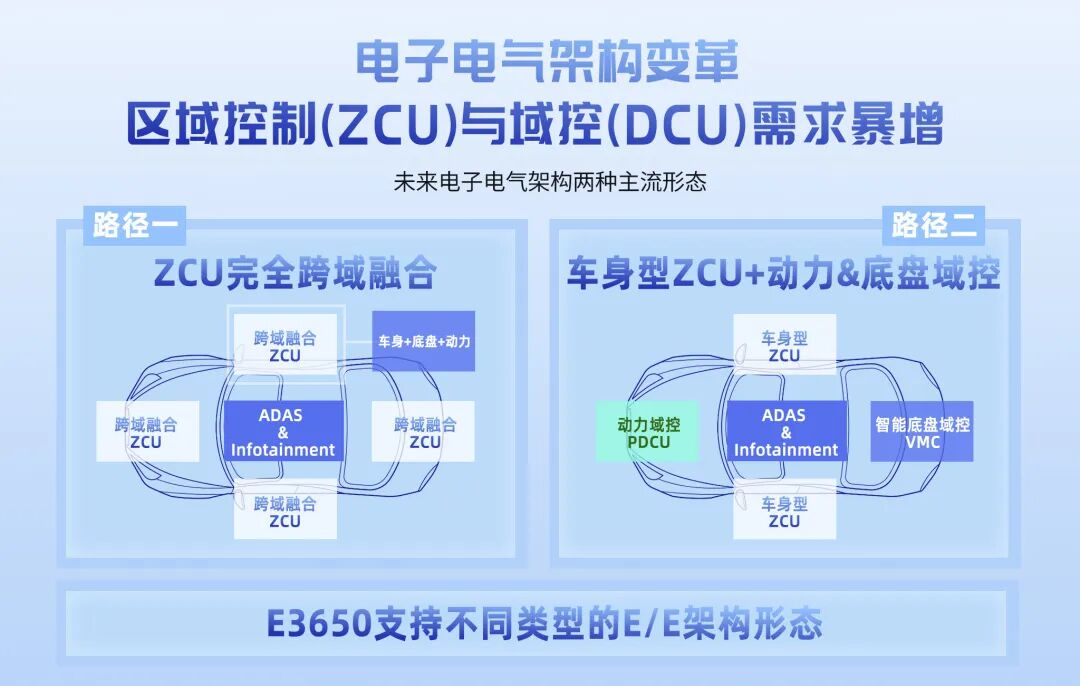
Image Source: Xinchip Technology
Specifically, the E3650 can serve as the “brain” of a highly integrated regional controller (ZCU), managing all electronic functions within a physical area; it can also play the main control role of high-performance functional domain control. This “one chip, multiple uses” feature provides unprecedented flexibility and freedom for OEMs in architectural selection, whether for aggressive full regionalization or stable semi-regionalization.
Moreover, Xinchip Technology also offers the E3620B, which is highly compatible with the hardware, software, and ecosystem of the E3650. Together, they form a one-stop selection solution that seamlessly covers the differentiated performance needs of high and low configurations or different location controllers in vehicles.
This “platformization” strategy greatly simplifies the system design complexity for OEMs, reduces supply chain management and software development costs, and accelerates the implementation of centralized architectures.
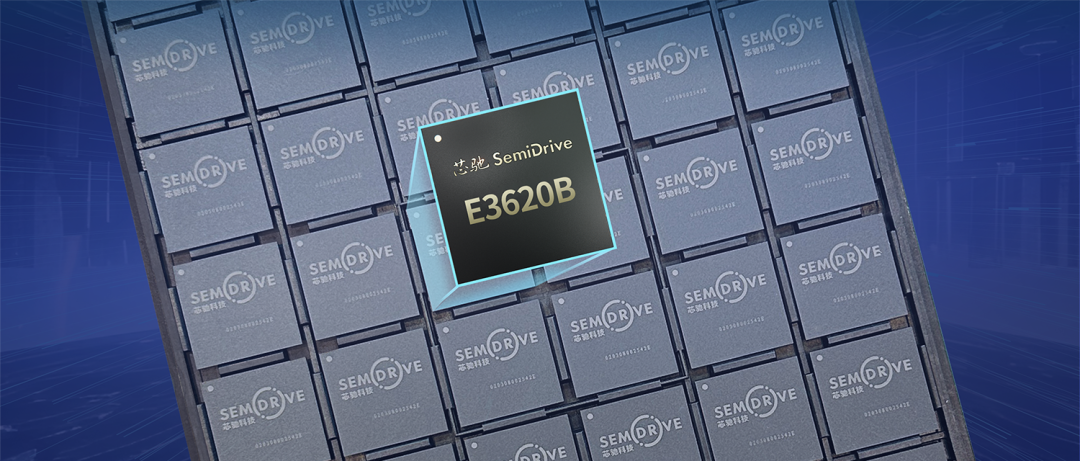
Image Source: Xinchip Technology
Secondly, the power system is undergoing a complete transformation from mechanical transmission to deep integration of electric control.
Nowadays, the power system is no longer just an independent engine or transmission; it has evolved into a highly integrated system that includes electric drive, power supply, thermal management, and even chassis control. This deep integration poses nearly “hell-level” challenges to the computing power, real-time response speed, control precision, and functional safety levels of control chips.
The E3620P, which Xinchip Technology has begun sampling, is designed to conquer this “fortress.” It is not a simple modification of a general-purpose chip but a product deeply defined for advanced power systems.
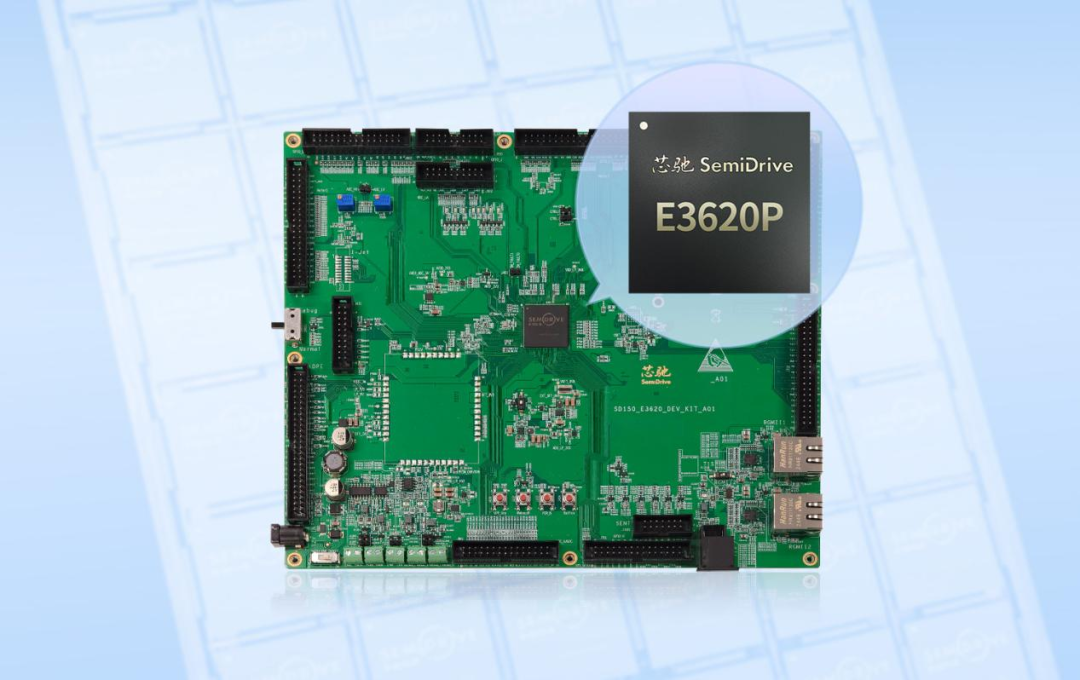
Image Source: Xinchip Technology
By integrating stronger computing power cores, optimizing bus and storage architectures, and enhancing the performance of dedicated co-processors and accelerators, the E3620P successfully meets the control needs of key modules such as electric drive, onboard power, thermal management, VCU (Vehicle Control Unit), high-voltage boost, and internal combustion engine control, achieving efficient integration at the chip level and providing vehicle manufacturers with stronger performance, higher integration, and better cost solutions.
Xinchip E3 Series: Building a Powerful “Digital Heart” for Intelligent Vehicles
Exceptional product strength must be supported by strong technical backing.
In the chip field, leading process technology is often the primary manifestation of product competitiveness. The entire E3 series from Xinchip adopts the 22nm automotive-grade process first, which has a significant generational advantage in the current automotive MCU market dominated by 28nm and above.
A more advanced process means that more transistors can be integrated in a given area, laying a physical foundation for enhancing core computing power, storage, and co-processing units. At the same time, the 22nm process brings significant optimization in power consumption and heat generation. In highly integrated systems like domain controllers, limited heat dissipation space has become a key factor restricting performance release.
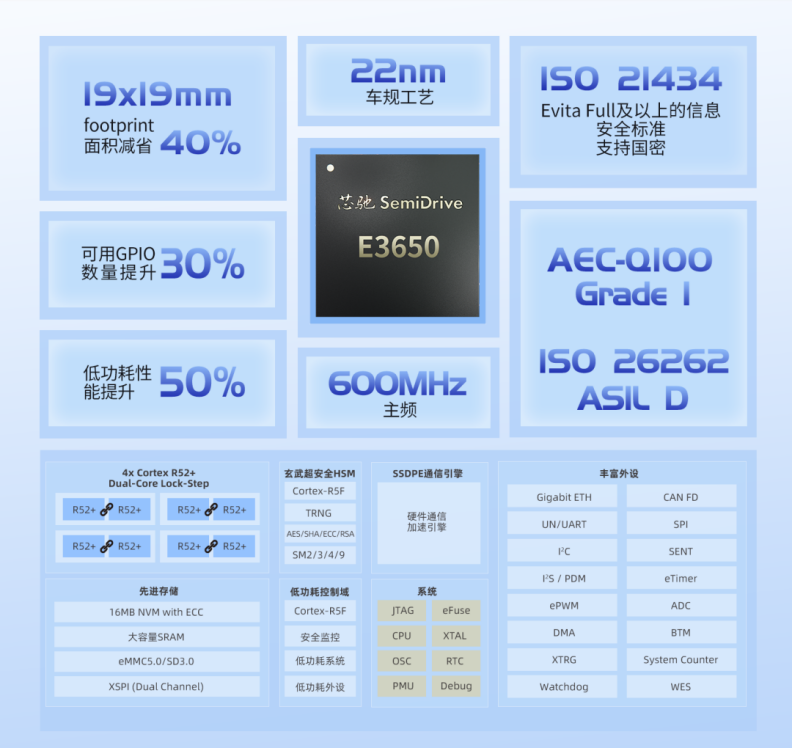
Image Source: Xinchip Technology
The E3 series not only achieves performance breakthroughs through leading processes but also enhances the long-term operational reliability and energy efficiency of systems, clearing obstacles for the continuous integration of vehicle electronic and electrical architectures.
As the flagship product of the E3 series, the design goal of the E3650 is very clear: to become the “universal brain” for future regional controllers and high-performance domain control.
In terms of architectural design, the E3650 does not merely focus on stacking cores but achieves a unity of performance and safety through the combination of a multi-core cluster of ARM Cortex-R52+ with a clock speed of up to 600MHz and a lockstep mechanism. The high clock speed ensures smooth processing in complex scenarios such as integrated communication, multi-task scheduling, and real-time decision-making; while the lockstep cores provide ASIL-D level functional safety backup for core control tasks, ensuring controllable behavior and predictable responses under extreme conditions.
The integration of 16MB of embedded non-volatile memory is a key move for the E3650 to address the “software-defined vehicle” challenge.It effectively provides the MCU with a high-speed, reliable local storage system, eliminating the need for external storage chips, significantly enhancing system startup speed and data access efficiency, and providing native support for the increasingly large software systems and continuous OTA upgrades.
Moreover, the E3650 natively supports virtualization technology that meets the high real-time and low resource overhead demands of domain control scenarios. This technology allows multiple independent operating systems or software environments to run simultaneously on a single MCU. This “one chip, multiple systems” capability breaks the functional boundaries of traditional MCUs, providing OEMs with the underlying possibility for true software and hardware decoupling and accelerated iteration.
In contrast to the “universal strong core” positioning of the E3650, the E3620P is deeply focused on the new energy power system, with a design philosophy that emphasizes heterogeneous integration and precise control.
The E3620P is equipped with a 6-core R52+ cluster and three multifunctional co-processors. This is not merely a simple increase in clock speed and core count but a thoughtfully designed “heterogeneous integration” architecture. The 6-core R52+ provides a strong general computing power foundation and task parallelism; the three co-processors offer hardware acceleration for critical tasks, ensuring extreme real-time performance and control precision.
This design enables the E3620P to easily meet the stringent requirements of new energy power systems for “high computing power, high real-time performance, and high precision control,” serving as a technical guarantee for its capability in core scenarios such as main electric drive and multi-in-one domain control.
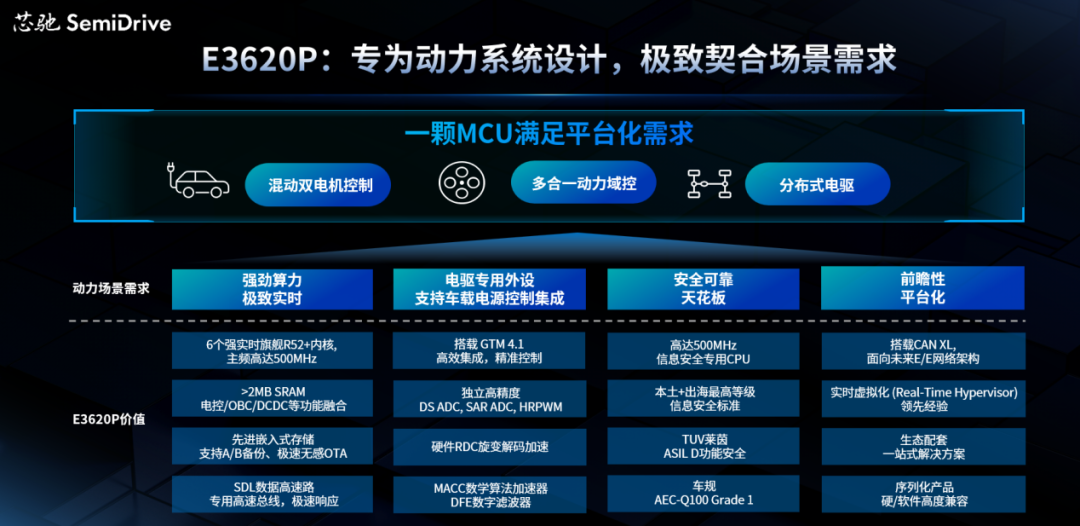
Image Source: Xinchip Technology
In terms of storage configuration, the E3620P integrates more than 2MB of SRAM and 10MB of advanced embedded non-volatile memory, providing a bottleneck-free “data supply line” for its “strong computing power.” The large-capacity SRAM ensures high-speed caching of data during multi-core concurrency; the built-in large-capacity storage simplifies PCB design, enhancing system integration and reliability.
Looking at the E3620B, its core computing unit adopts three pairs of lockstep high-performance, real-time ARM R52+ cores, with a clock speed of up to 500MHz, placing it in a leading position among products in the same class, providing strong computing power support for processing critical tasks. Additionally, the chip integrates multiple multifunctional auxiliary cores, allowing the system to support flexible deployment and efficient execution of various tasks, optimizing resource allocation.
In terms of storage capacity, the E3620B is equally impressive. It is equipped with over 2MB of SRAM and up to 10MB of advanced embedded non-volatile storage, providing ample on-chip storage space for complex applications and data.
Notably, the E3620B integrates a rich set of GPIOs, exceeding that of comparable products, addressing the pain point of significantly expanding IO for domain control scenarios, simplifying system design. By equipping a hardware-level SSDPE communication acceleration engine, this product effectively reduces the CPU load caused by communication tasks in domain control, ensuring zero packet loss under high load conditions. Meanwhile, its compact size of 19x19mm also helps automotive companies achieve extreme miniaturization of controllers.
The “Xinchip Speed” from Product Launch to Ecosystem Building
A powerful chip is just the beginning of the story.
Xinchip Technology’s core competitiveness lies in its ability to transform technological advantages into market-recognized “ecosystem building” capabilities and “Xinchip speed.”
Currently, the Xinchip E3 series MCUs have cumulatively shipped millions of units, covering over 70 mainstream mass production models, widely used in core areas such as regional control, body, electric drive, BMS, intelligent chassis, and ADAS, and have achieved multiple “firsts” in domestic innovative applications.
This large-scale market validation provides undeniable reliability backing for the launch of the new E3650 and E3620 series, significantly reducing customer verification costs and application risks, forming a valuable “snowball” effect.
It is reported that in the electric drive field, leading company Zhenqu Technology has integrated Xinchip Technology’s MCU product E3620P into its new generation of electric control products and has listed Xinchip Technology as a core supplier. The “lighthouse effect” of this benchmark case has immeasurable value in accelerating the penetration of E3620P in the industry chain. At the same time, the E3620B and E3650 have already secured multiple designated projects upon their release, proving that their solutions have been recognized by leading market customers.
As of now, Xinchip Technology has over 200 designated projects, serving more than 260 customers, covering over 90% of domestic OEMs and several international mainstream automotive companies, including SAIC, Chery, Changan, Dongfeng, FAW, Nissan, Honda, Volkswagen, and Li Auto. Currently, Xinchip’s entire series of intelligent cockpit and intelligent vehicle control chips have been mass-produced, with cumulative shipments exceeding 9 million units, installed in over 130 mainstream models.

Image Source: Xinchip Technology
In the context of ongoing uncertainties in the global chip supply chain, reliable delivery capability has become a core competitive advantage.
From the release of the E3620P at the Shanghai Auto Show in April this year to the timely commencement of customer sampling, and the E3650 achieving large-scale mass production strictly according to the planned timeline, Xinchip Technology has demonstrated precise project management and strong execution capabilities. This “Xinchip speed” of “doing what we say” has won valuable model development windows for rapidly iterating automotive industry customers and established deep customer trust.
Xinchip Technology deeply understands that customers need more than just a chip. Therefore, the company’s layout has long surpassed a single product. Centered around the E3650, Xinchip Technology has built a complete one-stop mass production solution, including supporting high functional safety level customized PMICs, efficient IO expansion chips, mature virtualization software, comprehensive adaptation to mainstream AUTOSAR and OEM-customized OS, and a complete development toolchain. This complete ecosystem aims to clear all obstacles from chip selection to mass production deployment for customers, achieving seamless integration and rapid deployment.
Clearly, Xinchip is deeply empowering the architectural evolution of the Chinese automotive industry, as well as the transitions to intelligence and electrification. Its collaborative innovation model with industry chain partners aims to jointly push Chinese automotive chips into the global market, establishing a “new benchmark” from China in the waves of electrification and intelligence.
Conclusion
With the full-scale mass production delivery of the E3650 and the successful sample verification of the E3620P and E3620B, Xinchip Technology is well-prepared for the Chinese automotive industry to navigate the deep waters of intelligence and electrification, equipped with three powerful “Chinese chips.” This is not only a victory for the products but also a testament to systemic capabilities. It marks the first time that Chinese automotive chip companies possess the R&D strength, mass production speed, and ecosystem building capabilities to compete with international giants in the core arena of high-end automotive-grade MCUs.
Looking to the future, Xinchip Technology will continue to collaborate with global automotive industry partners in innovative ways, using continuously leading technology and stable, reliable delivery to jointly promote the evolution of automotive electronic and electrical architectures towards their ultimate form, accelerating the arrival of a new generation of mobile travel era that is smarter, safer, and more efficient. In the grand journey of Chinese automotive chips towards autonomy and controllability, Xinchip Technology is leading the industry towards a promising new blue ocean with its solid steps.
If you like this article, please give it aheart~