Author
Guo Zhaoxian, Fang Ao
Shanxi University Journal (Social Science Edition)
2023 Issue 5
Abstract
The Industrial Smart Internet has great potential to promote structural changes in the national economy and transformations in social engineering systems. This paper reviews the evolution from the Industrial Internet to the Industrial Smart Internet, distilling its multi-layered connotations and analyzing its important role in empowering the construction of a modern industrial system within a horizontal framework. Currently, the global Industrial Smart Internet is at a critical stage of technological acceleration, expansion of application scenarios, and large-scale growth. The US, China, Japan, and Germany have certain first-mover advantages; technological innovation is primarily focused on core empowerment capabilities and engineering applications; new links, processes, and entities are continuously emerging; and technological standards and development security are receiving more attention. China has achieved significant results in the practice of the Industrial Smart Internet, with ongoing improvements in top-level design, expanding industrial scale, deepening regional collaboration, and continuously expanding application scenarios. However, challenges remain, including insufficient supply capacity of key technologies, certain industries encountering empowerment bottlenecks, an incomplete talent training system, and an urgent need to improve multi-dimensional security assurance systems. To promote high-quality development of the Industrial Smart Internet and fully leverage its role in constructing a modern industrial system, it is necessary to improve the new national system for tackling technological challenges, break down barriers to collaborative innovation; leverage the advantages of application-scale data scenarios to unleash industrial development potential; establish a complete professional talent supply and demand system and strengthen talent team building; and build a high-standard industrial chain security system to ensure comprehensive industrial safety.
Keywords
Industrial Smart Internet; Industrial Internet; Industrial Networked Technology; Modernization of Industrial System
Funding
Major Innovation Project in National Governance of the Chinese Academy of Social Sciences (2023YZD011); Scientific Research Project of the Graduate Research Innovation Support Plan of the Chinese Academy of Social Sciences University (2023-KY-71).
The report of the 20th National Congress of the Communist Party of China states that to “build a modern industrial system,” we should “focus on the real economy, promote new industrialization,” and “accelerate the development of the digital economy, promote the deep integration of the digital economy and the real economy, and create internationally competitive digital industrial clusters.” As a product of the deep integration of a new generation of information technology and the industrial economy, Industrial Networked Technology empowers industrial enterprises to transform towards digitization, networking, and intelligence, changing the underlying architecture of traditional industrial production, nurturing new production factors and processes, and continuously optimizing resource allocation, becoming a key force in promoting high-quality industrial development. With the in-depth development of industrial and technological revolutions, the concepts and technologies of the Industrial Smart Internet are gradually emerging, becoming a strategic innovation direction to enhance industrial international competitiveness and reshape the global industrial development pattern.
Building a complete industrial ecosystem for the Industrial Smart Internet, promoting the leapfrog upgrade of existing industrial Internet and industrial IoT industrial chains and technology systems towards “smart networking,” is of significant practical importance for accelerating the construction of a modern industrial system in China, advancing the construction of a strong manufacturing nation, a quality strong nation, and a network strong nation, and consolidating and enhancing China’s position in the global industrial value chain, innovation chain, and industrial chain. This paper reviews the evolution of concepts and analyzes the mechanism by which the Industrial Smart Internet promotes the construction of a modern industrial system based on the connotation framework of the Industrial Smart Internet. At the practical level, it analyzes and assesses the current global development status and trends of the Industrial Smart Internet, and combines China’s current stage of practical achievements and major issues to propose targeted countermeasures and suggestions.
1
Industrial Smart Internet: Vertical Concept Evolution and Horizontal Empowerment Framework
(1) Vertically: The Concept Evolution from “Networking” to “Intelligent Networking”
The process of integrating industrial technology and information technology began as early as the mid-20th century. In the 1970s and 1980s, the global information technology revolution rapidly elevated the status of the information industry within the national economic system, while also reshaping traditional industrial manufacturing. Since the 21st century, new generation information technologies and digital technologies represented by 5G, artificial intelligence, and big data have made breakthroughs, pushing traditional industries onto the fast track of digital development, with Industrial Networked Technology becoming an important focus for digital transformation in the industrial sector. Overall, the development of Industrial Networked Technology has gone through three evolutionary phases: from the Industrial Internet to the Industrial IoT, and then to the Industrial Smart Internet.
In 2012, General Electric first proposed the concept of the Industrial Internet in its white paper “The Industrial Internet: Breaking the Boundaries Between Wisdom and Machines,” defining it as the flow and interaction of data, hardware, software, and intelligence, established through sensor networks, big data analysis, and software to create an adaptive intelligent industrial network. The concept of the Industrial Internet quickly attracted significant attention from major countries around the world, which recognized its potential to empower existing industries, achieve ubiquitous connectivity, and drive structural changes in the national economy, thus promoting high-quality economic development.
With the deepening of the industrial technological revolution, the concept and technology of the Internet of Things (IoT) have rapidly gained popularity. With the support of IoT technology, the concept of the Industrial Internet has gradually evolved into the concept of the Industrial IoT. At the end of 2017, the IEEE Computer Society listed the Industrial IoT as one of the top ten technology development trends for 2018. Compared to the Industrial Internet, the Industrial IoT emphasizes the connection between network systems and material elements, as well as equipment terminals. Industrial equipment, cloud computing, edge computing, and other resources are integrated into the network system, achieving extensive deep interconnections down to the end-edge devices through the perception access layer and control operation layer.
Currently, representative technologies of a new round of information technology revolution exhibit a trend of integrated innovation, focusing on high-performance heterogeneous data computing platforms and Industrial Networked Technology coupled with artificial intelligence, big data, and blockchain technologies. This leads to the emergence of the Industrial Smart Internet (Industrial Internet of Minds) concept and technology, aimed at solving issues of system resource utilization efficiency, adaptability, autonomy, self-organization, and security, and achieving knowledge automation analysis and automated services for industrial processes. The Industrial Smart Internet effectively integrates intelligent system engineering technologies at a higher level of intelligence, providing technical support for the new generation of industrial intelligent industries.
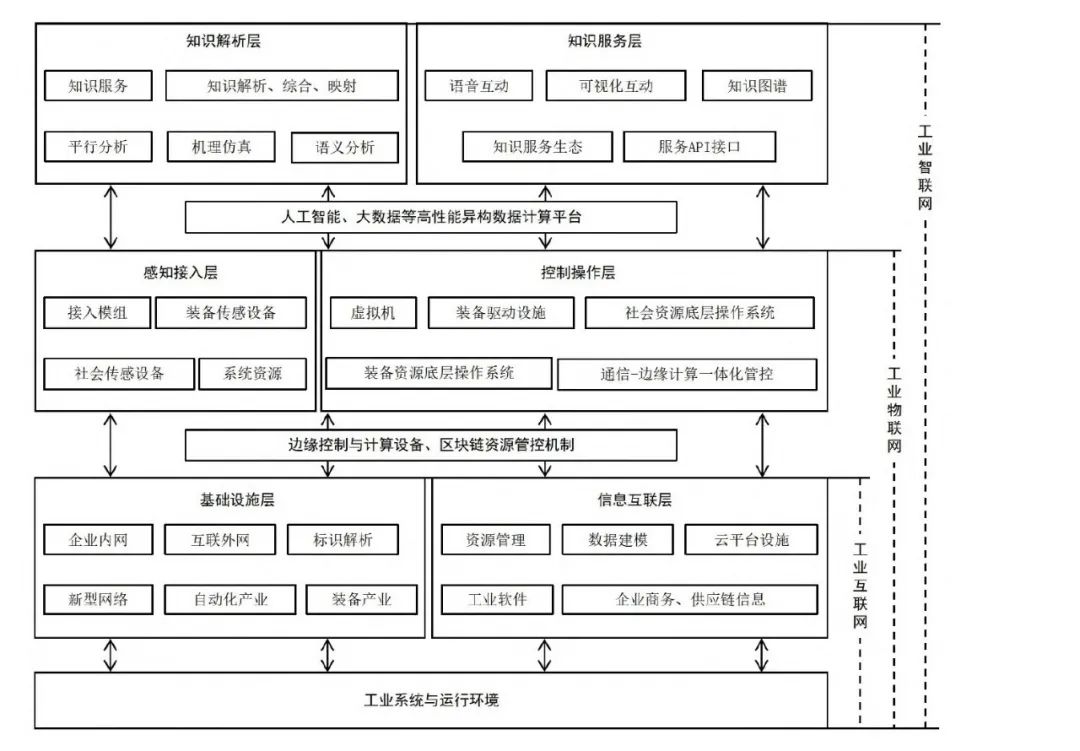
Figure 1
The Conceptual Evolution from the Industrial Internet to the Industrial Smart Internet
With the expansion of technological concepts (see Figure 1), countries around the world have introduced a series of industrial networked development frameworks based on their national conditions, development advantages, and stage characteristics, such as the US Smart Manufacturing Ecosystem (2011), Germany’s Industry 4.0 (2012), China’s Intelligent Manufacturing (2015), and Japan’s Industrial Value Chain (2016).
(2) Horizontally: Multi-layered Industrial Smart Internet Connotation Framework Empowering Modernization of the Industrial System
General Secretary Xi Jinping emphasized the need to “lead with technological innovation, accelerate the high-end, intelligent, and green upgrading of traditional industries, cultivate and expand strategic emerging industries, and accelerate the construction of a modern industrial system characterized by intelligence, greenness, and integration, meeting the requirements of integrity, advancement, and safety.” Vertically, the concept of the Industrial Smart Internet has evolved through the stages of the Industrial Internet and Industrial IoT. Horizontally, the concept of the Industrial Smart Internet can be defined through a multi-layered connotation framework (see Figure 2), which includes frontier technologies, infrastructure and tools, new industrial models and industrial forms, intelligent economic ecology, and social engineering systems. As the connotation of the concept expands, the support, adjustment, and optimization roles of the Industrial Smart Internet for the industrial system also deepen, promoting the construction of a modern industrial system from different dimensions, improving the modernization level and development quality of the industrial system, and enhancing the international competitiveness of the industrial chain and innovation chain.
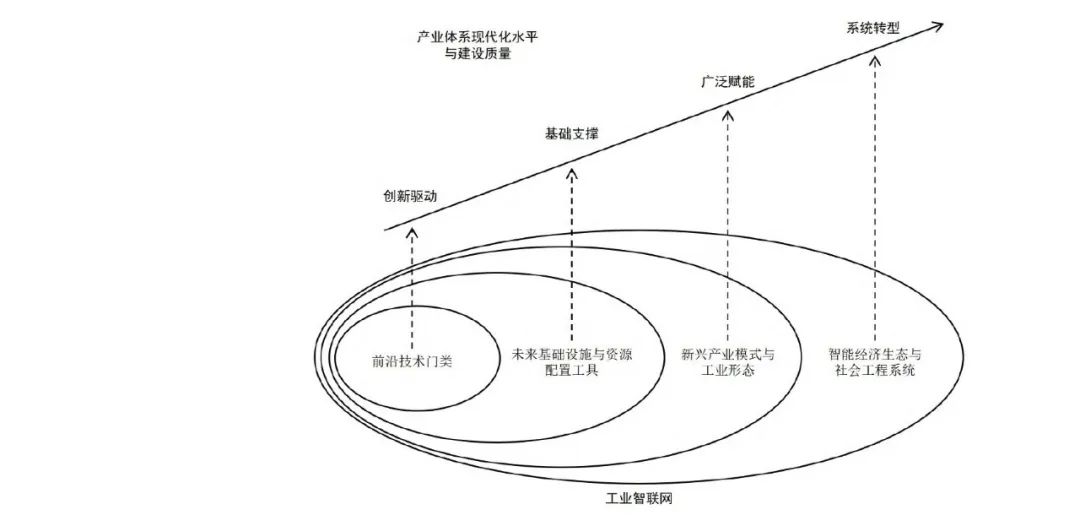
Figure 2
Multi-layered Connotation Framework of the Industrial Smart Internet and Pathways to Enhance the Modernization Level of the Industrial System
1. Frontier Technology Innovation as the Fundamental Driver for Building a Modern Industrial System
Essentially, the Industrial Smart Internet is a frontier technology with dynamism and time-variability, which changes system content, form, methods, and structure in real-time through the accumulation of experiential knowledge, directly targeting complex industrial systems and operating environments. Its goal is to provide automated knowledge analysis and knowledge services, while engaging in real-time knowledge interaction and behavioral interaction with the real world. The Industrial Smart Internet itself requires a good innovation environment and system, further accelerating the flow efficiency of innovative elements such as equipment, talent, and technology, expanding innovation channels, improving the innovation environment, enhancing innovation efficiency, and transforming the driving force of industrial development from investment-driven to innovation-driven, providing fundamental motivation for building a modern industrial system.
2. Providing Basic Support as Future Infrastructure and Resource Allocation Tools
Based on technological applications, the Industrial Smart Internet has become a key infrastructure and resource integration and allocation tool for future industries. China’s “14th Five-Year Plan for Digital Economy Development” points out the need to “build a reliable, flexible, and secure industrial Internet infrastructure to support ubiquitous connections, flexible supply, and efficient allocation of manufacturing resources.” The industrial Internet, based on communication, sensing, base stations, networks, monitoring systems, and industrial applications, achieves extensive connections of people, machines, and materials in industrial processes, providing a complete, efficient, responsive, and secure real-time production control network for networked enterprises.
Building on this foundation, the Industrial Smart Internet more precisely provides intelligent technology applications and knowledge services supported by multi-layered integrated computing systems and socially engineered systems, enabling massive industrial entities to achieve socialized knowledge collaboration, fundamentally transforming industrial production forms, and greatly liberating and enhancing social productivity. As the forefront application field of new infrastructure, the Industrial Smart Internet drives energy conversion, quality transformation, structural upgrades, efficiency improvements, and environmental optimization, empowering the high-quality development of the real economy, and providing basic support for advancing new industrialization and building a modern industrial system.
3. Shaping New Industrial Models and Forms to Enhance the Modernization Level of the Industry
By extensively empowering traditional industrial sectors, the Industrial Smart Internet gradually shapes a new industrial form and model. The Industrial IoT achieves comprehensive interconnectivity among enterprises across devices, systems, plants, and regions based on traditional industrial production models, enabling efficient and precise allocation of various resources. The Industrial Smart Internet further models, analyzes, and controls various industries, allowing them to operate and develop autonomously with high efficiency, automatically analyzing macro and micro data across all industries and establishing a manufacturing and service application system covering the entire industrial chain and value chain, forming a truly data-driven, knowledge-based, and intelligent industrial model.
The interaction between traditional industrial systems and virtual industrial systems establishes a new industrial system characterized by intelligence, virtual-reality interaction, and entanglement, supporting production decision-making and asset management, and driving the integration and collaboration of industrial systems across all scales, elements, and value chains, completing the management, control, analysis, and optimization of actual industrial systems, significantly improving the development quality and efficiency of the industrial economy. On the one hand, the development of the Industrial Smart Internet fosters and strengthens strategic emerging industries such as artificial intelligence, big data, blockchain, and intelligent equipment. On the other hand, it accelerates the high-end, intelligent, and green upgrading of traditional industries, enhancing the modernization level and construction quality of the industrial system.
4. Promoting the Transformation of Economic and Social Systems to Improve the Development Quality of the Modern Industrial System
In the broadest sense, the Industrial Smart Internet empowers the entire economic and social domain, shaping an intelligent economic ecology and promoting the transformation of intelligent social engineering systems. The Industrial Smart Internet promotes the evolution of point-wise intelligence to comprehensive integrated intelligence, accelerating profound changes in innovation mechanisms, organizational forms, and business paradigms, establishing a new collaborative data trust, sensing control, and knowledge automation system that directly covers all economic entities.
Social system disciplines suggest that the “physical space” physical engineering system, “cyber space” artificial engineering system, and “social space” social engineering system together constitute a complete social system. Under the development background of the Industrial Smart Internet architecture, agricultural smart internet, transportation smart internet, energy smart internet, and enterprise smart internet have emerged, enabling the artificial engineering system to achieve real-time control of the physical engineering system and guide the social engineering system. The social system also provides real-time feedback to the physical and artificial systems, ultimately realizing the interconnection of physical space, cyber space, and social space, constructing a complete intelligent social engineering system. The Industrial Smart Internet expands the construction of a modern industrial system to the social level, aligning more closely with the requirements of integrity, advancement, and safety, and receiving real-time feedback from the economic ecology and social engineering systems, timely adjusting and correcting to improve the quality of industrial system construction, effectively creating a modern industrial system that meets social needs, adapts to social characteristics, and aligns with social forms.
2
Current Status and Trends of Global Industrial Smart Internet Development
Currently, the global Industrial Smart Internet is at a critical stage of technological acceleration, expansion of application scenarios, and large-scale growth, with the industrial landscape not yet fully determined, possessing significant development potential. In terms of industrial status, the US, China, Japan, and Germany have certain first-mover advantages based on their existing Industrial Internet industrial foundations; in terms of technological trends, innovation is primarily focused on core empowerment capabilities and engineering applications; in terms of industrial ecology, new links, processes, and entities are continuously emerging; and in terms of overall ecology, diverse entities are strengthening cooperation, with greater emphasis on technological standards and development security.
(1) The US, China, Japan, and Germany have Dominant Industrial Scales, while Upper-Middle-Income Countries Seize Opportunities
The Industrial Smart Internet is still an emerging technological concept, and major countries or organizations in the world have not yet reached a consensus on its industrial and technological standards, nor do they have a unified statistical caliber. Given that the Industrial Smart Internet developed from the Industrial Internet, this section describes the industrial foundation of the Industrial Smart Internet industry based on the added value of the Industrial Internet. According to data from the OECD and World Bank, the China Industrial Internet Research Institute estimated the industrial scale of 59 representative countries (see Table 1). In 2020, the total added value of the Industrial Internet in these 59 countries was $3.74 trillion. The top four were the US ($885.84 billion), China ($566.46 billion), Japan ($305.57 billion), and Germany ($247.59 billion), with the combined scale of the US, China, Japan, and Germany exceeding 50% of the global scale.
By regional classification, the combined proportion of the Industrial Internet scale in East Asia and the Pacific, Europe and Central Asia, and North America exceeds 90%. Among them, East Asia and the Pacific account for $1.32 trillion (35.29%) with a growth rate of 5.21%; Europe and Central Asia account for $1.13 trillion (30.14%) with a growth rate of 2.37%; and North America accounts for $0.95 trillion (25.41%) with a growth rate of 1.51%. In addition, the added value of the Industrial Internet in South Asia, Latin America, and the Caribbean accounts for about 9% of the global total. According to income levels, high-income countries account for a total scale of $2.55 trillion (68.12%) with a growth rate of 1.41%; upper-middle-income countries account for $0.94 trillion (25.21%) with a growth rate of 7.34%; and lower-middle-income countries account for $0.25 trillion (6.67%) with a growth rate of 1.59%. It can be seen that high-income countries have a first-mover advantage in industrial foundation due to their already developed industrial systems, but upper-middle-income countries such as China, Russia, and Brazil are striving to seize opportunities in the new round of technological and industrial revolutions, strengthening the application of the Industrial Smart Internet in their national economic systems, aiming to achieve a “curve overtaking” in the development of the Industrial Smart Internet.
Table 1
Top Ten Countries and Regions in Global Industrial Internet Added Value in 2020 and Income Classification
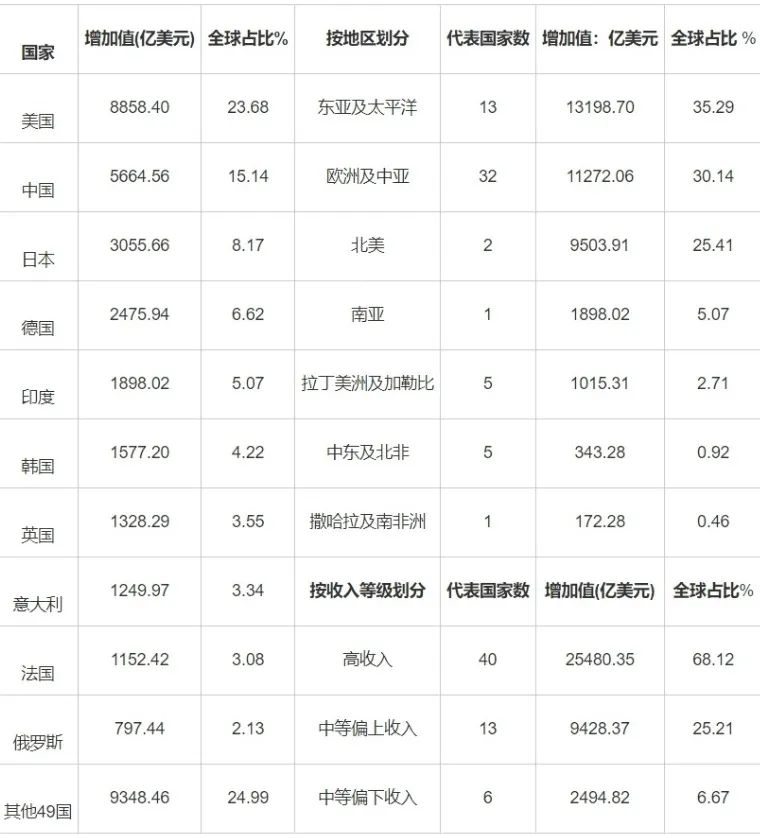
Data Source: Compiled from the “China Industrial Internet Industry Economic Development White Paper (2021)”.
(2) Technological Innovation Primarily Focused on Core Empowerment Capability Growth and Engineering Application
Current technological innovation in the Industrial Smart Internet primarily targets two directions: one is the upward focus on more complex knowledge processing and higher performance demands for core empowerment capability growth; the other is the downward focus on engineering breakthroughs for industrial deployment and application.
In terms of core empowerment capabilities, first, data science focuses on more complex and diverse industrial problems, with deep learning at its core. Deep Reinforcement Learning (DRL) optimizes multi-decision execution in dynamic environments and complex scenarios through continuous iteration and trial-and-error in industrial practice, demonstrating powerful optimization capabilities in product design and development, scheduling control, processing paths, operation management, and strategies. Generative Adversarial Networks (GAN) increase the quantity of effective industrial samples through the continuous game between two neural networks, improving industrial data quality and providing a data foundation for industrial model training. Second, based on deep learning, application innovation focuses on enhancing the capability to identify key issues and knowledge service capabilities related to production and customers. Industrial vision technology increasingly focuses on high-precision small target recognition scenarios and processing capabilities under low-quality data conditions. Natural Language Processing (NLP) enhances user interaction recognition capabilities in user service segments by analyzing knowledge graphs to deeply explore customer needs and improve service efficiency and quality. Third, knowledge engineering is moving towards graph-based, automated construction and updating, and quantitative complex decision-making. The core processes of industrial knowledge acquisition, processing, and application have been clarified, and the automation of constructing and updating industrial knowledge graphs is gradually taking shape, with the semantic processing phase shifting from manual processing to automated extraction and integration, and the graph updating phase achieving dynamic organization and self-updating. Some institutions have established knowledge “open crowd-sourcing” mechanisms for graph management. The application of industrial knowledge graphs is gradually shifting from semantic information retrieval and qualitative decision-making to quantitative complex decision-making, enhancing graph inference capabilities through the integration of machine learning models in decision execution in core fields. Fourth, the interaction and learning methods of industrial robots are shifting towards human-machine, brain-like, and brain-machine technology directions, with breakthroughs in bidirectional brain-machine interfaces and brain-like + brain-machine interfaces profoundly changing human-machine collaboration modes, although this field is still in theoretical research and experimental stages.
In terms of engineering applications, technological innovation focuses on model efficiency, process interpretability, data quality, industrial integration, and scalable implementation. First, hardware and software working together address model efficiency issues. Currently, the Von Neumann architecture-based chips face the “memory wall” challenge, with domestic and international AI companies and chip manufacturers such as Hailo and Kunlun Technology introducing acceleration modules and edge computing boxes, focusing on architectural design and scenario optimization for diverse explorations. At present, model efficiency enhancement techniques such as knowledge graph structure distillation, knowledge refinement, and parameter pruning and quantization are receiving widespread attention, but their specificity and academic nature limit their promotion in industrial implementation. Second, enhancing process interpretability in fields such as equipment management and process optimization. On one hand, causal/correlational relationships are mined and visualized in scenarios such as quality inspection and equipment anomaly identification based on feature visualization methods; on the other hand, in scenarios such as fault root cause analysis and production defect prediction, interpretability is enhanced using decision trees, decision rules, and industrial knowledge graphs for local/global approximation. Third, addressing the small sample dilemma and industry-specific dataset construction issues to improve data availability. The small sample dilemma arises from the fragmentation, marginalization, and weak correlation of current industrial data, making it difficult to extract knowledge. Currently, there are mainly several solution paths, including data augmentation, introduction of prior knowledge, and optimization of model structures. At the industry level, intelligent algorithm models are developed based on datasets to enhance the capacity to address common industry issues; at the field level, common needs are explored to enhance the ability to address scenario-specific issues. However, these solutions currently face constraints such as data asset/commercial confidentiality breaches, immature privacy computing technologies, and incomplete legal regulations. Fourth, AI frameworks are gradually becoming core areas for accelerating industrial integration and scalable implementation. TensorFlow, PyTorch, and Baidu PaddlePaddle have become widely used AI frameworks in the domestic industrial field, supporting differentiated industrial applications and connecting diverse industrial hardware. On one hand, they provide a unified and scalable infrastructure layer to enhance model training performance; on the other hand, they perform targeted adaptations and specific optimizations for target hardware to ensure model deployment and inference speed at the edge, with the ultimate goal of improving the adaptability and usability of AI frameworks, promoting industrial integration and scalable implementation.
(3) The Overall Industrial Ecosystem Construction Gives Rise to New Links, Processes, and Competitive Entities
As industrial networked technology continues to develop, developed countries are increasingly emphasizing its importance in reshaping the overall industrial ecosystem and enhancing national industrial competitiveness. Development goals have shifted from early efforts to revitalize local manufacturing to fully leveraging the penetration, empowerment, and transformation effects of the Industrial Smart Internet to improve the overall quality of industrial development. The US has further increased government support for industries such as artificial intelligence, 5G, and advanced manufacturing, continuously adding R&D investments. Germany has continued to release a series of strategic policies such as the “Digital Strategy 2025” and the “German Industry Strategy 2030,” promoting the formation of multi-layered industrial networked industry clusters. Large high-tech multinational companies like Siemens and SAP are integrating their advantages to accelerate global industrial transformation and layout. The EU and its member states continue to promote the development of emerging industries and recreate high-value-added segments of existing industries. Japan has launched the “Industrial Value Chain Plan” to establish a localized interconnected industrial support system.
Under the overall industrial ecosystem construction goals, new links and processes such as industry data labeling have emerged, with AI-centered service enterprises becoming typical representatives of new market entities. Data labeling and other data service industries concentrate on warehousing logistics and security scenarios, with newly established companies such as Motor Intelligence, Iceberg Data, and Awakening Vector gradually requiring large-scale, high-quality labeled datasets for industrial development. The fragmented characteristics of industrial scenarios require industrial intelligent models to continuously iterate and optimize. Currently, a batch of AI technology-centered industrial service companies has emerged in high-value equipment health management and other fields, injecting AI capabilities into industrial production management processes to provide users with intelligent services such as equipment monitoring, operation and maintenance, and predictive maintenance. In addition to AI service companies, large consulting firms are also entering the competition in the intelligent service market, expanding their market share with customized intelligent solutions. Companies like Accenture and Deloitte have rich industrial consulting experience and a wide range of intelligent technology ecosystem partners. For example, Accenture has over 50 years of global consulting service experience, with more than 9,000 technology consultants covering over 40 industries, and maintains close cooperation with Microsoft, Google, and Amazon. These companies build technical advantages by establishing research institutions and provide industrial AI services such as factory design, operational consulting, solution development, and deployment to clients. The collaborative model of industrial enterprises around AI core empowerment is gradually taking shape, with one being product-bound cooperation, acquiring data from industrial enterprises and empowering industrial products and equipment; the other being knowledge-bound cooperation, leveraging the professional knowledge of industrial enterprises to utilize the advantages of general AI technologies to create intelligent product solutions.
(4) Multi-Party Stakeholder Collaboration, Emphasis on Technical Standards and Industrial Development Security
Industrial networked technology industries generally fall into two types of development models: the enterprise-led model represented by the US, which is “bottom-up” and promotes the integration of physical systems and digital networks through industrial alliances; and the government-led model represented by Germany, which is “top-down” and promotes cooperation between the government and stakeholders, gathering enterprises at all levels to advance standardization, research and development, and testing. Whether “bottom-up” or “top-down,” the collaborative cooperation among diverse stakeholders, including governments, research institutions, service providers, factory operators, machinery manufacturers, and platform operators, has become the mainstream trend. The Industrial Internet Consortium (IIC) in the US has gathered 270 companies from 38 countries and regions, coordinating between government, industry, and academia to promote the global deployment and application of industrial networked technology, with members including giants such as SAP, Bosch, and Siemens. Germany’s Industry 4.0 strategy has established partnerships among government, academia, and the private sector, including government departments such as the Ministry of Education and Research and the Ministry of Economic Affairs, with academia represented by institutions like the Fraunhofer Society, National Academy of Sciences and Engineering, and German Research Center for Artificial Intelligence, and the private sector including associations from the IT, machinery, and electronics sectors. Japan has established the Industrial Value Chain Promotion Association (IVI), primarily uniting enterprises to create an open and secure manufacturing ecosystem and has released the “Strategic Implementation Framework for Japan’s Interconnected Industrial Value Chain,” constructing a top-level framework for the development of Japan’s Industrial Smart Internet.
As the importance of industrial networked technology standardization and security issues becomes increasingly prominent, countries around the world are gradually increasing the policy weight of standardization and security issues, forming a “technology-standard-security” triad focus for industrial development. According to statistics from the EU’s Internet of Things Innovation Alliance, there are currently over 100 industrial networked technology standardization organizations globally, with Germany and the US in leading positions. In 2016, Germany established the Global Industry 4.0 Research Institute to formulate digital manufacturing standards and participate in national and international standards coordination. The US’s AllSeen Alliance and Open Connectivity Foundation (OCF) actively participate in formulating industry standards, with many of their strategies and solutions being widely promoted. The EU’s creation of the Digital Single Market (DSM) strategy focuses on data free flow, responsibility allocation, ownership, interoperability, availability, and access to achieve interoperability and standardization. Regarding security issues, countries are strengthening the government’s leading role in industrial security systems, focusing on enhancing cybersecurity, data security, and other contents, with regulatory security standards tending towards unification. In 2018, the US established the Cybersecurity and Infrastructure Security Agency (CISA) to oversee cybersecurity and infrastructure security. In 2019, it introduced the “Internet of Things Device Security Act,” “Energy Infrastructure Security Act,” “Using Cybersecurity Technologies to Protect Grid Resources Act,” and “Supply Chain Cybersecurity Risk Management Guidelines,” comprehensively safeguarding the information security of critical infrastructures such as IoT, energy, and healthcare. The EU’s Network and Information Security Agency (ENISA) released the “Cybersecurity Challenges and Recommendations for Industry 4.0” to guide the construction of industrial information security. Subsequently, it released strategic documents such as the “Protecting Social Security Strategy in the Information Age,” “EU Cybersecurity Strategy,” “Critical Infrastructure Protection Plan,” and “General Data Protection Regulation.” Germany is building a layered security management system centered on cyber-physical systems platforms, issuing documents such as the “Industry 4.0 Security Guidelines,” “IT Security in Industry 4.0,” and “Cross-Enterprise Secure Communication.” Japan released the “Cyber/Physical Security Countermeasure Framework” in 2019 to ensure the overall security of new supply chains. In 2019, South Korea promulgated the “National Cybersecurity Basic Plan” to guide improvements in the security environment of information communication networks and information infrastructure, enhancing the security of critical infrastructures.
3
China’s Industrial Smart Internet Practice Achievements and Issues
China’s Industrial Smart Internet technology and industry have gradually progressed from the initial stage of development to deeper industrial applications. Overall, significant achievements have been made in top-level design, industrial scale, regional collaboration, and application ecology. However, China’s Industrial Smart Internet practice has revealed a series of issues, including weak technological supply and innovation collaboration, bottlenecks in industrial empowerment, an incomplete talent training system, and an urgent need for a robust security assurance system.
(1) Achievements in China’s Industrial Smart Internet Practice
1. Continuous Improvement in Top-Level Design and Expansion of Industrial Scale
Under the decision-making arrangements of the Party Central Committee and the State Council, China’s top-level design for the Industrial Smart Internet continues to improve, with continuous introduction of supporting policies across various fields. Overall, China has formed a relatively complete support system for the development of the industrial networked industry, gradually forming synergy in the “technology-standard-security” triad.
In terms of technology, the state has set high standards for bottom-level technological innovation development plans, strengthening infrastructure construction, and making progress in network systems, identification and resolution systems, multi-layered platform systems, industrial applications, etc. High-quality enterprise external networks have been established, covering over 300 cities nationwide, connecting 180,000 industrial enterprises, while enterprise internal networks are accelerating upgrades, and the scale deployment of IPv6 is continuously advancing. Five national top-level nodes in Wuhan, Guangzhou, Beijing, Shanghai, and Chongqing have been established and are operating stably, with a daily resolution volume exceeding 100 million times, and the number of secondary nodes reaching 197, covering 29 provinces and regions, with access to 127,000 enterprises. The number of platforms with certain industry and regional influence has exceeded 100, connecting 76.86 million industrial devices, with the number of industrial mechanism models reaching 588,000, serving 1.6 million enterprises. Successful cases of private cloud platform construction from outstanding enterprises like Zoomlion’s “ZValleyOS,” China Electronics’ “CE Cloud Network,” and Beiqi Foton’s “Beiqi Cloud” continue to emerge, with the number of industrial applications exceeding 250,000.
In terms of standards, enterprises, governments, research institutions, and other stakeholders are promoting the steady development of the standard system, with frameworks for basic common standards, network connection standards, identification and resolution standards, data computing standards, application standards, and security standards gradually maturing, and several achievements reaching international leading levels. In March 2021, China’s globally first industrial network international standard—ITU-T Y.2623 “Technical Requirements and Architecture of Industrial Internet Networks (Based on the Evolution of Packet Data Networks)” was passed at the International Telecommunication Union’s standardization bureau meeting, defining the network networking framework for the first time and standardizing the primary functional components and interrelationships of network interconnection and data exchange. In May 2022, the world’s first international standard for the functional architecture of industrial network systems, IECPAS63441, led by China, passed voting at IEC/TC65 (Industrial Measurement and Automation). China is driving global industrial ecosystem construction through standard leadership, continuously improving the global industrial network technology standard system, and contributing “Chinese solutions” to global industrial transformation.
In terms of security, China’s Industrial Smart Internet security policies and security assurance management systems are increasingly improving, with widespread enhancement of industrial enterprises’ security awareness and significant improvements in the level of industrial information security assurance technology, promoting the comprehensive development of the industrial network security industry. Currently, all 31 provinces have introduced nearly 50 policy deployments related to local industrial network technology security assurance, and a collaborative management pattern for industrial network security has basically formed, involving cross-departmental collaboration, government guidance, enterprise主体, and third-party support. The “Industrial Internet Security Standard System (2021)” that has been launched covers three major categories, 16 sub-fields, and 76 specific directions for security standard construction guidance.
According to estimates, from 2017 to 2021, the scale of China’s Industrial Internet added value grew from 2.36 trillion to 4.13 trillion, with a growth of 1.77 trillion and an annual growth rate of 15.02%, increasing its proportion of GDP from 2.83% to 3.67%, becoming an important factor promoting China’s GDP growth. The direct industrial scale grew from 0.67 trillion to 1.09 trillion, with an annual growth rate of 12.94%, while the penetrating industrial scale grew from 1.69 trillion to 3.04 trillion, with an annual growth rate of 15.81%. The ratio of penetrating industry to direct industry added value has risen to 2.79, indicating that the Industrial Internet is accelerating its deep integration with various industries. The empowering effect of the Industrial Internet on the primary, secondary, and tertiary industries is evident, with the related scale of the primary industry increasing to 66.84 billion, an annual growth rate of 17.43%; the related scale of the secondary industry growing from 1.2697 trillion to 2.07139 trillion, with an annual growth rate of 13.02% and an increase in industry proportion from 3.81% to 4.58%; and the related scale of the tertiary industry growing from 1.049 billion to 1.988 billion, with an annual growth rate of 17.33% and an increase in industry proportion from 2.42% to 3.29% (see Table 2). Overall, the empowering effect of the Industrial Internet on the primary industry is gradually becoming apparent, with accelerated growth; the driving effect on the secondary industry has seen some decline; while the penetration effect of the tertiary industry combines both scale and speed, expected to surpass the secondary industry.
Table 2
Scale and Structure of China’s Industrial Internet Added Value in Recent Five Years
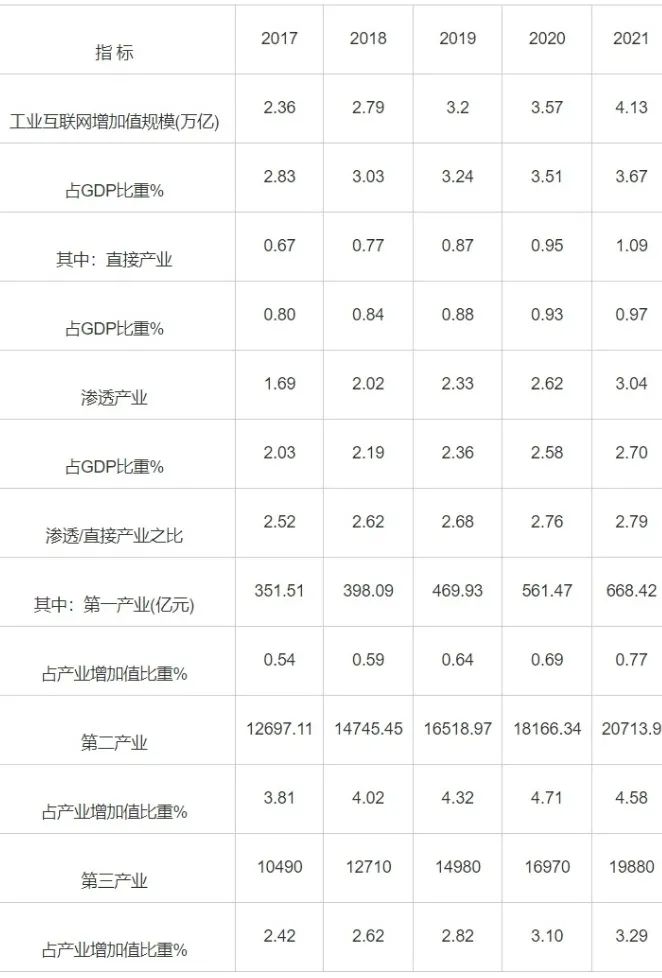
Data Source: China Industrial Internet Research Institute, “China Industrial Internet Industry Economic Development White Paper (2021)”; 2021 data is estimated. Proportions calculated based on “China Statistical Yearbook 2021” data.
2. Deepening Regional Collaboration and Expanding Application Scenarios
Currently, over 30 provinces and cities nationwide have clarified supporting policies for the “Industrial Smart (IoT) Internet,” initially forming a systematic promotion, stepwise development, and complementary advantages of the regional industrial collaborative development pattern. The Yangtze River Delta region is accelerating the construction of the “Integrated Development Demonstration Area for the Industrial Smart Internet,” with Shanghai, Jiangsu, Zhejiang, and Anhui signing the “Strategic Cooperation Agreement for Jointly Promoting the Construction of the Integrated Development Demonstration Area for the Yangtze River Delta Industrial Internet” in 2020. In 2021, the four regions jointly established the “Yangtze River Delta Industrial Internet Identification Integrated Construction Special Class” to promote the integrated construction of the Industrial Smart Internet in the Yangtze River Delta. The Guangdong-Hong Kong-Macau Greater Bay Area combines manufacturing and information communication technology advantages, focusing on “5G + Industrial Internet.” Guangdong has successively introduced policies to open up new development spaces through “network first, benchmarking, classified measures, and promoting construction through use.” The Beijing-Tianjin-Hebei region signed the “Framework Cooperation Agreement for Building a Collaborative Development Demonstration Area for the Industrial Internet,” jointly promoting the construction of the Industrial Smart Internet collaborative development demonstration area. Beijing issued the “Action Plan for Accelerating the Construction of New Infrastructure (2020-2022),” precisely optimizing the innovation and development environment for the Industrial Smart Internet, while Tianjin focuses on cultivating benchmark demonstrations for the Industrial Smart Internet, and Hebei emphasizes creating application scenarios for the Industrial Smart Internet. The Chengdu-Chongqing region fully leverages policy, industry, and resource advantages, signing the “Strategic Cooperation Agreement for the Integrated Development Demonstration Area for the Chengdu-Chongqing Industrial Internet” to support the collaborative advancement of industrial construction in the region.
The Ministry of Industry and Information Technology is guiding and driving nearly 70 billion yuan in total investment through policies such as the “512 Project,” forming a batch of demonstration-driven projects, industrial bases, and big data centers. The four bases in Shanghai, Beijing, Wuhan, and Shenzhen have become important levers for leading industrial Smart Internet industry clusters. The National New Industrialization Demonstration Base in Songjiang District, Shanghai achieved an industrial output value of 447.69 billion yuan in 2020, with over 5,000 enterprises; the “Industrial Internet of Wuhan” National New Industrialization Demonstration Base achieved an industrial output value of 351.2 billion yuan in 2020, covering a complete industrial chain of “optical chips, screens, terminals, networks, clouds, and intelligence,” serving as the national center for digital design and manufacturing innovation, and the largest base for optical communication R&D, optical fiber and cable production, and optoelectronic device manufacturing in China. The National Industrial Internet Big Data Center is laid out according to the “1+N” system, covering about 2.9 billion industrial data points across the Yangtze River Delta, Guangdong-Hong Kong-Macau, Beijing-Tianjin-Hebei, and Chengdu-Chongqing areas, covering about 7.03 million enterprises, with a basic national industrial data center system taking shape. The Industrial Internet Industry Alliance has over 2,000 member units.
The potential for integrated applications of the Industrial Smart Internet in different fields is gradually being released, with the breadth and depth of applications continually expanding, and innovations in application models becoming active, with new models and new business formats emerging across key national economic sectors such as steel, machinery, electricity, transportation, and energy.
1. Platform-based Design and Intelligent Manufacturing. Providing digital functional components, technical means, and software tools for traditional R&D design significantly reduces R&D costs while promoting the development of specialized platforms in the cloud design field, supporting multi-subject collaborative design across enterprises, departments, regions, and disciplines, with excellent cases emerging such as Huawei’s platform-based design and Shanghai Waigaoqiao’s “Supply Chain Collaborative Cloud.” Intelligent manufacturing applications based on integrated and consolidated enterprise on-site data are continuously emerging, with companies like Haier’s Shenyang refrigerator connected factory and COMAC significantly shortening R&D cycles, increasing capacity, and reducing operational costs through intelligent manufacturing applications.
2. Networked Collaboration and Personalized Customization. Promoting the sharing of various information resources among enterprises on the supply chain through data interconnectivity and business integration, enhancing resource sharing, capability trading, and business optimization. The flexibility of design and production and the agility of manufacturing are continuously improved, with a shared manufacturing model of “platform order, process breakdown, multi-factory collaboration” integrating to continually reduce production and transaction costs. Industrial applications such as customer service and logistics tracking are developed based on platforms, enabling enterprises to respond promptly to user needs and provide personalized services, currently widely applied in the garment industry market.
3. Service Extension and Digital Management. Enterprises extend from manufacturing business to high-value-added links at both ends of the value chain, achieving integrated development through “manufacturing + service” and “product + service.” Enterprises break down data chains internally and extract data value to optimize strategic decision-making, operational management, R&D manufacturing, and market services, constructing a new data-driven operational model. Excellent cases include SANY Group’s Root Cloud platform, Midea’s Cloud platform, and Ansteel Group’s “Precision Steel” platform, which significantly reduce production cycles and inventory costs through supply chain management.
(2) Major Issues in China’s Current Industrial Smart Internet Development
1. Insufficient Local Supply Capacity for Key Technologies, Lack of Collaboration Among R&D Innovation Entities
While recognizing achievements, it is also necessary to acknowledge that there are still gaps between China and developed countries in many areas such as the industrial ecosystem foundation, management standardization level, information technology level, cross-industry capabilities, data quality, and modeling capabilities. From 2000 to October 2018, there were nearly 50,000 global patent applications related to the Industrial Internet, with the US accounting for 48%, ranking first globally, while China ranked second with 25%. Among the top 10 global patent applicants, only Huawei ranks eighth among Chinese companies, with IBM holding nearly 7,000 patents, ranking first globally and nearly equal to the sum of the remaining nine companies. In terms of network interconnectivity technology, China leads globally in overall technological innovation, with the number of global patents for fieldbus, industrial Ethernet, and OPC Unified Architecture technologies being 9,500, 5,776, and 763, respectively, with proportions from China being 62%, 58%, and 57%. However, Siemens of Germany ranks first in all three technologies. While the State Grid, Shenyang Automation Research Institute of the Chinese Academy of Sciences, and Northeast University have entered the global top ten, they rank lower. Regarding Time-Sensitive Networking (TSN) technology, there are a total of 536 patents globally, with the US ranking first with 33% and China ranking second with 19%, with Huawei ranking fifth among applicants, while all others are foreign companies. In network identification and resolution technology, China performs well in Object Identifier (OID) and the Unified Item Code (Ecode) for the Internet of Things, but lacks competitiveness in Object Name Resolution Service (ONS) and Handle System technologies, with global proportions of only 14% and 5%, respectively. In the field of industrial cloud technology patents, the US holds 33% of edge computing/fog computing technology, while China holds 31%; for Platform as a Service (PaaS) and multi-tenant technology, China’s patent proportions are 11% and 15%, far less than the US’s 63% and 66%.
High-end industrial software and industrial control systems are almost entirely monopolized by foreign companies, with insufficient local supply capabilities for key technologies such as networks, identification and resolution, cloud computing, and platforms. The collaborative and shared innovation pattern among leading enterprises, upstream and downstream companies, hardware, communication equipment, operations, internet companies, governments, research institutions, and universities has not yet been established, and the competitiveness of the supply chain innovation chain is weak. At the same time, there are deviations in the R&D focus of different innovation entities in China, with rigid boundaries between the industrial end and the R&D end, making the two-way path of market-driven R&D and R&D empowering industry not smooth, hindering the free flow of elements such as technology, talent, systems, and data, and obstructing the flow of products, services, and information data.
2. Some Industries Encounter Bottlenecks in Empowerment Development, and Industry Platforms Face Challenges
According to estimates from the China Industrial Internet Research Institute, the scale of China’s Industrial Smart (IoT) Internet industry is expected to reach 4.13 trillion yuan in 2021, but in some industries, the proportion of related industry scale has declined. The empowerment proportion for the manufacturing industry decreased from 5.59% in 2020 to 5.35%, for the wholesale and retail industry from 2.71% to 2.61%, and for transportation, warehousing, and postal services from 3.34% to 3.12%, indicating that the empowerment development has encountered bottlenecks.
Taking the automotive manufacturing industry as an example, most industrial platforms are constructed by vehicle manufacturers, which account for less than 1% of the industry, failing to effectively meet the numerous differentiated demands of the automotive industry’s complex subdivisions. The overwhelming majority of parts manufacturers and distributors are in a “low, scattered, and weak” stage, and the development of specialized platforms for components is relatively lagging. Open, comprehensive, and co-creative approaches are fundamental requirements for the Industrial Smart Internet to create value, while closed, differentiated, and self-protective characteristics are inherent to the industrial sector. This contradiction is particularly severe for mature industries with numerous subdivisions and replicable experiences, where manufacturers rationally and objectively protect core technologies, knowledge, and experience to ensure their sustainable competitive advantages, especially in an environment where intellectual property protection and business cooperation models have not yet been clarified, leading to significant challenges in platform promotion. Different enterprises of varying sizes and fields have strong personalized demands for platform applications, but the unclear costs of project implementation and benefits of project landing have also led to stagnation in the development of the Industrial Smart Internet platform.
3. Low Standardization Level of Industry-Related Positions, Incomplete Talent Training System
The development of the Industrial Smart Internet requires not only compound talents in OT, IT, and CT, but also enterprise management talents, industry leaders, professional technical talents, and industrial workers across multiple dimensions and levels. It requires both academically talented individuals with outstanding innovative capabilities and application-oriented talents who can solve problems in the workplace. Currently, there are issues on both the demand and supply sides of talent for the Industrial Smart Internet in China. On the demand side, enterprises have a large demand for talent, but the standardization level of job titles, responsibilities, and capabilities is low, with significant differences in job capability descriptions among different enterprises, which is not conducive to higher education institutions formulating training programs. Meanwhile, on the supply side, the talent training system is not yet well-established and faces many difficulties. Some universities are actively exploring talent training for the Industrial Smart Internet, but due to a lack of courses, textbooks, qualified teachers, and specialized training environments, the teaching process faces significant challenges. The integration of industry and education in talent cultivation is insufficient, and a collaborative talent training model deeply integrating industry and education has not yet formed. The proportion of related specialized programs is low, with high flexibility in professional adjustments but insufficient foundational capabilities. Continuing education is actively exploring talent training for the Industrial Smart Internet industry, but the systematization is still lacking. Overall, there is a lack of high-quality talent, and the matching degree between talent supply and demand is low.
4. Urgent Need to Improve Multi-Dimensional Security Assurance Systems, Severe Risks to Industrial Security
Due to the unique nature of the Industrial Smart Internet’s penetration into various industries of the national economy, its industrial security assurance issues are extremely important. Currently, China’s multi-layered security assurance systems covering Industrial Smart Internet devices, hosts, CNC equipment, robots, IoT devices, internet networks, identification and resolution systems, 5G networks, industrial applications, and industrial data have not yet been fully established. The large number of industrial hosts and relatively outdated operating systems pose insufficient security protections; high-end industrial control systems are predominantly foreign brands, which carry risks of remote maintenance backdoors and difficulties in timely upgrades, with the number of vulnerabilities in industrial control systems reaching a new high in 2020. The internal security of Industrial Smart Internet platforms is insufficient, and most platforms have not formed systematic security protection mechanisms according to standards, merely adding some security protection devices; there are security risks in various aspects of industrial data, including collection, storage, communication, and access control.
As the global Industrial Smart Internet industry develops, the methods of cyber attacks are becoming increasingly diverse, including polluting software development, testing, deployment, and maintenance environments or tools, pre-installing malicious software on devices, infecting legitimate applications, and stealing legitimate certificate signatures for malicious software. Chinese security companies have insufficient product accumulation and service experience in industrial information security and Industrial Smart Internet security, still in the stage of tackling challenges. Many enterprises have weak awareness of responding to cyber attacks, incomplete security management systems, inadequate security detection and evaluation mechanisms, and insufficient guidance on the cybersecurity of industrial enterprises.
4
Countermeasures and Suggestions
In response to the current issues in the development of the Industrial Smart Internet in China regarding technological supply, collaborative innovation, industrial empowerment, talent supply and demand systems, and security assurance systems, the following countermeasures and suggestions are proposed to fully leverage the Industrial Smart Internet’s role in constructing and empowering the modern industrial system.
(1) Improve the New National System for Tackling Technological Challenges and Break Down Barriers to Collaborative Innovation
Establish a new national system for tackling key technological challenges, leveraging effective market vitality, strengthening the position of enterprises as main bodies of technological innovation, efficiently allocating scientific and technological forces and innovation resources, and enhancing cross-field and cross-disciplinary collaborative tackling. Support industrial organizations, industry alliances, and professional institutions to compile and publish field-specific intellectual property layout guidelines, guiding leading enterprises to implement intellectual property management standards and enhance their awareness and capabilities regarding intellectual property strategies. Leverage policy guidance to promote the integration of industry, academia, and research, establishing and improving collaborative promotion mechanisms among governments, enterprises, industry organizations, industry alliances, and think tanks, further strengthening coordination between industrial enterprises and digital enterprises in technology tackling and standard formulation. Maintain a “synchronized resonance” of R&D tackling, product application, and industrial cultivation, creating a favorable innovation ecosystem for the Industrial Smart Internet, breaking down resource circulation barriers among different innovation entities, and promoting high-quality development of the Industrial Smart Internet innovation chain.
(2) Leverage the Advantages of Application-Scale Data Scenarios to Unleash Industrial Development Potential
Based on China’s super-large-scale, multi-level, and diversified domestic demand market, leverage the advantages of China’s diverse industrial categories, large industrial scale, extensive application scenarios, and complete data types to eliminate bottlenecks and obstacles in the industrial networked industry, promoting smooth connectivity among various links, industries, and regions. Further drive the internal network transformation and upgrade of industrial enterprises, advancing IP-based, flat, and flexible technological transformations and construction deployments, breaking down information silos and data barriers, laying a solid foundation for broader interconnectivity. Accelerate the construction of external networks for industrial enterprises, promote the improvement of broadband network infrastructure and upgrades, expand network coverage, and optimize and upgrade the national backbone network to ensure ubiquitous interconnectivity and smooth data flow across all links of the industrial chain. Reduce the information network service costs for small and medium-sized enterprises and support the integrated development of large, medium, and small enterprises. Accelerate the exploration and application of new network technologies such as 5G, MEC, and TSN, introducing more network solutions closely aligned with the transformation and upgrading needs of manufacturing enterprises. At the same time, advance the construction of a new development pattern that promotes domestic and international mutual reinforcement at high standards, driving a high-value, high-level, and systematic supply-demand cycle, and constructing a complete, safe, and reliable Industrial Smart Internet supply chain system.
(3) Build a Complete Professional Talent Supply and Demand System and Strengthen Talent Team Building
Establish a knowledge property expert consultation system, set up an intellectual property expert committee and expert database, and select and cultivate a batch of leading talents in manufacturing industry intellectual property. Encourage and support relevant higher education institutions to strengthen the cultivation of application-oriented talents in manufacturing intellectual property, promoting the establishment of training bases for in-service talents in manufacturing intellectual property. Conduct training on intellectual property strategies and skills targeting leading enterprises in the industry. Build a national-level talent data platform for the Industrial Smart Internet, aggregating data on infrastructure investments, job recruitment, and graduates from relevant majors in various regions, supporting the construction of the industrial talent supply and demand system. Establish a vocational and job research system, regularly conducting surveys targeting various enterprises in the Industrial Smart Internet field. Carry out talent certification work for the Industrial Smart Internet, establishing a certification system for typical positions, including certification courses, certification examinations, and certification authorization points. Collaborate with research institutes, enterprises, universities, social organizations, and suppliers to build a national talent cultivation ecosystem for the Industrial Smart Internet, complementing each other’s advantages, dividing labor, and cooperating to jointly construct a complete talent supply and demand system for the Industrial Smart Internet, improving the quality and efficiency of talent cultivation.
(4) Construct a High-Standard Industrial Chain Security System to Ensure Comprehensive Industrial Safety
Focus on industries with strong foundations and urgent security needs, carrying out pilot demonstrations and promoting the application of security technologies, products, and solutions. Construct a security assessment and certification system for Industrial Smart Internet devices, networks, and platforms, relying on third-party organizations to conduct evaluations and tests of security protection capabilities. Establish a data security management system for the entire industrial chain of the Industrial Smart Internet, clarifying the responsibilities and specific requirements for data security protection for related subjects, and enhancing security protection capabilities in data collection, storage, processing, transfer, and deletion. Establish a classified management system for industrial data, forming a data flow management mechanism for the Industrial Smart Internet, clarifying requirements for data retention and data breach notifications, enhancing the implementation of network security responsibilities for related enterprises, guiding enterprises to increase security investments, strengthen security protection and monitoring measures, and carry out pilot demonstrations for Industrial Smart Internet security to enhance security protection capabilities. Fully leverage the role of national research institutions and social forces to enhance the national-level technical support capacity for Industrial Smart Internet security, focusing on improving hidden danger investigation, attack detection, emergency response, and attack tracing capabilities.
Notes
① Xi Jinping: “Upholding the Great Banner of Socialism with Chinese Characteristics to Unite and Strive for the Comprehensive Construction of a Socialist Modern Country—Report at the 20th National Congress of the Communist Party of China,” Beijing: People’s Publishing House, 2022, p. 30.
[1] Yang Shuai: “Industry 4.0 and the Industrial Internet: Comparison, Insights, and Response Strategies,” Contemporary Finance, 2015, Issue 8.
[2] Wang Feiyue, Zhang Jun, Zhang Jun, Wang Xiaoy: “Industrial Smart Internet: Basic Concepts, Key Technologies, and Core Applications,” Acta Automatica Sinica, 2018, Issue 9.
[3] Xinhua News Agency: “Xi Jinping Listens to Reports from the Shaanxi Provincial Party Committee and Provincial Government,” https://www.gov.cn/yaowen/liebiao/202305/content_6874465.htm.
[4] Guo Zhaoxian, Fang Ao: “The Generative Logic and Priority Strategies of New Infrastructure Empowering High-Quality Development of the Real Economy,” Journal of Xinjiang Normal University (Philosophy and Social Sciences Edition), 2023, Issue 6.
[5] Li Li, Lin Yilun, Zheng Nanning & Wang Fei-Yue, “Parallel Learning: A Perspective and a Framework,” IEEE/CAA Journal of Automatica Sinica, 4(2017): 389—395.
[6] Wang Fei-Yue, Zhang Jun Jason & Wang Xiao, “Parallel Intelligence: Toward Lifelong and Eternal Developmental AI and Learning in Cyber-Physical-Social Spaces,” Frontiers of Computer Science, 12(2018).
[7] China Academy of Information and Communications Technology, Industrial Internet Industry Alliance: “Industrial Intelligence White Paper (2022),” 2022.
[8] Li Xiaomei: “The Evolution and Insights of Industrial Internet Policies in Major Developed Countries,” Regional Economic Review, 2022, Issue 4.
[9] China Academy of Information and Communications Technology, Industrial Internet Industry Alliance: “Industrial Intelligence White Paper (2022),” 2022.
[10] Industrial Internet Industry Alliance: “China Industrial Internet Security Situation Report (2019),” 2020.
[11] Zhang Ni, Liu Lianru, Tian Zhihong et al.: “Progress and Trends in Industrial Internet Security,” Journal of Guangzhou University (Natural Science Edition), 2019, Issue 3.
[12] At the overall level, there are guiding opinions on deepening the “Internet + Advanced Manufacturing” to develop the Industrial Internet, the “Industrial Internet Development Action Plan (2018-2020),” and the “Industrial Internet Innovation Development Action Plan (2021-2023).” In terms of technology, there are guidelines for the construction and promotion of the Industrial Internet network, the “5G + Industrial Internet” 512 project promotion plan, the Industrial Internet identification management measures, the Industrial Internet platform construction and promotion guidelines, and the Industrial Internet APP cultivation project implementation plan (2018-2020). In terms of standards, there is the “Guidelines for the Construction of a Comprehensive Standardization System for the Industrial Internet.” In terms of security, there are guiding opinions on strengthening industrial Internet security work and the “Industrial Internet + Safety Production” action plan (2021-2023).
[13] China Industrial Internet Research Institute: “Report on the Effectiveness of Industrial Internet Innovation Development (2018-2021),” 2021.
[14] Sina Finance: “The National Top-Level Node Identification Resolution Volume Exceeds 138.1 Billion, How Does the Industrial Internet Advance?” https://baijiahao.baidu.com/s?id=1735201585531634439&wfr=spider&for=pc.
[15] China Industrial Technology Software Industry Alliance, Industrial Internet Industry Alliance: “Industrial APP White Paper (2020),” 2020.
[16] “China’s First Industrial Internet Network International Standard Completed by Leading the Way,” Intelligent Manufacturing, 2021, Issue 2.
[17] “The World’s First International Standard for the Functional Architecture of Industrial Internet Systems Passed Voting,” Mould Industry, 2022, Issue 6.
[18] Li Yangchun, Wang Hailong, Li Yuxiao, Chen Lei, Li Youping: “Research on the Layout of Industrial Internet Security Industry Abroad and Its Enlightenment,” China Engineering Science, 2021, Issue 2.
[19] The China Industrial Internet Research Institute divides the industrial Internet into direct and penetrating industries, where the direct industry includes networks, platforms, and security, while the penetrating industry refers to the new industrial ecology and industry applications created by the Industrial Internet from multiple dimensions.
[20] Industrial Internet Industry Alliance: “Analysis of Key Technology Patent Trends in the Industrial Internet,” 2019.
[21] Shao Mingkun, Lei Xiaobin, Ma Dongyan, Quan Huyang: “The Application Status, Restrictive Factors, and Countermeasure Suggestions of Industrial Internet Platforms in China’s Automotive Industry,” Science and Technology and Industry, 2021, Issue 10.
Guo Zhaoxian
Researcher, Industrial Economy Research Institute, Chinese Academy of Social Sciences, Director of the Industrial Organization Research Room
Reply to Guo Zhaoxian in the public account to view detailed information

Fang Ao
PhD student at the Chinese Academy of Social Sciences University, School of Applied Economics.
Guo Zhaoxian, Fang Ao. From Industrial Internet to Industrial Smart Internet: Global Development Trends and China’s Strategies. Shanxi University Journal (Social Science Edition), 2023, 50(05): 76-87.