
Source: EETOP Blog Author: mervin_li
Link: https://blog.eetop.cn/1582944
As we all know, chip projects are complex system engineering tasks, where each link can significantly impact the final delivery.
From experience, good project management includes important aspects such as resource allocation, risk assessment, process control, and delivery acceptance. How can these points be achieved independently yet cohesively?
The establishment and continuous follow-up of process management and acceptance standards, such as checklists and action items, can create a simple and efficient standardized process. Institutionalizing and standardizing processes can greatly reduce human errors.
Typically, there will be a signoff standard before delivery to ensure that each check meets the criteria. This mainly includes but is not limited to timing clean; DRC clean, LVS pass. Of course, under each major signoff requirement, there will be numerous detailed checks, case by case, so it is necessary to start discussions, planning, and finalizing this series of standards early on.
For example, timing clean not only includes setup and hold clean but also includes drv (max trans, load, min period, min pulse width, etc.) clean, data check, max delay, clock cell VT types, special path skew, and other special checks.
DRC and LVS are similar; many large chips also need to pass ERC and PERC checks strictly. Of course, power consumption, IR, CLP, formal/LEC, etc. All these require a systematic table to track time, date, status, responsible parties, etc. This is the standard check for acceptance.
Therefore, on the eve of acceptance, in order to avoid inefficiencies and rework during acceptance, we need to prepare the checklist review in advance. The formulation of checklist items is very crucial. It can be updated regularly in the later stages of the project to maintain consistency in data and timing.
So, in order to better assist delivery acceptance, what contents do our checklists typically include?
In summary, there are three main parts:1. Pre-acceptance of signoff standards;2. Checks for special checks;3. Confirmation of document dates and versions.
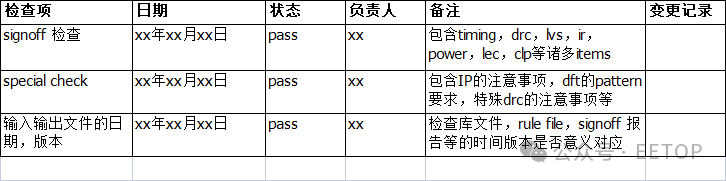
Large projects have many modules, and each owner needs to strictly ensure that their part is under control of risks. Therefore, it is necessary to continuously control processes and provide risk warnings. Thus, this checklist should not only be used for comparison before delivery but can also be continuously updated and followed up during the mid-project to avoid human negligence causing project delays.
At the beginning of the project, it is necessary to plan the schedule and manage project resources, which can also be independently made into a table.During the project, create an action item list to align progress and warn of risks.In the later stages of the project, check the checklist to ensure documents are correct.At the end of the project, check each signoff item to ensure a smooth delivery acceptance.
Practice makes perfect, let’s encourage each other.