
Reference Information


Background Introduction

With the increasing demand for environmental pollution control and industrial safety, the development of efficient, stable, and low-cost gas sensors has become an urgent issue. Traditional metal oxide semiconductor (MOS) sensors are low-cost but suffer from poor selectivity, high operating temperatures, and instability; while electrochemical sensors offer high selectivity and low power consumption, they rely on expensive noble metal catalysts (such as Pt/C) and lack long-term stability. Therefore, there is an urgent need to develop gas sensing materials that do not require noble metals, exhibit excellent performance, and stability for the efficient detection of important pollutants such as nitrogen dioxide (NO₂).

Material Characterization

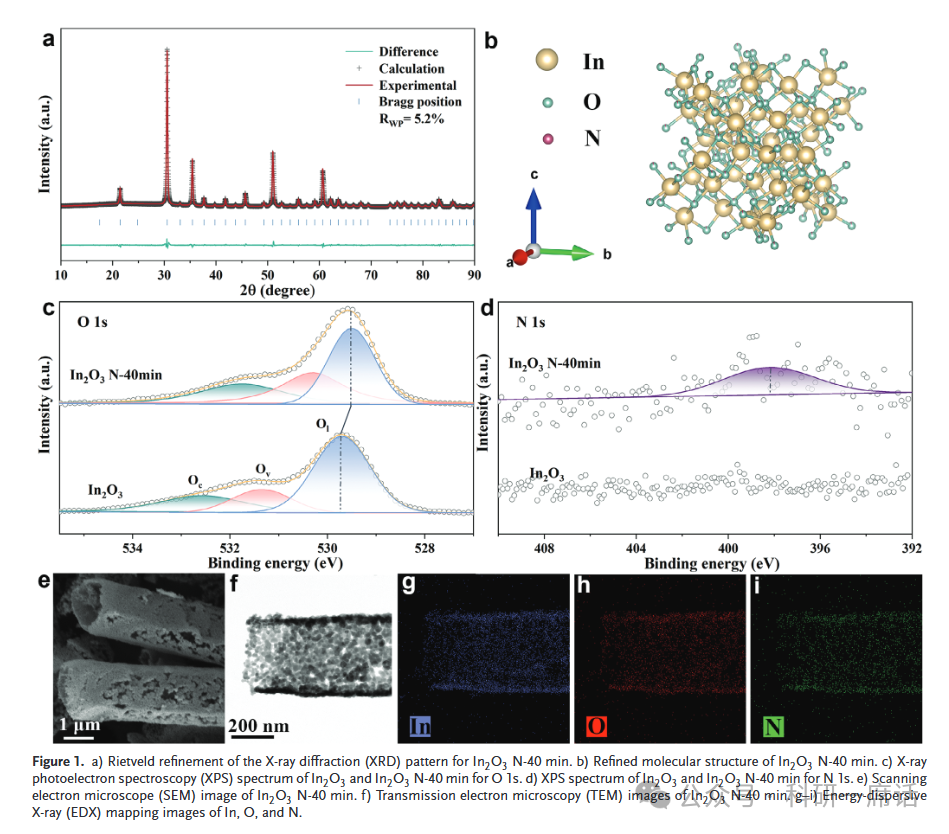
Figure 1 systematically characterizes the structure and composition of nitrogen-doped indium oxide (In₂O₃N-40min) through XRD refinement, XPS spectroscopy, SEM/TEM imaging, and EDS elemental distribution: XRD refinement confirms that the material retains the cubic In₂O₃ crystal structure, with a slight reduction in lattice parameters; the O 1s peak shifts to lower binding energy by 0.22 eV, and a weak N 1s signal appears, confirming nitrogen incorporation into the lattice and an increase in oxygen vacancies; SEM/TEM shows that the material consists of hollow nanorods with a diameter of approximately 1.3 µm and porous walls, with a BET specific surface area of 39 m² g⁻¹; EDS mapping indicates a uniform distribution of In, O, and N, collectively demonstrating the successful construction of a nitrogen-doped structure rich in defects and high specific surface area after 40 minutes of nitriding.

Performance Testing

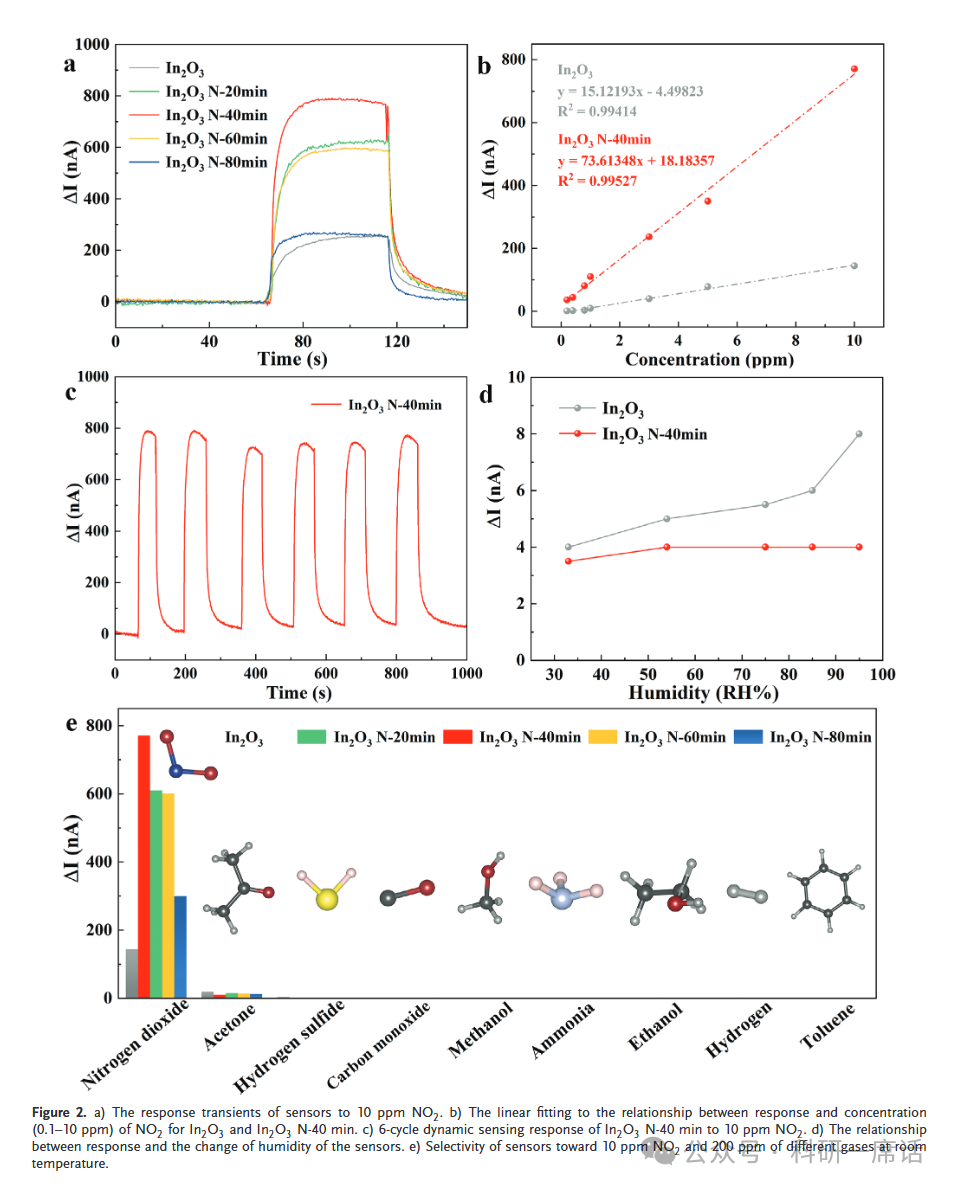
Figure 2 evaluates the gas-sensitive performance of the nitrogen-doped indium oxide sensor at room temperature for NO₂: the In₂O₃N-40 min device exhibits the highest response current of 771 nA for 10 ppm NO₂, with a sensitivity of 73.61 nA ppm⁻¹, a linear range of 100 ppb–10 ppm, and excellent reproducibility over six cycles; the signal remains almost unchanged under humidity levels of 33–95% RH, demonstrating strong humidity resistance; the response to 10 ppm NO₂ is significantly higher than that for 200 ppm of acetone, H₂S, CO, methanol, NH₃, ethanol, H₂, and toluene, indicating outstanding selectivity.
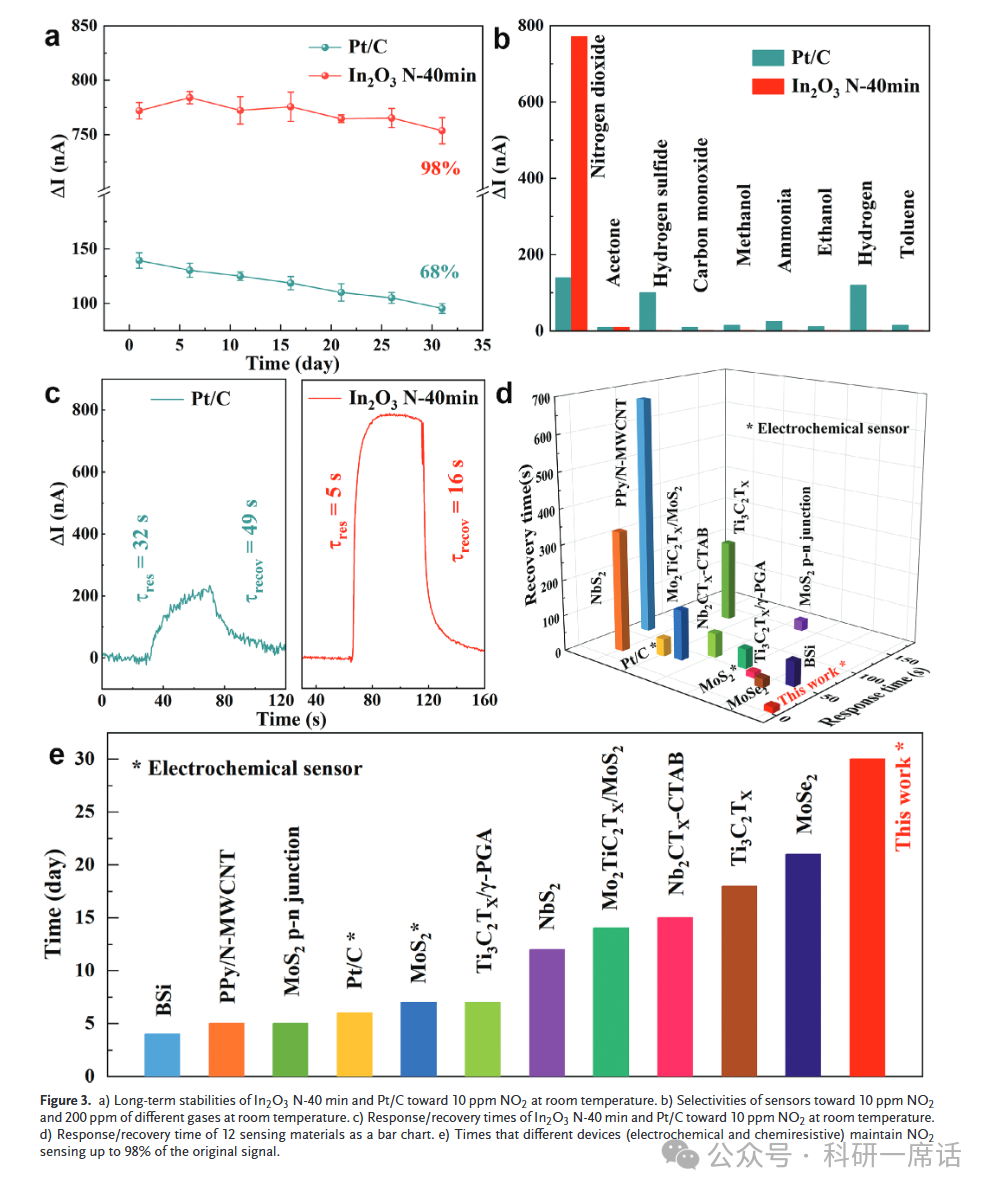
Figure 3 compares the overall performance of In₂O₃N-40 min with Pt/C sensors: during 30 days of continuous testing, In₂O₃N-40 min maintains 98% of its initial response, while Pt/C only retains 68%; the response/recovery times for 10 ppm NO₂ at room temperature are 5 s/16 s, which is 84% and 67% shorter than Pt/C, respectively; the selectivity bar chart shows that In₂O₃N-40 min’s response to NO₂ far exceeds that of other interfering gases; considering comprehensive stability, speed, selectivity, and cost (only 1% of Pt/C), nitrogen-doped indium oxide significantly outperforms traditional noble metal catalysts.

Sensing Mechanism

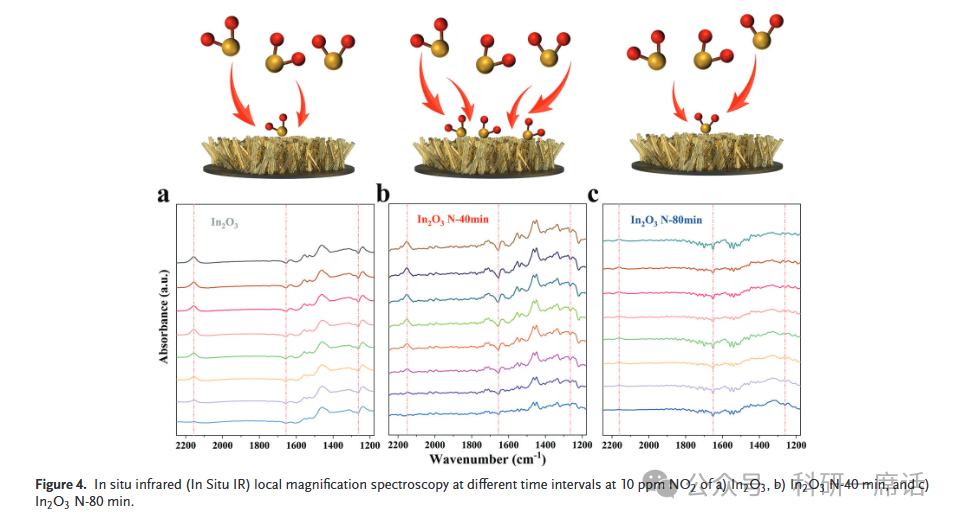
Figure 4 presents in situ infrared (IR) results, revealing the reaction pathway of NO₂ on the material surface: in a 10 ppm NO₂ atmosphere, the In₂O₃N-40 min surface shows absorption bands at 2152, 1650, and 1220 cm⁻¹ over time, corresponding to the formation of NO adsorption states and nitrite (NO₂⁻), with peak intensities significantly higher than those of In₂O₃ and In₂O₃N-80 min; the quantity of nitrite reaches its maximum in the 40 min nitrided sample, confirming that moderate nitrogen doping can introduce an appropriate amount of hydroxyl groups and promote the continuous reduction of NO₂→NO₂⁻→NO, thereby providing the sensor with the highest response.

Conclusion

This study developed a nitrogen-doped indium oxide In₂O₃₋ₓN₂ₓ/₃Vx/₃ (x = 0.1) with a hollow porous nanorod structure rich in oxygen vacancies through a simple nitriding strategy, achieving room temperature electrochemical detection of NO₂ without noble metals. The optimal In₂O₃N-40 min sensor exhibits a response of up to 771 nA for 10 ppm NO₂, with response/recovery times of only 5 s/16 s, maintaining 98% stability over 30 days, and demonstrating excellent humidity and interference resistance, with performance and cost far superior to traditional Pt/C. Experimental-theoretical combined evidence confirms that nitrogen doping enhances NO₂ adsorption and charge transfer, promoting the surface reaction of NO₂→NO₂⁻→NO. This work provides scalable new materials and mechanistic insights for the development of low-cost, efficient, and stable electrochemical gas sensors.