When you’re streaming videos smoothly in the living room, but your phone’s Wi-Fi signal drops to one bar as soon as you enter the bedroom, don’t blame the router. The issue lies in your understanding of the “struggles” of Wi-Fi signals. Today, let’s discuss this modern household “pain point” that you might not be aware of.
1
What is Wi-Fi Signal?
The Wi-Fi signal emitted by the router is essentially an electromagnetic wave, akin to mobile signals, visible light, and microwaves.One core characteristic of electromagnetic waves is that they primarily propagate in a straight line within the same medium (like air). They do not actively navigate around obstacles like water or a cat.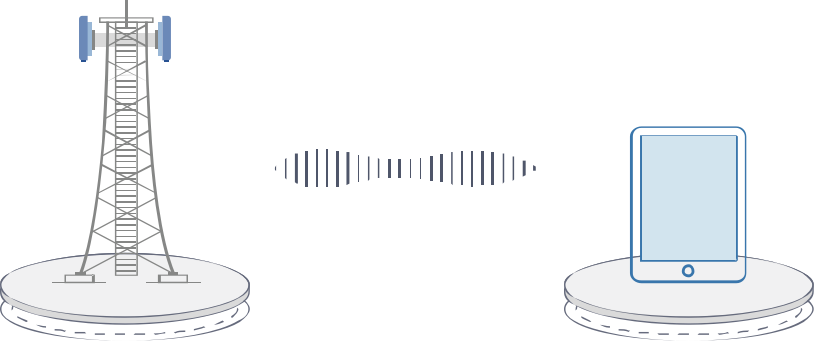
2
2.4GHz or 5GHz?
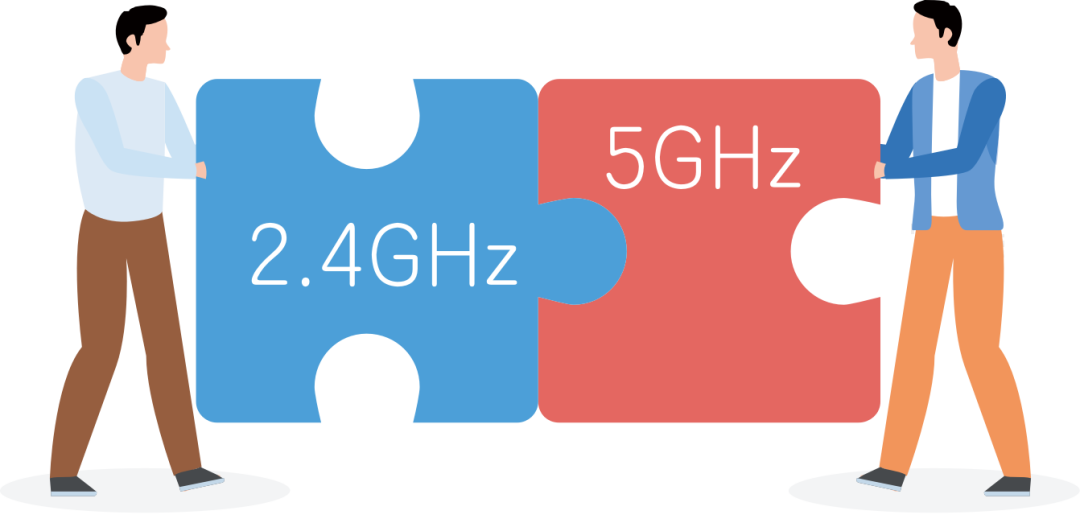
Wi-Fi primarily operates on two frequency bands: 2.4GHz and 5GHz.
Is it true that the higher the frequency, the better the wall penetration? This is a common misconception! In fact, the opposite is true:
The higher the frequency, the shorter the wavelength, leading to greater energy attenuation (loss) when penetrating obstacles, thus reducing the “wall penetration capability”.
-
2.4GHz: Think of it as throwing a large stone into water, creating long-wavelength, low-frequency ripples. These ripples have larger fluctuations, travel further, and are more capable of bypassing obstacles.
-
5GHz: This is like throwing a small stone into water, producing shorter-wavelength, high-frequency ripples. These ripples are denser, can carry more information (faster speeds), but experience rapid energy attenuation, resulting in shorter transmission distances and poorer ability to bypass obstacles. Therefore, the signal strength may “plummet” after passing through a wall.
So, when you are far from the router or behind a wall, your phone is likely connected to the 2.4GHz band.
3
Who are the Real Signal Killers?
“Walls” are the true signal killers! Wi-Fi signals do not “pass through” walls like a ghost; they hit a sound-absorbing barrier.
Wall Material
The material of the wall is crucial, as different materials have varying impacts on signals.
-
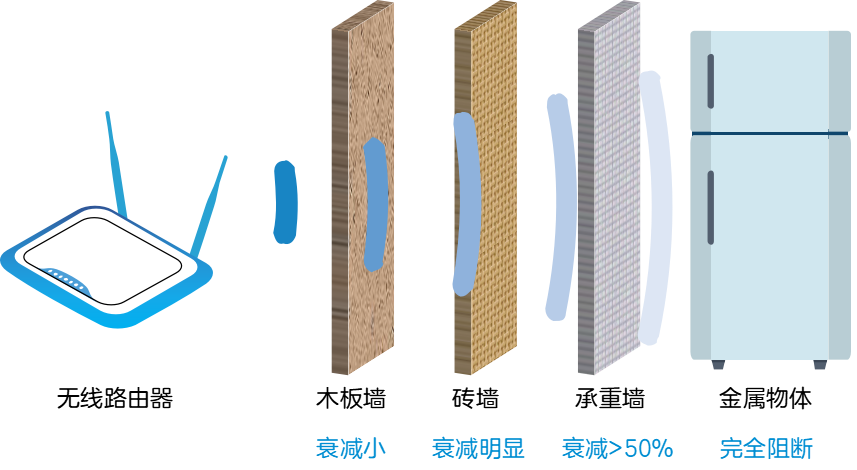
Load-bearing walls (concrete + steel): These are the ultimate “Wi-Fi killers”. The internal steel mesh reflects signals like a mirror, while concrete absorbs a significant amount of signal energy, causing signal attenuation of over 50%!
-
Metal objects: Such as refrigerators and metal cabinets, can almost completely block signals.
-
Regular brick walls and wooden walls: These have relatively minor effects but can still cause noticeable attenuation.
Wall Thickness
The thicker the wall, the harder it is for the signal to “break through”.
Thus, even though the living room where the router is placed is only separated from the bedroom by one wall, that wall can be as formidable as a small mountain for weak Wi-Fi signals.
4
How Does Wi-Fi Signal “Curve to Save the Day”?
Since straight-line propagation is blocked by walls, how can we still access the internet in most rooms? This is because Wi-Fi signals have their own set of “fancy maneuvers” when encountering obstacles.Imagine a calm pool of water; when we throw a stone into the center, concentric ripples expand outward.
Reflection
When the ripples encounter a solid, straight dam that is much larger than the wavelength, they do not “climb” the dam but instead “turn back”, reflecting along the incoming direction and forming a new ripple that propagates towards the center. This is similar to how waves behave at the boundary of different media, where energy cannot pass through, and most is reflected back.
Diffraction
When ripples meet an obstacle but there is a narrow gap (with a width close to or smaller than the wavelength), although most of the ripples are blocked, the portion that passes through the gap will regenerate into concentric semicircular ripples, continuing to propagate into the water behind the gap, as if the gap has become a new “source of vibration”. This is one of the unique properties of waves. When waves encounter the edge of an obstacle or a small hole, they change direction and continue to propagate behind the obstacle. The smaller the gap, the more pronounced the diffraction effect, resulting in more perfect semicircular ripples.When ripples encounter an obstacle resembling a “small island” (like a wooden stake in the water), the ripples will calmly “go around” this thin stake, and behind the stake, the ripples continue to propagate almost unaffected, as if the stake does not exist. The smaller the obstacle, the easier it is for the wave to diffract and “ignore” it.The signal you receive has made its way to your phone through these “twists and turns”, naturally resulting in a significant reduction in strength. Moreover, those “dead corners” in buildings, like bathrooms and storage rooms, make it even harder for signals to reach due to the complex paths.