The architecture of vehicle networking SoC chips is undergoing a transition from distributed ECUs to centralized CCU + ZCU. The traditional architecture, due to its dispersed computing power and low collaboration efficiency, struggles to meet the demands of intelligent connected vehicles. In contrast, the central computing architecture provides a technical foundation for advanced ADAS and intelligent cockpits through centralized computing power, harness optimization, and vehicle-cloud collaboration. This transformation has already formed a clear path in the technological layouts of companies like Xiaomi and Huawei.
Vehicle Networking SoCTransition from Distributed to CentralizedCONTENT
The current vehicle networking SoC chip architecture is rapidly transitioning from distributed ECUs to a centralized “Central Computing + Zone Control” (CCU + ZCU) architecture, a trend particularly evident in the technological layouts of companies like Xiaomi, GAC, and Huawei.
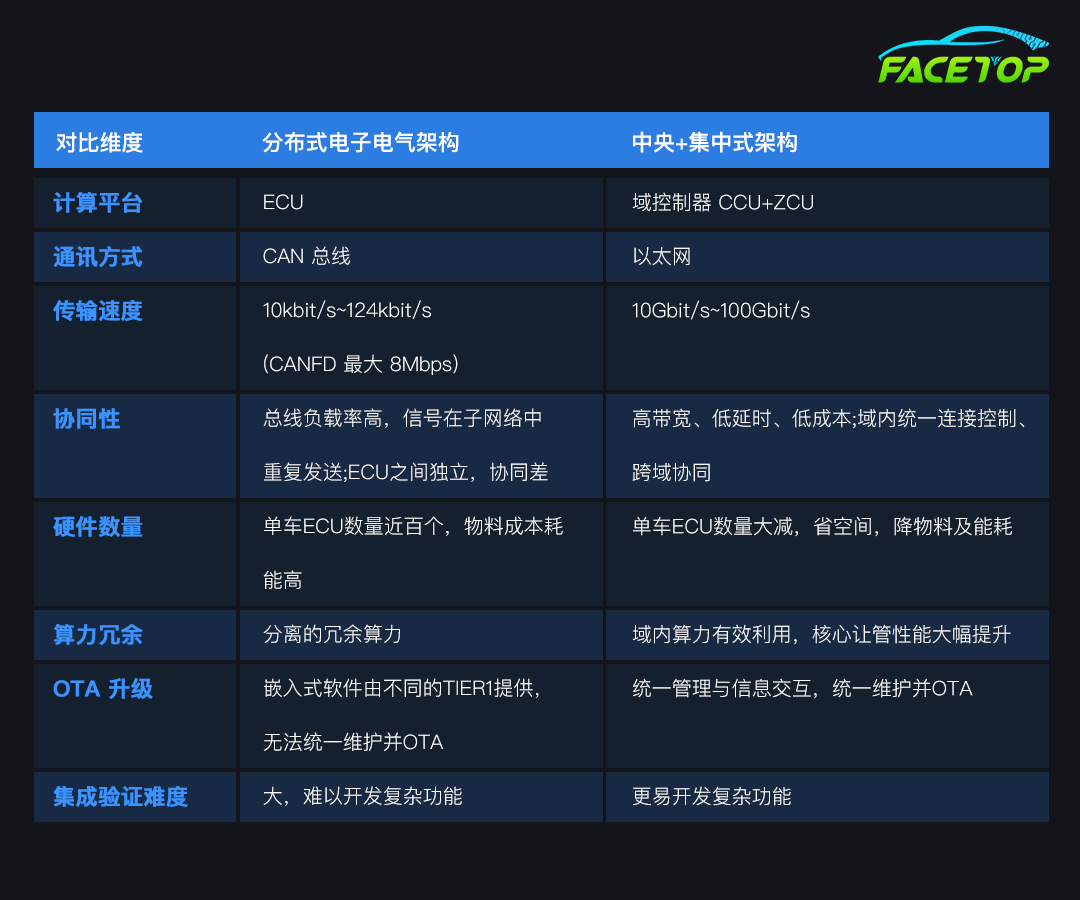
Traditional distributed ECU development is simple, with functional isolation and a relatively mature supply chain. However, it also involves many devices, poor collaboration between ECUs, non-shared hardware, and requires heavy wiring, leading to dispersed computing power.
The new central domain control architecture adopts a CCU + ZCU control model, merging the functions of dispersed ECUs into the ZCU. This architecture can coordinate the allocation of computing power among various subcomponents, allowing for independent software development, compatibility with manufacturer self-developed algorithms, reduced wiring, and significantly lower latency. It also supports more ADAS and intelligent cockpit requirements, greatly enhancing computing power compared to traditional ECU methods.
The vehicle networking SoC architecture is undergoing three development stages: from distributed ECUs to the current domain-centralized architecture, and finally to the central computing architecture. The central computing architecture further concentrates computing power, with the vehicle responsible for collecting internal information and real-time data processing, while the cloud serves as a supplement, providing non-real-time data interaction.
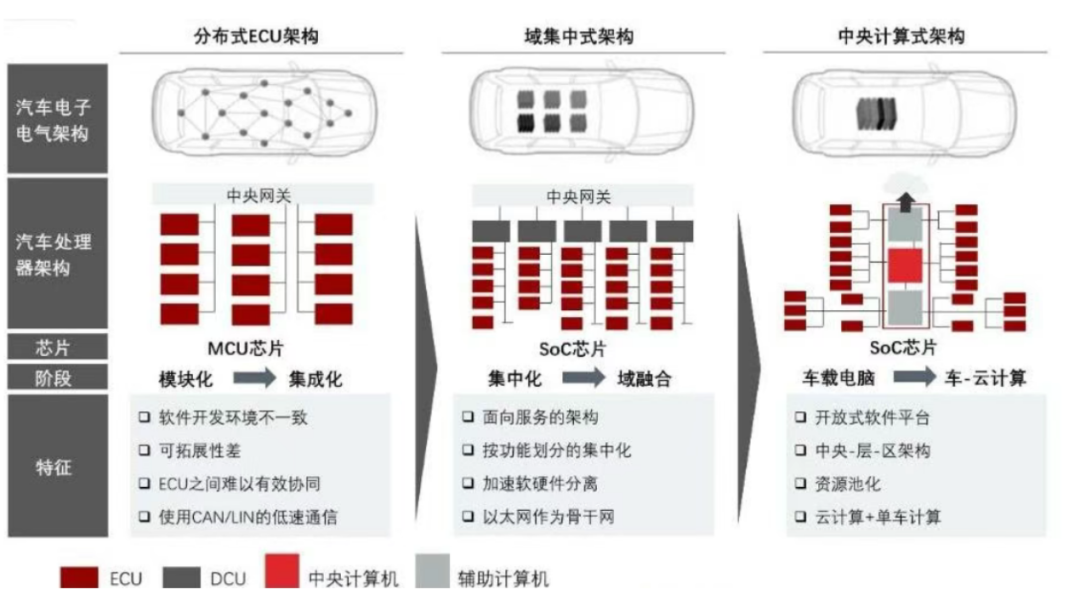
Traditional Distributed Electronic and Electrical Architecture vs. Central Domain Centralized Computing Architecture
 CCU + ZCUCore Logic of the ArchitectureCONTENT
Functions and Roles of CCU and ZCU
The Central Computing Unit (CCU) acts as the “brain” of the vehicle, handling advanced tasks such as intelligent driving, intelligent cockpit, and vehicle networking, typically powered by high-performance SoCs (e.g., Qualcomm 8295, NVIDIA Thor);
*Its core functions include three aspects:
-
Serving as the communication interface between the vehicle and the outside world
Such as 4G/5G cellular communication, vehicle internet access, corresponding data uploads and downloads; GPS/Beidou satellite positioning; V2X communication, including future vehicle-to-vehicle (V2V), vehicle-to-infrastructure (V2I), vehicle-to-pedestrian (V2P), and vehicle-to-network (V2N) communications.
-
Intelligent Gateway
The CCU, as the central domain controller, connects various internal area controllers, acting as a router to forward and translate data between different networks, ensuring smooth information flow between domains. The CCU also provides network security firewall functions, serving as the first line of defense for network security by verifying the legality of external commands and protecting critical control systems within the vehicle, such as brakes, throttle, and steering.
-
Other Advanced Functions
Such as OTA upgrades, remote monitoring and control, emergency call eCall/bCall, fleet management for commercial or rental vehicles, collecting big data from vehicles, and intelligent traffic scheduling.
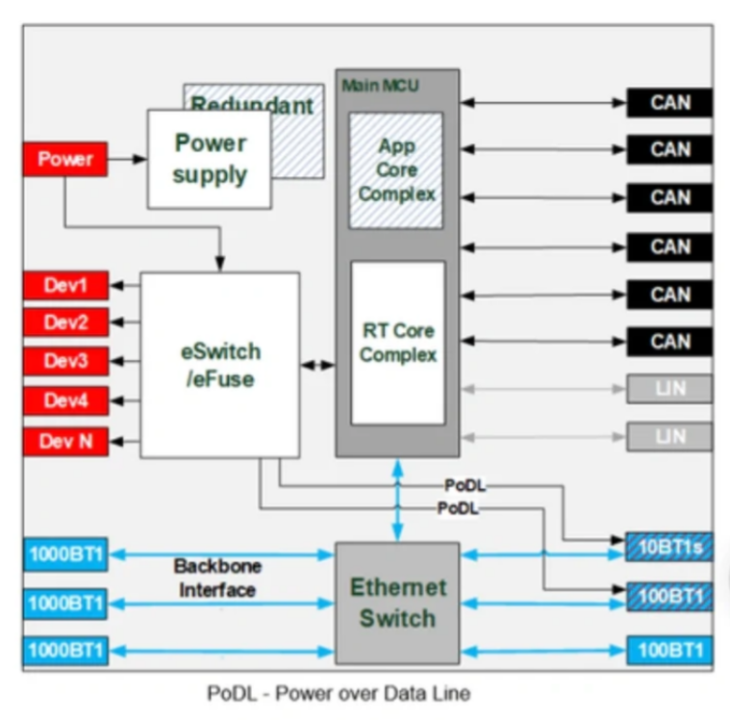
The Zone Controller (ZCU) acts as the “nerve center,” integrating multiple traditional ECU functions (such as body control, lighting management) to achieve real-time control and data preprocessing within the zone, relying on high-performance automotive-grade MCUs (e.g., Infineon TC4x, Chipone E3650).
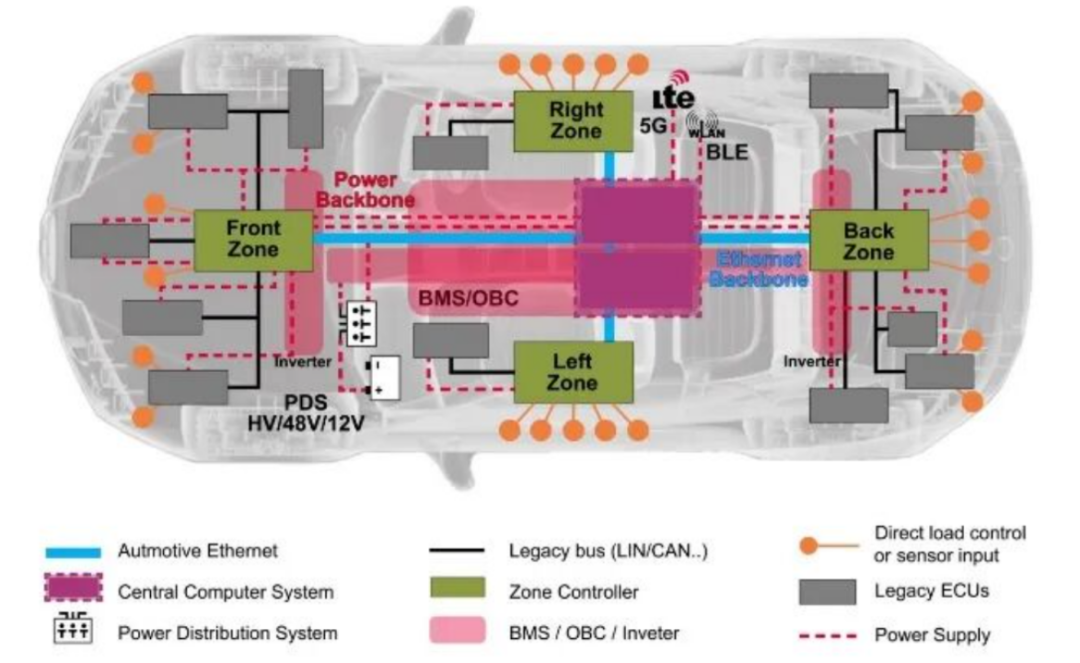
The ZCU primarily serves as a gateway, switch, and intelligent junction box, distributing power and data. In addition to performing traditional ECU functions, future ZCUs will provide greater computing power, aiming to reduce the number of regional ECUs as much as possible.
As shown in the figure, four ZCUs are used in the front, rear, left, and right, applied in various fields such as intelligent driving, intelligent cockpit, and body control.
In the field of intelligent driving, the ZCU achieves real-time monitoring and recognition of the vehicle’s surrounding environment through sensors such as radar and cameras; in the intelligent cockpit field, the ZCU connects with in-car entertainment and air conditioning devices to provide convenience and comfort; in the body control field, the ZCU controls doors, windows, and lights to ensure safety and convenience.
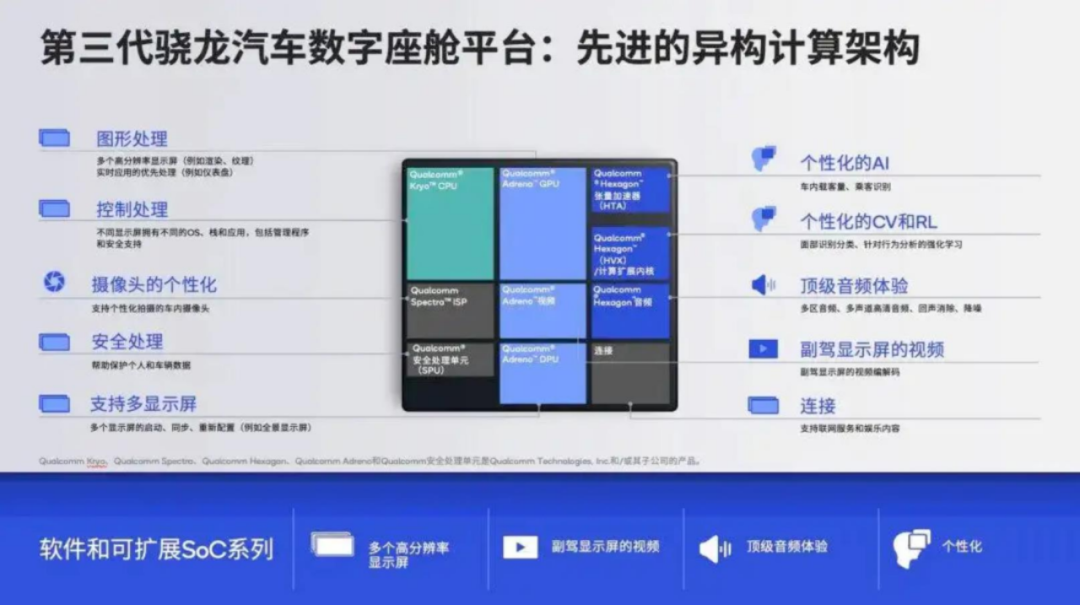
Taking the cockpit SoC as an example, we find that behind multiple high-resolution screens and a smooth system, it is not just a competition of the computing power and video processing capabilities of the vehicle chip, but also a focus on performance indicators such as AI capabilities. For instance, the Qualcomm 8155 chip is Qualcomm’s third-generation Snapdragon automotive digital cockpit flagship platform, featuring a heterogeneous architecture that includes CPU, GPU, DSP, ISP, and AI engine.
Mainstream Technical Routes
*Solution 1: High-Performance SoC + Multiple ZCUs For example, the Leap 3.0 architecture of Leap Motor uses NVIDIA Orin or Qualcomm 8295 as the CCU, paired with 4 ZCUs to achieve “four domains in one,” reducing the number of controllers from 42 to 28 and decreasing wiring weight by 30%.
*Solution 2: Integrated Cockpit and Driving SoC + Streamlined ZCU Chipone Technology “Dragon Eagle No. 1” single chip integrates cockpit and parking functions, paired with 2-3 ZCUs, allowing Geely Galaxy E5 to reduce costs by 15%.
Key Technological Breakthroughs
Communication Architecture Upgrade: GAC and Yutai Micro jointly developed the G-T01 chip, supporting gigabit Ethernet TSN (Time-Sensitive Networking), with latency as low as microseconds, meeting the real-time collaboration needs of autonomous driving and vehicle networking.
Functional Safety Enhancement: Huawei’s Qian Kun vehicle control module integrates MPU, MCU, LSW, and other five-in-one functions, certified by ASIL-D, with a programmable network processor NP performance exceeding the industry standard by 4 times, and latency only 1/5.
Typical CasesCONTENT
The following introduces the differentiated paths of Xiaomi, GAC, and Huawei.
Xiaomi SU7: Lightweight Architecture Dominated by ZCU
Architecture Design: Adopts the “VCCD Central Gateway + 3 ZCUs” solution, with VCCD integrating body control, energy management, and other functions. The ZCU uses the DRV8718-Q1 half-bridge driver chip to achieve motor control and fault diagnosis within the region, supporting OTA remote upgrades.
Chip Selection: The cockpit domain uses Qualcomm 8295 SoC (7nm process, 30 TOPS computing power), while the vehicle control domain relies on NXP S32G series MCUs, and the communication layer deploys MediaTek’s vehicle SerDes chip (12.8 Gbps transmission rate).
Technical Features: Reduces reliance on high-performance CCU through functional decoupling, with ZCU undertaking over 60% of real-time control tasks, shortening the overall vehicle wiring length by 40%.
GAC Star Spirit Architecture: Fully Self-Developed Central Computing Platform
Architecture Design: The central computing cluster (CCU) integrates intelligent driving, infotainment, and vehicle control functions, interconnected with 4 ZCUs via gigabit Ethernet, supporting 5G V2X communication and vehicle-cloud collaboration.
Chip Layout:
-
Intelligent Driving Domain: Horizon Journey 6P (560 TOPS computing power) processes lidar and camera data;
-
Vehicle Networking Domain: Self-developed G-T01 chip achieves TSN communication and network security protection;
-
Control Domain: Chipone E3800 serves as the core ZCU, integrating A core, NPU, and lock-step MCU, supporting ASIL-D safety level.
Technical Advantages: Computing power increased by 50 times, data transmission rate reaches 10 Gbps, supporting hardware embedding for L4 level autonomous driving.
Huawei Qian Kun Solution: Fully Integrated 5G Vehicle Control SoC
Architecture Innovation: The world’s first five-in-one vehicle control SoC module integrates MPU (Ascend 610), MCU (self-developed A² series), LSW (switch chip), etc., achieving a 30% reduction in size and a 25% reduction in power consumption through SiP packaging.
Core Technologies::
-
Communication Acceleration: XoETH protocol stack latency < 10μs, supporting dual-link redundancy for in-vehicle Ethernet and 5G NR-V2X;
-
Functional Safety: Built-in VOS real-time operating system and HAS Studio development toolchain, supporting ASIL-D level fault redundancy and hardware isolation.
Application Scenarios:: Dongfeng Lantu, Mengshi, and other models equipped with this module achieve millisecond-level collaboration for chassis control, power management, and vehicle networking.
Deep TransformationHeterogeneous Computing and Ecological IntegrationCONTENT
The following are the development trends of deep transformation in heterogeneous computing and ecological integration.
Technological Evolution Directions
Blurring Boundaries Between SoC and MCU: Infineon’s TC4x series MCUs embed SIMD vector processors, supporting simple AI algorithms (e.g., pedestrian detection); Aixin Yuan Zhi’s M57 series SoCs integrate MCU security islands, achieving hardware-level integration of BEV algorithms and real-time control.
Exploration of Storage-Computing Integration Architecture: Huawei’s Ascend 610 adopts 3D stacking technology, with on-chip storage bandwidth reaching 1.2TB/s, improving energy efficiency by 3 times, supporting localized processing of vehicle networking data.
Standardization of Communication Protocols: The integration of in-vehicle Ethernet TSN and 5G NR-V2X has become mainstream, with GAC’s G-T01 and Huawei’s Qian Kun module both passing TSN consistency certification, supporting 802.1AS time synchronization and IEEE 1722.1 audio-video stream transmission.
Data Algorithm Optimization
In the future, CCU and ZCU will further optimize data processing algorithms, improve signal transmission efficiency, and develop smarter power management systems. As vehicle networking becomes more widespread, there will be greater demand for data interaction, and data processing capabilities and transmission latency will face more challenges, indicating the evolution direction and development trends of ZCU.
Reconstruction of Industrial Ecology
Vertical Integration of Chip Manufacturers: Qualcomm launched the “Snapdragon Ride Flex” platform, integrating autonomous driving, cockpit, and vehicle networking functions, achieving hardware reuse through software definition; Horizon’s Journey 6 series is compatible with mainstream algorithm frameworks like BEV and Transformer, lowering the development threshold for automakers.
Self-Development and Cooperative Game of Automakers: Xiaomi strengthens ZCU design capabilities through investment in Jingwei Hengrun, GAC collaborates with Huawei and Horizon to build a “chip – algorithm – vehicle” closed loop, while Huawei opens its intelligent driving data training platform to automakers based on Ascend AI cloud services.
Challenges and Responses
Reliability Verification: Automotive-grade chips must pass -40℃~150℃ temperature cycling and 1000 hours HTOL (High-Temperature Operating Life) testing. Xiaomi’s SU7 adopts a compromise solution of “consumer-grade chips + automotive-grade packaging,” balancing long-term reliability and cost.
Supply Chain Security: Huawei’s Ascend chips use a 16nm process (manufactured by SMIC), while GAC’s Star Spirit architecture achieves 70% localization of chips, avoiding dependence on TSMC and Samsung’s processes.
Future Development TrendsCONTENT
From Distributed ECUs to Domain Controllers and Central Computing
*To address the above issues, the automotive electronic architecture is undergoing a revolutionary evolution:
Domain-Centralized:
-
Integrating multiple ECUs with similar functions into a more powerful domain controller (DCU).
-
For example, integrating the control of dashboard, in-car entertainment, head-up display, voice assistant, etc., into a singleintelligent cockpit domain controller (usually based on a high-performance SoC chip).
-
Similarly, integrating perception, decision-making, and fusion functions related to autonomous driving into theintelligent driving domain controller.
Vehicle-Centralized / Central Computing Architecture:
-
This is the ultimate form, using 1-2 high-performance central computers to replace all domain controllers and mostECUs.
-
The original ECU functions are downgraded to simpleactuators orsensor driver units, responsible only for basic signal conversion and driving, while all complex calculations and decisions are centralized in the “central brain.”
-
Tesla is a leader in this architecture, with its Model 3/Y models already achieving a structure of central computing (CCM) + left/right body controllers (BCM LH/RH).
Currently, the vehicle networking SoC chip architecture is transitioning from “functional domain centralization” to “central computing + regional control” deep collaboration. Xiaomi’s lightweight ZCU, GAC’s fully self-developed platform, and Huawei’s 5G vehicle control module represent different technological paths. In the future, with the application of processes below 7nm (such as TSMC N3E) and photonic integration technology (such as silicon photonic interconnects), as well as the popularization of SOA (Service-Oriented Architecture) and vehicle-cloud integration, vehicle networking SoCs will become the core carrier of software-defined vehicles, driving the intelligent reconstruction of the entire “end – pipe – cloud” link.
—end—