
Touching the smartphone screen with fingertips, fitness watches recording heart rates… From fingerprint recognition to health monitoring, the magic wand of optical sensors is unlocking more and more secrets of life.
The Optical Code on Your Fingertips
Currently, there are three main methods for screen fingerprint recognition:
(1) Optical Screen Fingerprint Recognition:
Utilizes the principle of optical recognition, identifying fingerprint patterns through a CMOS sensor located beneath the screen;
(2) Capacitive Fingerprint Recognition:
The capacitive fingerprint module forms an electric field with the conductive subcutaneous electrolyte through the fingerprint sensor. The varying heights of the fingerprint create different pressure differentials with the sensor, allowing for the identification of specific fingerprints;
(3) Ultrasonic Fingerprint Recognition:
Utilizes the principle of ultrasonic recognition, where ultrasonic waves pass through the screen and reflect differently based on the unique fingerprint, allowing for the identification of specific fingerprints.
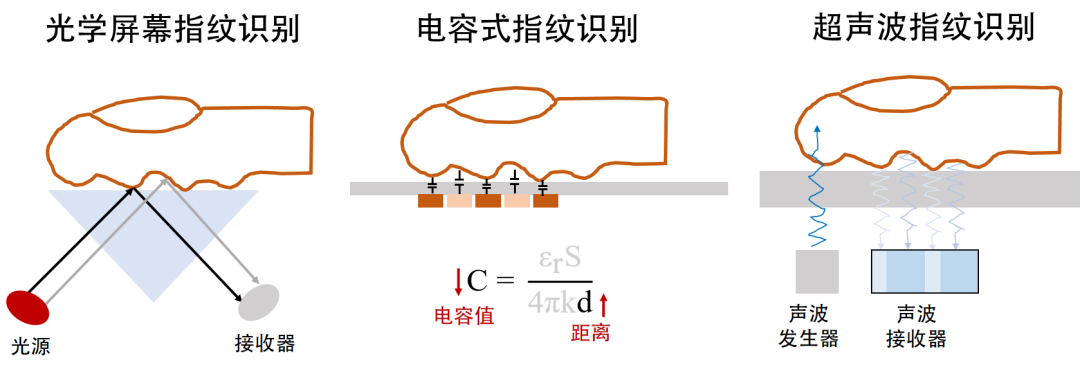
The three main methods of screen fingerprint recognition. Image source: Zhang Senhao
The Basic Principles of Optical Biosensing
The core working mechanism of optical biosensing revolves around the interaction between light and biological tissues. When light illuminates human tissues, different depths of tissue exhibit unique “light codes”.
Surface Recognition: When light illuminates the fingerprint (skin surface), the smooth surface of the stratum corneum reflects some light directly, while epidermal cells and melanin absorb a significant amount of short-wavelength light (such as blue and green light). Therefore, it is possible to quickly capture surface features based on the differences in visible light reflection, enabling applications such as fingerprint unlocking.
Deep Detection: As light penetrates deeper into human tissues, the complex structure of the body causes multiple scattering of light. At this point, near-infrared light, due to its longer wavelength, experiences 10 to 50 times less scattering than visible light, allowing it to penetrate biological tissues up to 3 to 5 millimeters deep, such as in muscles and the retina.
Upgrading from a “Rigid Card” to
“Wearable Optical Skin”
If rigid optical biosensors could become soft like a band-aid, they could closely conform to human tissues, upgrading from a “rigid card” to “wearable optical skin”.
Professor Xue Feng’s team at Tsinghua University has made traditional light-emitting diodes only 10 micrometers thick, integrating them with a transparent flexible substrate (PDMS) through serpentine interconnects, creating an optoelectronic system that can naturally conform to the human body. By measuring the absorption of blood at different wavelengths of light, they can determine changes in blood volume and flow rate, thereby measuring blood oxygen and blood pressure values.
Source:Popular Science OpticsEditor: Yuan JingReviewer: Xiao Haiqing