The state of charge requirement for pure lithium-ion battery cargo must not exceed 30%, initially strongly promoted by the International Civil Aviation Organization (ICAO) and has been enforced for many years. For lithium-ion battery cargo related to equipment, the latest regulations from the International Air Transport Association (IATA) Dangerous Goods Regulations (DGR) 67th edition, effective January 1, 2026, are as follows:
01Packaging Instructions PI966
Applicable toUN3481lithium-ion batteries packed with equipment (lithium ion batteries packed with equipment), where “equipment” refers to devices that require lithium batteries to operate. Such cargo includes items like electric drills and robotic vacuum cleaners, where the lithium battery is packaged separately but shipped in the same box.
For Part I of PI966,it must be transported with a state of charge not exceeding 30% of its rated capacity. If it exceeds 30%, transportation is only allowed with the approval of the originating country and the airline’s country.
For Part II of PI966,
(1) For lithium batteries exceeding 2.7Wh,it must be shipped at no more than 30%. If it exceeds 30%, transportation is allowed only with approval.
(2) For lithium batteries not exceeding 2.7Wh,it is recommended to ship at no more than 30%. In other words, exceeding 30% is considered normal transportation and does not require national approval.
02Packaging Instructions PI967
Applicable toUN3481lithium-ion batteries contained in equipment (lithium ion batteries contained in equipment), such as mobile phones and tablets. Starting January 1, 2026,it is recommended that the state of charge does not exceed 30%, or the device displays no more than 25%.
Note: This regulation is a recommendation rather than a requirement and applies to both Part I and Part II of PI967.
03Packaging Instructions PI952
Applicable toUN3556vehicles powered by lithium-ion batteries.
(1) When exceeding 100Wh, during transportationit must not exceed 30%, or display no more than 25%, this is a mandatory requirement.
(2) When below 100Wh, during transportationit is recommended not to exceed 30%, or display no more than 25%. This is a recommended measure.
(3) For those exceeding 100Wh and exceeding 30% (or displaying over 25%), transportation is allowed only with approval.
Conclusion
The above content can be summarized as follows:
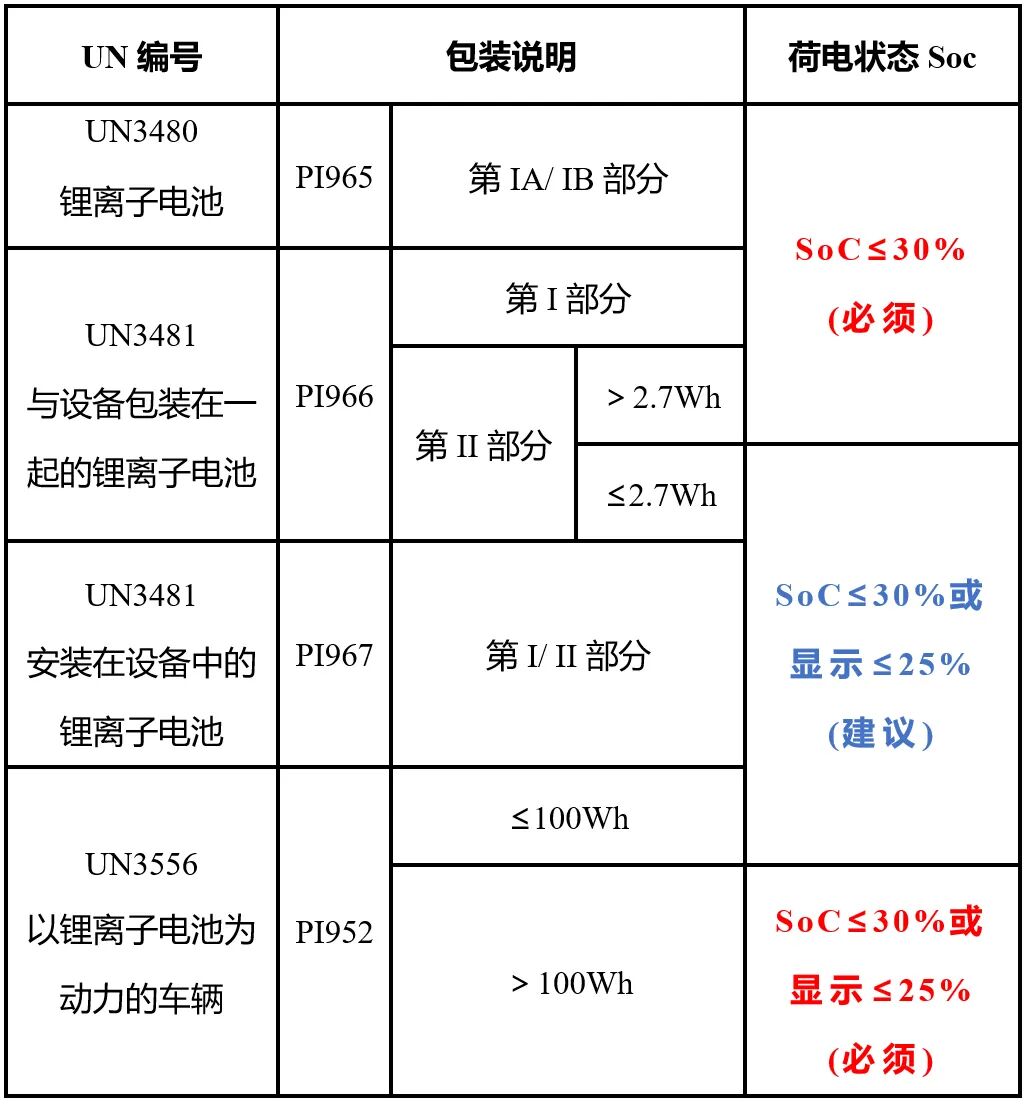
Additionally, no national civil aviation authorities or airlines have proposed differences to the above regulations in the 67th edition of IATA DGR for 2026, meaning no stricter requirements have been suggested. However, some airlines require the shipper’s Dangerous Goods Declaration (DGD) operational instructions to indicate “state of charge not exceeding 30%, or display not exceeding 25%.” Airlines known to have made such requests include Korean Air, All Nippon Airways, Asiana Airlines, and Starlux Airlines.