 2.2 Reactor Design PrinciplesThe most commonly used reactor is the traditional parallel plate electrochemical filter press, which has a simple structure and scalability (Figure 1a). Simple separation between the electrode plates can reduce the solution resistivity and operating costs, and the electrochemical unit can also be expanded from a single anode-cathode pair to multiple parallel anode-cathode pairs.Due to the mass transfer limitations in the aforementioned electrochemical cell during the nitrate reduction process, researchers have designed electrochemical cells equipped with different turbulence promoters and filled with fluidized bed inert particles in the space between the electrodes (Figure 1b). Additionally, as shown in Figures 1c and 1d, anode bed-type cells can be assembled to form an integrated device to increase the electroactive area of the cathode and mass transfer effects. To enhance the reaction rate, mass transfer effects must be strengthened by increasing the flow rate.
Although the design of the above electrochemical reaction cells is feasible, the FM01-LC laboratory-scale electrochemical reactor (Figure 1e) — equipped with a parallel plate and frame filter press configuration — is the most commonly used equipment configuration. This efficient and uniform reaction cell is widely applied in fields such as electrosynthesis, energy storage, metal ion removal, and environmental pollutant degradation due to its ability to deliver large and stable amounts of substances to the electrodes. Future designs of the FM01-LC reactor must adjust the flow field and electrode geometry to enhance the uniformity of fluid dynamics within the cell. Furthermore, designing an electrochemical cell that meets economic requirements while matching commercial electrochemical nitrate reduction units remains a challenge. One approach to constructing a reactor is to use a three-dimensional (3D) electrochemical reactor that combines the advantages of chemical catalysis and electrocatalytic nitrate reduction (Figure 1f).
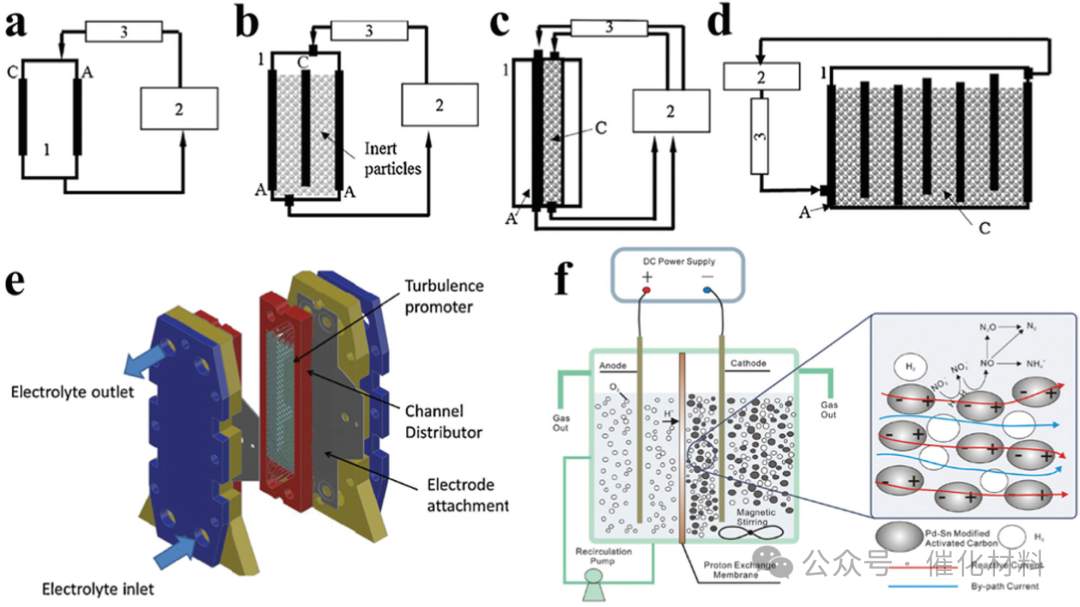
Figure 1 Schematic diagram of electrochemical reactors for nitrate reduction reaction: (a) plate electrode unit, (b) inert particle fluidized bed unit, (c) packed bed cathode unit, and (d) vertically moving particle bed unit. (e) Schematic diagram of the FM01-LC electrochemical reactor. (f) Schematic diagram of the electrocatalytic reactor based on palladium-tin/activated carbon particles.
2.3 Product Detection Methods
The products of electrocatalytic nitrate reduction include liquid products, namely residual nitrate (NO3-), nitrite (NO2-), and ammonium ions (NH4+), as well as gaseous products, namely nitrogen (N2), nitrous oxide (N2O), and nitric oxide (NO). Analytical methods and instruments used to determine reaction products include but are not limited to ultraviolet-visible spectrophotometry (UV-vis), ion chromatography (IC), and gas chromatography (GC).
Ultraviolet-visible spectroscopy is commonly used to determine the concentrations of NO3-, NO2-, and NH4+. The selectivity of N2 can then be further determined by subtracting the amounts of NO2- and NH4+ produced. It is important to emphasize that the performance of electrocatalytic nitrate reduction is estimated by assuming that the yields of N2O and NO can be neglected. In practice, N2, N2O, and NO can be detected by gas chromatography, and the concentrations of NO3-, NO2-, and NH4+ can be determined by ion chromatography, thus obtaining accurate data. However, most studies indicate that the main gaseous product of electrocatalytic nitrate reduction is N2, therefore, other gaseous products (such as N2O and NO) will not be further discussed in this review.
2.4 Electrocatalytic Parameters and Evaluation Methods
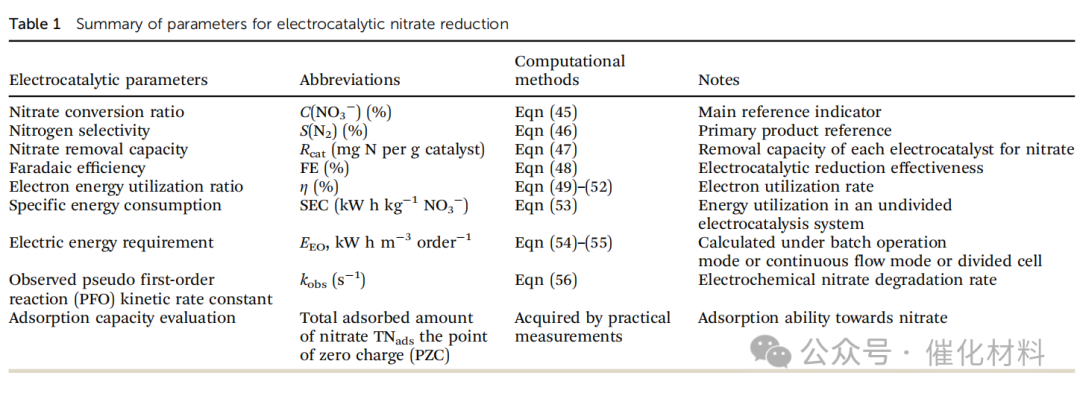
Table 1 summarizes the commonly used electrocatalytic parameters and their calculation methods during the electrocatalytic nitrate reduction process.
The performance of the electrochemical reaction cell during electrocatalytic nitrate reduction is typically determined by two parameters: nitrate conversion rate (C(NO3⁻)) and nitrogen selectivity (S(N2)). The nitrate removal capability of the electrocatalyst (Rcat) is another important indicator of nitrate reduction. Given that these reactions are primarily related to electron transfer, the reduction effect of nitrate is usually assessed by the Faradaic current efficiency (FE), which reflects the utilization of electrons. According to Faraday’s law, the ratio of electrons consumed in the electrocatalytic reaction to the theoretical consumption amount is FE.In some published papers, current efficiency (j) is also used to represent the energy utilization rate of the catalytic system, which can be determined by the ratio of the amount of electrons used for the electrocatalytic reaction to the total amount of electrons flowing in the circuit.
Moreover, the electrocatalytic reduction performance of nitrate is also influenced by the electrochemical reactor. In the case of using a non-segmented electrochemical reactor, some reduction intermediates that have diffused to the anode surface may be re-oxidized, leading to a decrease in overall electrode efficiency. To obtain the electrical energy required for nitrate reduction, specific energy consumption (SEC, kW h/kg NO3⁻) can reflect the energy utilization of the electrocatalytic system.
The ohmic resistance and electron transfer resistance of the segmented reaction cell are both higher than those of the unsegmented reaction cell, resulting in increased energy consumption. Another parameter for assessing the operating costs of energy-dependent water treatment systems is the energy per batch (EEO, kilowatt-hours/cubic meter per batch), which quantifies the energy in terms of the amount of electricity per unit volume.
Additionally, the rate of electrochemical nitrate degradation follows the observed pseudo-first-order reaction kinetics (PFO), and its rate constant (kobs, in seconds^-1) can be calculated.