Extracellular vesicles (EVs) are nanoparticle structures enveloped by phospholipids that are secreted by cells into the surrounding environment. Extracellular vesicles can convey various biomolecules that mediate intercellular communication and play a crucial role in physiological and pathological processes. Therefore, extracellular vesicles are emerging as new biomarkers, therapeutic targets, and drug delivery vehicles for various diseases.
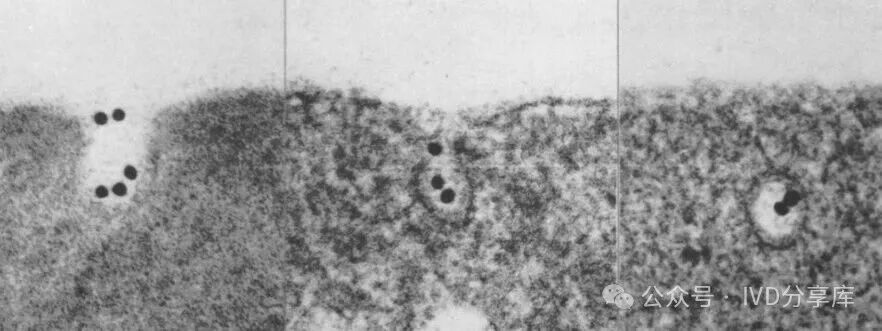
However, the isolation and detection of extracellular vesicles require a time-consuming and labor-intensive process, starting with the extraction of extracellular vesicles from biological and physiological fluids, followed by the high-sensitivity detection of EV-related molecules. Currently, the detection methods and instruments used for extracellular vesicle analysis are often not widely applicable outside research laboratories, posing practical obstacles to the study of EV-related molecules in biological and clinical applications.
To address this, recent research has focused on utilizing microfluidic technology for the extraction of extracellular vesicles, as microfluidic technology can handle microliter volumes of liquid and automate complex processes in miniaturized devices. Passive particle separation methods are common in microfluidic devices, allowing for the separation of extracellular vesicles based on particle size, such as through lateral displacement, inertial forces, and flow separation. Active methods, such as ultrasound, can also be employed in microfluidic devices to capture, separate, aggregate, and transport extracellular vesicles by applying different forces based on size. However, size-based separation of extracellular vesicles often results in low purity, as similarly sized contaminants may also be separated, and clogging remains a challenge. To overcome these limitations, electrophoretic methods have been explored as alternatives. However, these methods typically require the integration of microelectrodes at precise locations within the microfluidic device and the highly controlled modulation of high AC fields on these electrodes. Additionally, using non-insulated electrodes in water poses a risk of electrolysis, which may lead to device failure.
To overcome the aforementioned challenges, researchers at the Mayo Clinic have developed a digital microfluidic (DMF) device capable of automatically extracting extracellular vesicles from various biological fluids and detecting specific subpopulations based on their surface markers. The related research findings have been published in the recent Small journal under the title “An Integrated Digital Microfluidic Device for the Extraction and Detection of Extracellular Vesicle-Based Molecules”.
Unlike other microfluidic platforms, this digital microfluidic device consists of an array of insulated electrodes that manipulate fluids based on the principle of electrowetting. This unique structure allows for the sequential programming of droplet processing (e.g., separation, mixing, movement) without the need for physical microstructures (e.g., microvalves, microchannels). Consequently, these devices can automatically perform experiments requiring multiple steps, such as target extraction, washing, and culturing, based on user-defined parameters. In this digital microfluidic device, researchers used immunomagnetic microspheres to extract extracellular vesicles on-chip, as immunoaffinity provides higher specificity for EV subpopulations, followed by the detection of their surface markers using electrochemical sensors.
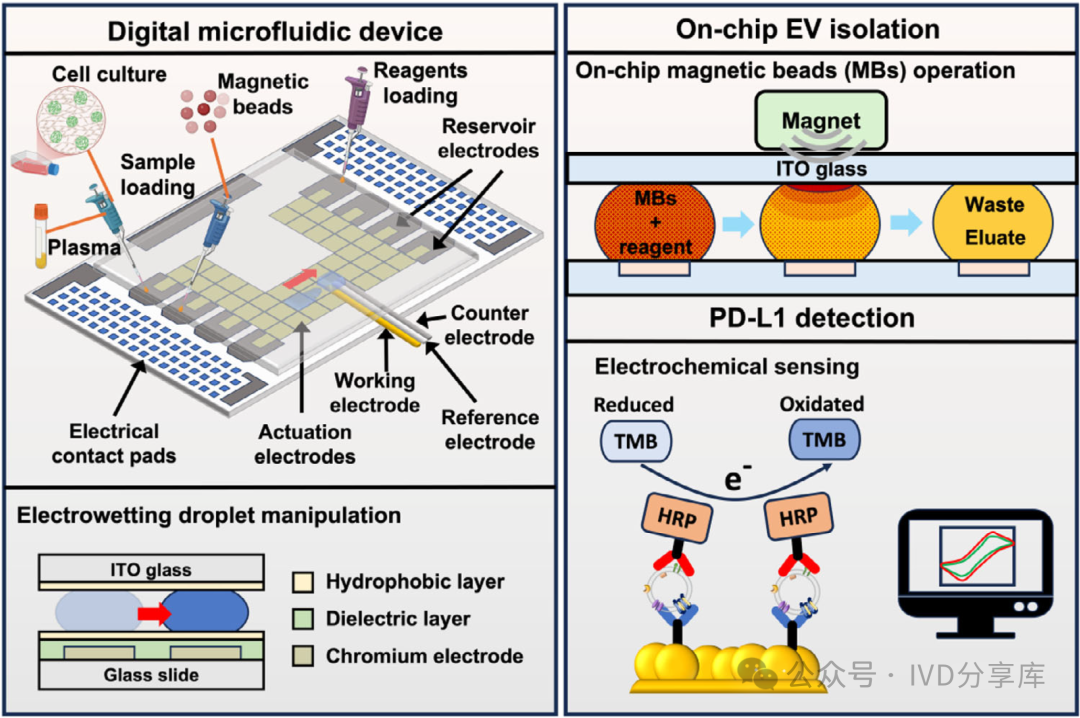
Digital microfluidic device based on electrowetting principle
In the proof of concept, researchers selected the immune checkpoint molecule PD-L1 as the target for binding extracellular vesicles, as its circulation in the blood is associated with resistance to PD1/PD-L1 blockade, a cutting-edge therapy in the field of immunotherapy. The developed digital microfluidic device can automatically extract extracellular vesicles from 20 µL of cell culture and human plasma samples within 25 minutes and detect PD-L1+ extracellular vesicles on-chip using electrochemical sensors, with a detection limit of 1 x 10⁴ EVs/mL. This study demonstrates the feasibility of simplifying the extraction of extracellular vesicles from various biological fluids and detecting specific EV subpopulations, which can be applied in biological research and clinical applications.
Digital microfluidic device platform
This digital microfluidic device consists of two glass substrates with a gap between them for droplet manipulation. The bottom substrate is patterned with driving electrodes, storage electrodes, and side electrical contact pads, while the top substrate is coated with indium tin oxide (ITO) as the grounding electrode, allowing for top-down observation of the liquid. The digital microfluidic device can be programmed to control the opening/closing of electrodes to process droplets in a timed manner. Samples and reagents (e.g., culture media, plasma, magnetic microspheres) can be dispensed onto different storage electrodes, which then split into smaller droplets based on the electrowetting principle and are processed on the driving electrodes. In this study, researchers achieved multiple functions within a single device, including magnetic microsphere functionalization, capturing extracellular vesicles from biological fluids, sample washing, and elution of extracellular vesicles. Subsequently, researchers inserted gold wire-based electrochemical sensors into the device to detect PD-L1+ extracellular vesicles.
On-chip TIM-4 magnetic microsphere preparation
In this study, researchers utilized immunomagnetic microspheres for the extraction of extracellular vesicles on-chip. First, researchers functionalized TIM-4 onto immunomagnetic microspheres within the digital microfluidic device. Briefly, 10 µL of streptavidin-coated magnetic microspheres were dispensed from the storage electrode on the chip, and the microspheres were retained using a magnet while the supernatant was separated and removed. Then, a biotin-labeled TIM-4 solution was added and suspended in a washing buffer, mixed with the magnetic microspheres, and TIM-4 was fixed through biotin-streptavidin coupling. Multiple 20 µL washing buffer droplets were then used to remove unbound molecules in the same manner. The microspheres were resuspended in a 20 µL washing buffer droplet before starting the extracellular vesicle separation process. It is noteworthy that many microfluidic processes use pre-functionalized microspheres prepared outside the chip, while this study combines the microsphere functionalization process with extracellular vesicle extraction, demonstrating the feasibility of on-demand functionalization of different biological recognition agents onto microspheres for specific detection.
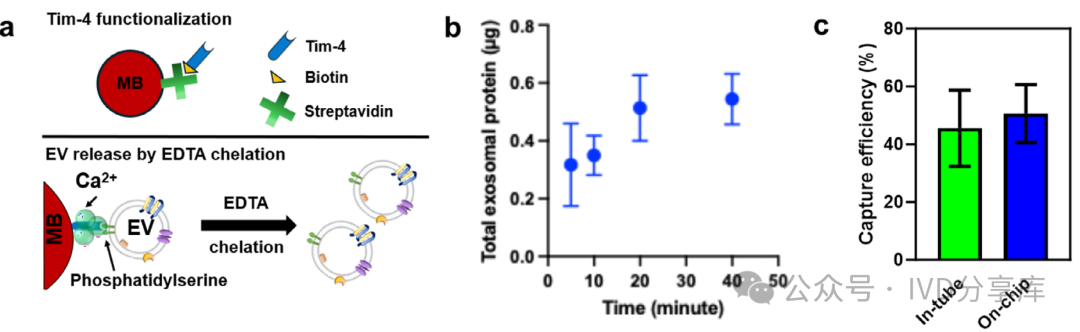
On-chip extraction of extracellular vesicles
Based on surface-modified working electrodes, researchers constructed an electrochemical immunosensor to detect the PD-L1 expression levels of the extracted extracellular vesicles on-chip.
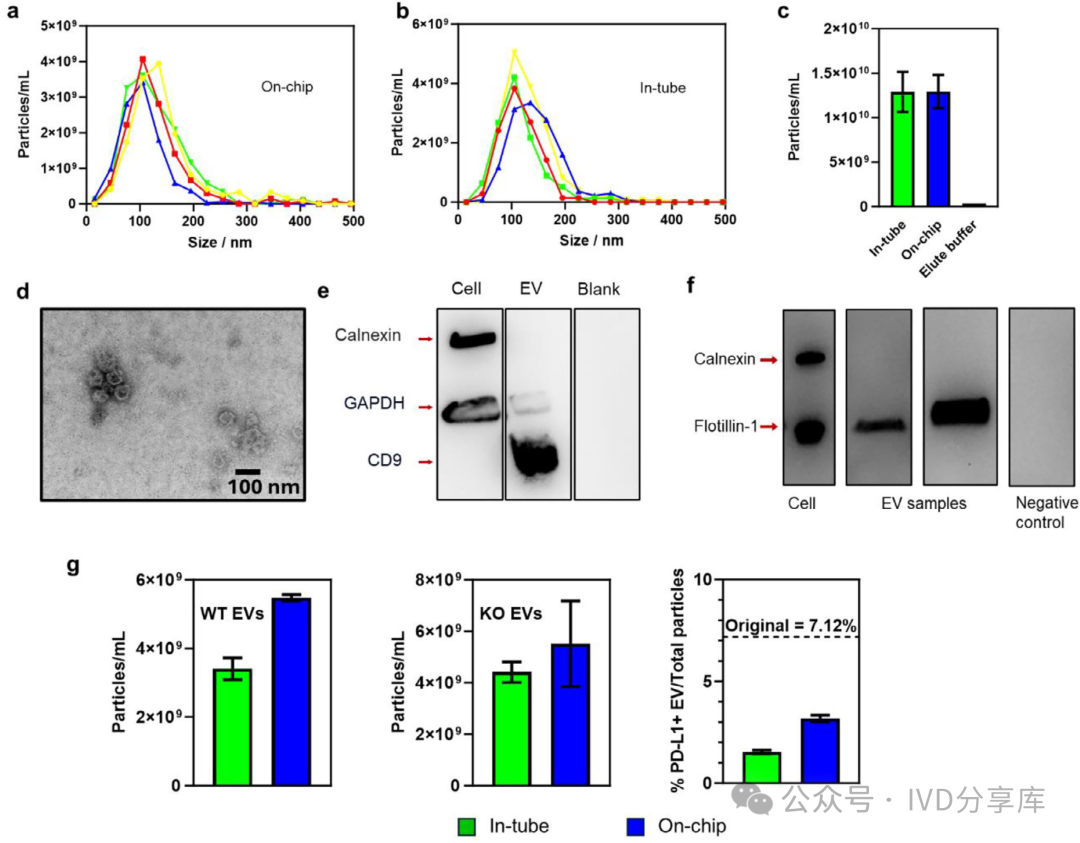
Characterization of extracellular vesicles
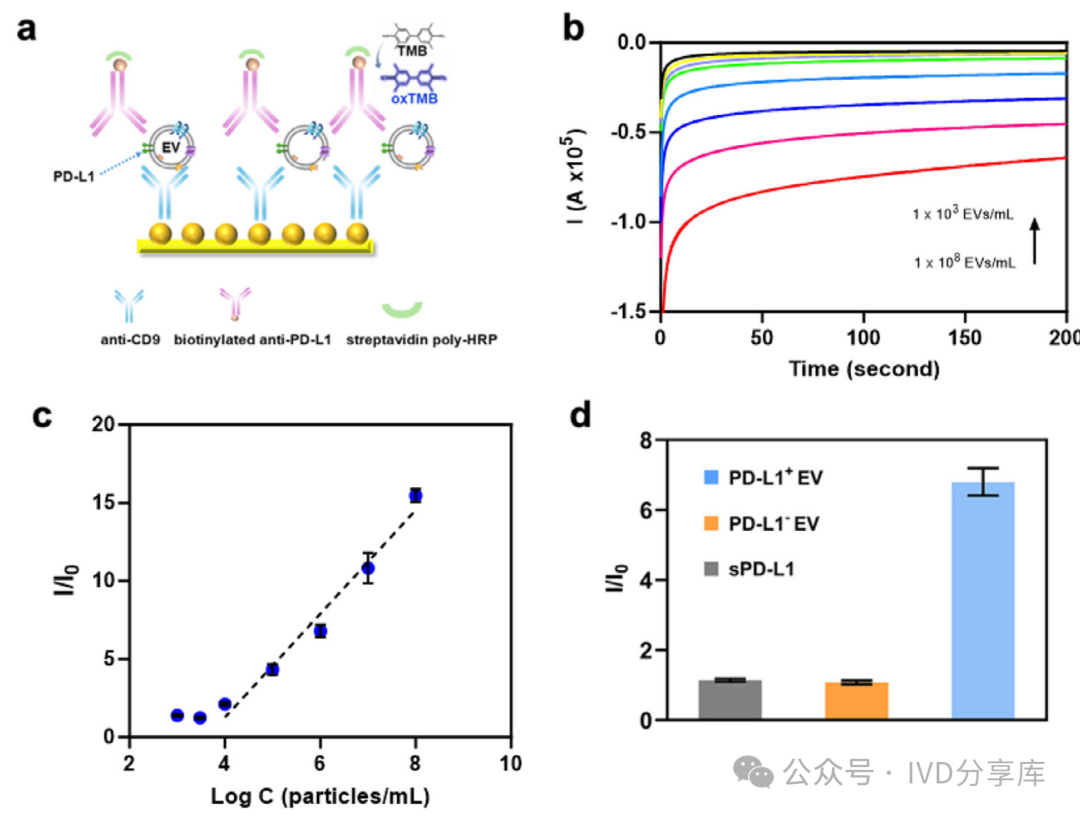
Detection of PD-L1+ extracellular vesicles using the designed electrochemical sensor
Conclusion
A key contribution of this work is the development and integration of a miniaturized electrochemical sensor into the digital microfluidic device to simplify and automate the extraction and detection of extracellular vesicles on-chip. This proof-of-concept platform can perform magnetic microsphere functionalization and extracellular vesicle extraction from 20 µL of cell culture media and clinical plasma samples within 25 minutes, and the electrochemical sensor can detect as low as 10⁴ PD-L1+ EVs/mL within 5 minutes. Over time, these sensors have demonstrated the required specificity and stability. Compared to standard extracellular vesicle analysis, this portable system significantly reduces the need for specific infrastructure, eliminating multiple time-consuming and labor-intensive processes, bringing hope for biomarker analysis based on extracellular vesicles in biological research and clinical applications. Ultimately, researchers envision that this platform could be transformed into a routine benchtop tool, making biomarker analysis based on extracellular vesicles possible in life science laboratories and clinical settings.
Download the paper PDF:
An Integrated Digital Microfluidic Device for the Extraction and Detection of Extracellular Vesicle-Based Molecules
If you have questions, ask the IVD intelligent agent!

For more information or to join the group, please scan the QR code below
Please note: Name – Company – Position
 Disclaimer: Some content published by this public account is sourced from the internet and is for learning, communication, and sharing purposes only. All content with specified sources is copyrighted by the original authors and sources. This public account is not responsible for the stance of the published content, and content whose copyright cannot be verified or is not specified is collected from the internet. If there are any copyright or other improper use issues, please contact the public account backend, and we will promptly delete or address them. Thank you for your understanding and support.