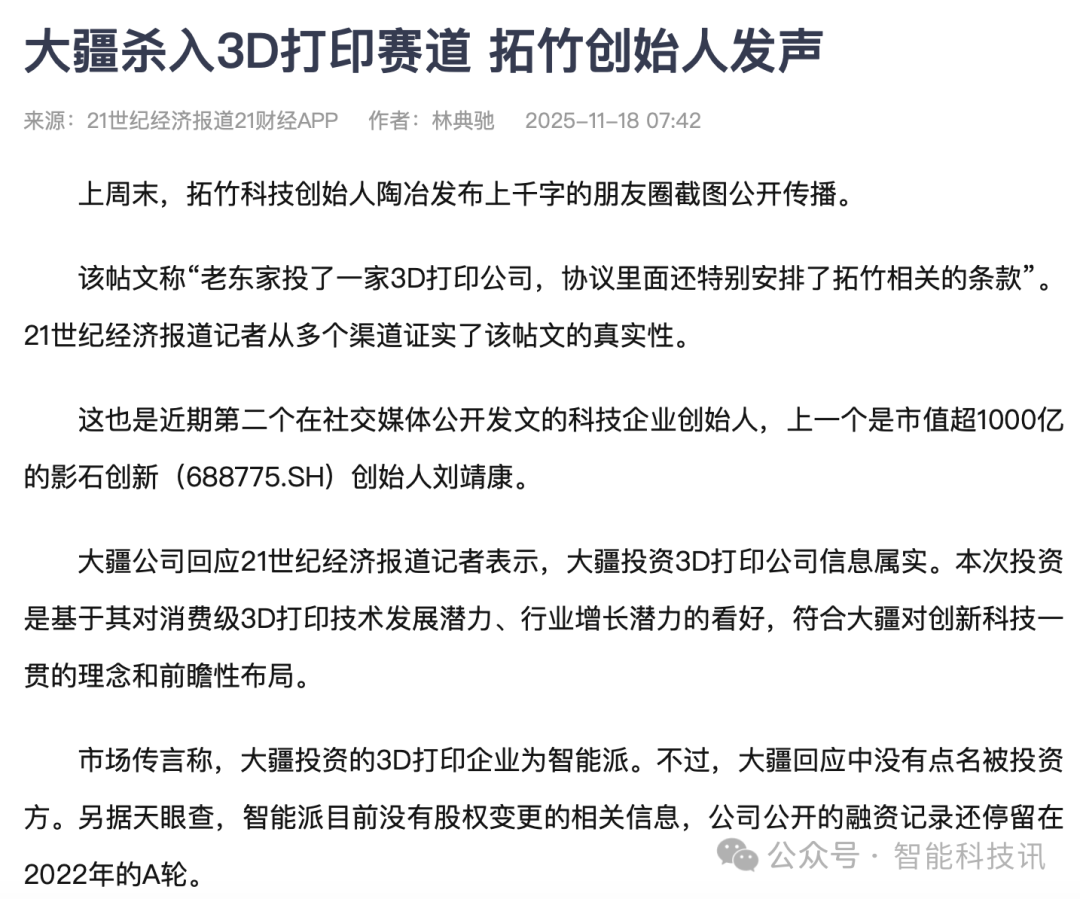
A “WeChat circle storm” in the venture capital community has suddenly put the low-profile DJI in the spotlight. The public questioning by Tao Ye, founder of TuoZhu, has completely ignited the news of “DJI investing in the 3D printing company Smart Technology,” marking the official entry of the consumer-grade 3D printing sector into a new era of competition among giants.
As the absolute leader in the drone field, DJI’s foray into this sector is not a spur-of-the-moment decision. With the annual shipment of consumer-grade 3D printers set to soar from 4.5 million units to 50 million units, and AI technology lowering the modeling threshold to zero, expanding the user base from millions to billions, this blue ocean market, comparable to the robotic vacuum cleaner boom 20 years ago, has already become a battleground for capital. DJI’s choice to bet on the less popular Smart Technology hides a deep logic that could rewrite the industry landscape.
1. A Trillion-Yuan Market Calls for Giants: DJI’s Cross-Border Move is Inevitable, Not Accidental
The explosive growth of consumer-grade 3D printing is no longer an industry secret. DJI’s entry is essentially a precise positioning in line with this trend.
1. Market Dividend: From “Geek Toy” to “Family Necessity”
Data confirms the potential: The global consumer-grade 3D printing market is expected to reach $4.1 billion by 2024, and is projected to grow to $16.9 billion by 2029, with a compound annual growth rate of 33%. As a core production base, China is expected to export 3.7777 million units of equipment in 2024, with consumer-grade products making a significant contribution.
AI Breaks Barriers: Generative AI allows 3D modeling to no longer rely on professional skills; ordinary consumers can generate models simply by inputting text, directly activating billions of potential users and completely opening up the C-end market space.
Attractive Profit Margins: Leading company TuoZhu is expected to achieve a profit margin of 30% in 2024, with net profits nearing 2 billion yuan, such high returns are enough to attract the attention of giants.
2. Industry Landscape: Giants Positioning Early, the Market is on the Eve of a Red Sea
Companies like Tencent, Meituan, and ZhuiMi have already quietly laid out their strategies, while Shenzhen’s “Four Kings” (Chuangxiang Sanwei, TuoZhu, Zongwei Lifang, Smart Technology) have captured 90% of the global entry-level market share. As the industry shifts from “barbaric growth” to “oligopolistic competition,” DJI’s entry at this time is to seize future discourse power.
2. Betting on Smart Technology: DJI’s ‘Potential Stock’ Logic Hides Three Considerations
Among the leading players, TuoZhu remains at the top but does not open up financing, while Chuangxiang Sanwei’s IPO in Hong Kong is more suited for secondary market strategies. DJI’s final choice of the third-tier Smart Technology is, in fact, the optimal solution after careful calculation.
1. An Underrated Industry Dark Horse
Leading in the niche market: Smart Technology’s resin 3D printers rank first globally, with shipments expected to reach 500,000 units in 2024, while also focusing on the FDM product line, accumulating over a million units shipped, forming a dual-track driving advantage.
High Growth and High Margins: Revenue growth has stabilized at 40% over the past three years, with 2024 revenue expected to reach 1.6 billion yuan, ranking third in the industry, and projected to reach 2.5 billion yuan by 2025. Through self-built production lines, its low-priced products can still maintain high margins, with industry-leading supply chain management capabilities.
2. Valuation Gap + Strategic Complementarity: The Most Cost-Effective Layout
Smart Technology’s current valuation is lower than that of Chuangxiang Sanwei, providing significant cost-effectiveness in the primary market. More importantly, its resin technology complements mainstream FDM technology, helping DJI quickly cover the entire technology route and build a complete product matrix.
3. Ambition and Execution: Aligning with DJI’s ‘Engineer Culture’
The founder of Smart Technology has set a goal of “exceeding 5 billion yuan in revenue in three years and initiating an IPO,” not only relocating the R&D team to Shenzhen Technology Park but also forming a dedicated product team, with a more aggressive marketing strategy. This resolute investment in technology and growth determination aligns closely with DJI’s “product-first” philosophy.
3. Signals of Market Change: DJI’s Entry Disturbs Threefold Landscape
DJI’s bet is not just a simple investment; it could rewrite the rules of the consumer-grade 3D printing industry.
1. Internal Conflict in the ‘DJI System’: Intra-Family Showdown Becomes Industry Focus
The core team of TuoZhu has many members from DJI, inheriting its engineer culture and technical methodology; while Smart Technology, as a direct investment target of DJI, is akin to a “favored child” entering the market. On one side is the industry leader built by “departed disciples,” and on the other is the potential dark horse “backed by the father”; this “internal conflict in the DJI system” will become a core focus of future industry competition.
2. Accelerated Industry Concentration: Survival Space for Small Players is Squeezed
Currently, Shenzhen’s “Four Kings” have monopolized 90% of the market. After DJI’s entry, capital, technology, and talent will further concentrate towards the top players. With Smart Technology receiving funding support, R&D investment and market expansion speed will significantly increase, leading the industry from “a hundred schools of thought contending” to “oligopolistic competition,” with leading companies’ market share expected to exceed 70% in the next three years.
3. Dual-Driven by Technology and Price: Consumers Welcome a Dividend Period
DJI’s engineer culture and technological accumulation are expected to be transmitted to the entire industry through Smart Technology. On one hand, it will promote technological iterations such as multi-material printing and precision enhancement; on the other hand, it may trigger a price war, further driving down the prices of entry-level products, accelerating the integration of 3D printers into everyday households.
4. DJI’s Resolve: More than Just Investment, but Ecological Layout
This cross-border move is backed by DJI’s consistent strategic logic—avoiding chasing hot trends and instead focusing on future layouts.
As the “Huangpu Military Academy of Hardware Entrepreneurship,” the talents cultivated by DJI have already built leading companies in various fields such as smart driving, outdoor power supplies, and 3D printing. Investing in Smart Technology is not only a positioning in the 3D printing sector but also a consolidation of its own talent ecosystem, preventing the loss of core technologies and teams.
Just like the investment in DJI’s automotive sector years ago, DJI never engages in short-term financial speculation but focuses on long-term industrial value. Its deeply ingrained “engineer culture” emphasizes a persistent reverence for technology and a relentless pursuit of product details; this gene, once injected into Smart Technology, may completely change the current state of the 3D printing industry, which is “heavy on marketing and light on R&D.”
Conclusion: Is Consumer-Grade 3D Printing Entering the ‘DJI Time’?
DJI’s entry has pressed the “accelerator button” for the consumer-grade 3D printing market. When giants bring capital, technology, and ecological resources into the arena, the industry’s game rules will inevitably be restructured—technological iterations will accelerate, prices will become more consumer-friendly, and application scenarios will become richer.
Will the pattern of Shenzhen’s “Four Kings” be broken? Can TuoZhu maintain its leading position? Will Smart Technology leverage DJI’s momentum to achieve a curve overtaking? The answers to these questions will ultimately be determined by product strength. But it is certain that the “change” in consumer-grade 3D printing is irreversible, and the center of this transformation will inevitably revolve around DJI and its bet on Smart Technology.