Click the blue text to follow us immediately
This research was conducted by Guanghai Fei and his team from KU Leuven in Belgium and published in the journal Advanced Functional Materials. The article systematically reviews the current development status and application prospects of grayscale photopolymerization 3D printing technology, focusing on its potential in the preparation of functionally graded materials with spatial gradient structures and properties.
The authors first review the basic principles of slot-type photopolymerization 3D printing and its various technical branches. They then categorize the existing grayscale VP technology, analyzing its mechanisms in exposure dose control, crosslinking degree control, and material property gradient construction. They also summarize its representative applications in microfluidics and micro-optics, biomedicine, gradient colors and coded structures, soft robotics, and “4D printing,” and finally propose prospects for further enhancing photopolymer materials systems and grayscale strategies.
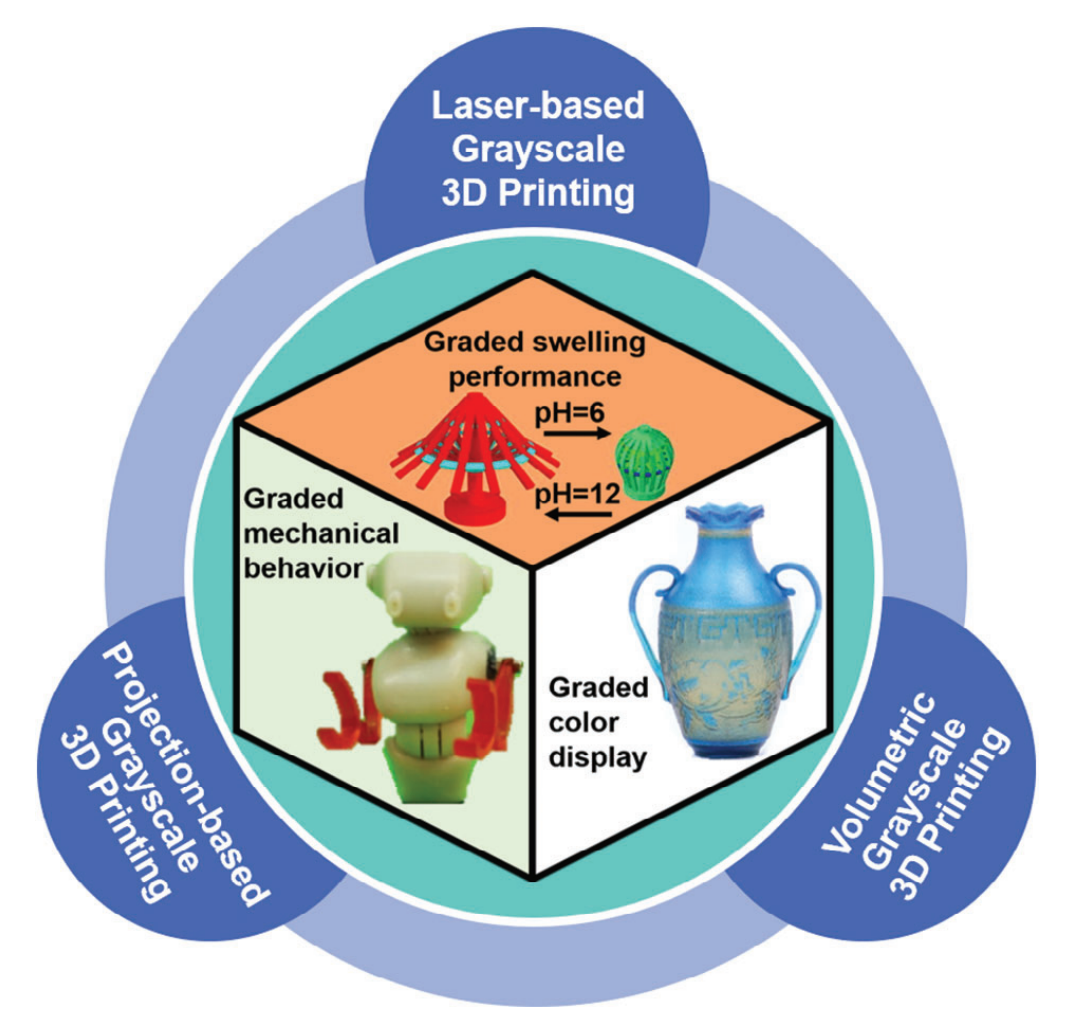
From the perspective of scientific principles and research background, the core feature of functionally graded materials is the continuous or discrete variation of their structure or composition in space, resulting in gradients in mechanical, thermal, swelling, optical, and other physicochemical properties. The earliest typical application was aerospace thermal barrier materials, which used heat-resistant ceramics on the high-temperature side and high thermal conductivity metals on the low-temperature side, achieving a continuous transition of composition in between to reduce thermal stress and enhance service reliability. As application scenarios expand to fields such as biomedical implants, energy-absorbing structures, sensors, and soft robotics, the demand for complex three-dimensional gradient structures and multi-physical field coupling performance has significantly increased. However, traditional gas-phase, liquid-phase, and solid-phase processes have obvious limitations in achieving truly three-dimensional designable gradients, often only obtaining one-dimensional or two-dimensional gradient structures. Therefore, how to develop new manufacturing technologies that can precisely control internal structure and performance distribution on a three-dimensional scale has become a key issue in the research of functionally graded materials.
VP 3D printing utilizes a light source to selectively initiate the polymerization reaction of photosensitive resins, offering significant advantages in constructing complex structures and high-resolution devices. Since Hull proposed “stereolithography” in 1986, VP technology has evolved from traditional point-by-point scanning to surface exposure and then to volume printing, forming various process paths: laser point scanning-based SLA and two-photon polymerization belong to serial printing technologies; layer projection and continuous projection using LCD, DMD, or LCoS belong to planar printing technologies; while computational axial lithography and xolography represent new directions in volume printing. At the material level, VP commonly employs free radical or cationic photopolymerization, with the former often using (meth)acrylate monomers and thiol-ene/alkyne systems, combined with type I or II photoinitiators; the latter relies on quaternary ammonium salts or sulfonium salts to initiate the cationic polymerization of epoxies, oxiranes, vinyl ethers, and other monomers. By selecting different photoinitiators and light source wavelengths, a broad spectrum of photopolymerization windows from deep ultraviolet to near-infrared can be achieved.
However, traditional VP printing typically uses fixed light intensity and a single resin formulation, providing a constant exposure dose throughout the construction process, thus obtaining uniform crosslinking density and homogeneous materials. This is insufficient for the preparation of functionally graded materials. The key idea of grayscale photopolymerization is to utilize spatially continuous or graded variations in light dose to precisely control the local monomer conversion rate and crosslinking degree, thereby forming designable gradients in density, hardness, elastic modulus, swelling behavior, surface roughness, and other aspects. The authors categorize the existing grayscale VP technology into three main types: serial grayscale printing based on laser scanning, planar grayscale printing based on projection, and other grayscale technologies based on physical/forward photopolymerization, and discuss the potential and challenges of volume printing in achieving grayscale capabilities.
In serial laser grayscale printing, each voxel is sequentially exposed to laser irradiation, allowing local exposure doses to be adjusted through three types of parameters: first, adjusting laser power; under the same scanning speed and path, higher power corresponds to higher energy density, thus achieving higher crosslinking density; second, adjusting scanning speed; the faster the speed, the shorter the dwell time, reducing local dose, which can form regions with lower crosslinking density and greater softness or swelling; third, adjusting layer spacing or scanning line spacing; increasing the distance between adjacent scanning planes or scanning lines will macroscopically reduce the local effective overlapping dose, making the polymer network more sparse. Under the demand for high-resolution gradients at the nanoscale, such as in micro-structured soft robotics or deformable micro-devices, using TPP combined with these parameters can achieve sub-micron level local performance gradient control.
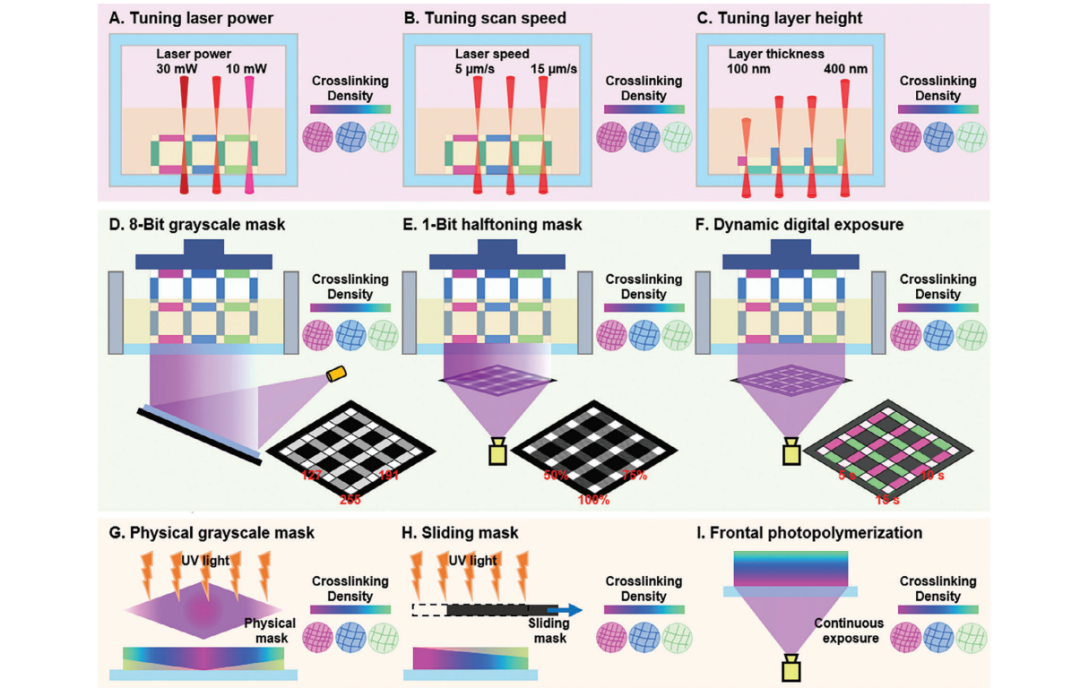
In planar projection grayscale printing, the authors point out that this route is currently the most universal grayscale 3D printing technology. Specifically, spatially varying doses can be achieved on a plane in two ways: first, the grayscale mask method, which modulates light intensity using an 8-bit grayscale image or a halftone mask based on binary dot patterns; second, the digital exposure method, which changes local doses by assigning different exposure times to different areas. In the former, the 8-bit grayscale mask relies on optical engines such as DMD/LCoS that can achieve grayscale duty cycle modulation, where the grayscale value of each pixel corresponds to the duty cycle of the mirror ON/OFF, thus forming 256 levels of approximately continuous light intensity; for commercial projection printers that only support black-and-white images, halftone algorithms can be used to encode grayscale information into black-and-white pixels of different densities and arrangements, controlling the light transmission ratio per unit area to achieve “equivalent grayscale.” In the latter, by modifying the printing G-code or controlling the projection timing, different exposure times can be assigned to different pixels on the same plane, allowing for gradient doses even under fixed light intensity. The authors note that both grayscale masks and digital exposure essentially construct spatially controllable exposure dose fields, with the former focusing on light intensity distribution and the latter on time allocation; both can be used complementarily to achieve a wider range of performance control.
The third category of “other” grayscale technologies includes physical grayscale masks, sliding masks, and forward photopolymerization methods. These methods are often used for height and crosslinking degree gradients in single layers or limited thickness directions, such as using a physical mask with radial transmission rate variations to prepare silicone elastomers with elastic modulus gradients, or forming linear exposure gradients on the resin surface through sliding masks. FPP creates continuous dose gradients in the thickness direction by having light enter from one side and gradually attenuate within the resin, suitable for preparing structures with swelling or stiffness gradients in the thickness direction. Compared to laser and projection schemes, these methods are less capable of achieving complex three-dimensional suspended geometries but have the advantage of being simpler in processing for surface textures, single-layer multi-level steps, or specific thickness gradient structures.
In terms of specific applications, the authors first introduce the application of grayscale VP in microfluidics and micro-optics. Based on Lambert-Beer law and SLA process curves, different curing depths can be obtained within a layer through a single grayscale exposure, thus constructing multi-level steps, curved interfaces, and complex cross-section microchannel structures without the need for multiple exposures or multi-step etching. Typical works include achieving approximately circular cross-section microchannels using dual-projection grayscale exposure, or using halftone masks to prepare mixer channels with multi-level concave-convex structures in a single exposure, thereby enhancing convective mixing at the microscale. Similar principles have also been used to prepare multi-level micro-lens arrays, metal lenses, and biomimetic compound eye structures, by grayscale controlling local curing thickness to obtain continuous surfaces and low roughness optical interfaces, providing manufacturing means for high-resolution imaging, micro-displays, and micro-optical components.
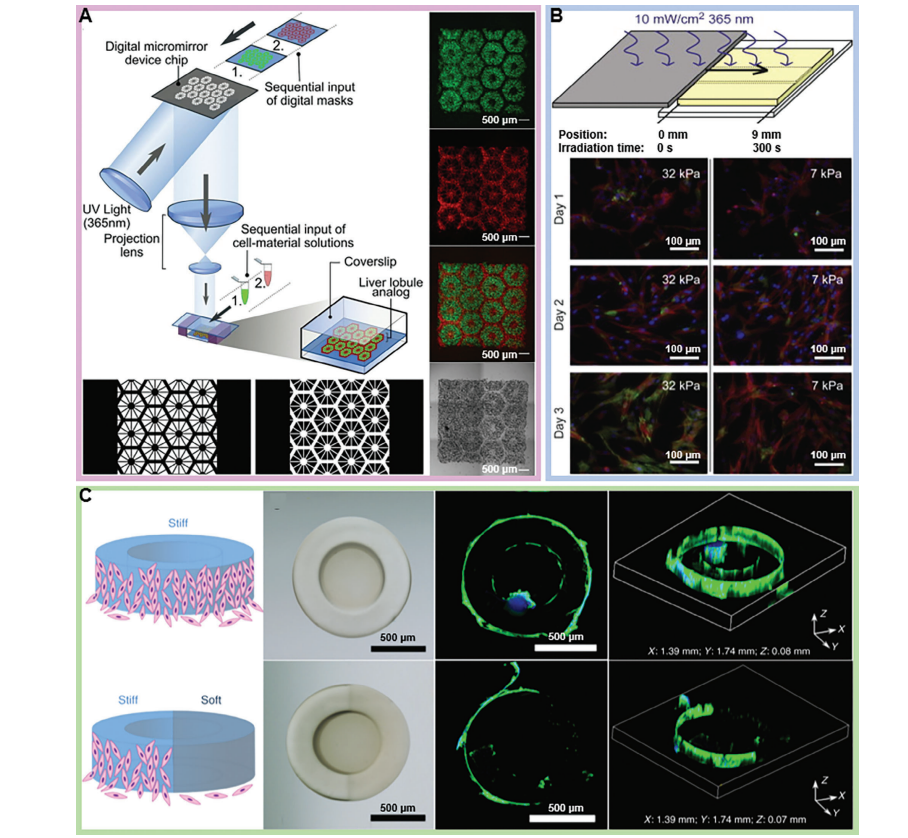
In the biomedical field, an important advantage of grayscale VP is its ability to finely control the mechanical and structural properties of the extracellular matrix (ECM) on a three-dimensional scale, thereby constructing tissue models that are closer to physiological environments. For example, a study cited by the authors utilized grayscale digital masks to print a 3D liver model containing liver lobule geometry and vascular networks, embedding human induced pluripotent stem cell-derived liver progenitor cells and supporting cells in different regions, achieving spatially partitioned cell-matrix combinations, and observing improved functional expression during long-term in vitro culture. Additionally, by using photodegradable or photo-tunable modulus hydrogels, researchers can construct elastic modulus gradients on the same substrate and study the activation behavior of cardiac valvular interstitial cells in regions of different stiffness, revealing the mechanism of ECM stiffness on myofibroblast differentiation. Utilizing grayscale UV dose control to modulate the crosslinking degree and stiffness of hydrogel scaffolds can also guide smooth muscle cells to selectively migrate and adhere on tubular structures, thereby constructing vascular-like tissues with anisotropic cell distributions. Overall, these works indicate that grayscale VP provides a high-precision, parameterizable platform for constructing in vitro microenvironments for tissue engineering, organ-on-a-chip, and drug screening.
In the area of gradient color printing and coded structures, grayscale exposure not only modulates mechanical and swelling properties but can also achieve color gradients and multi-level information encoding by affecting dye distribution, photochromic or photocatalytic processes. For example, by performing multi-level UV exposure to first construct crosslinking degree gradients in photopolymerized acrylate resins, and then utilizing the diffusion-adsorption behavior differences of pigments (such as photochromic spiropyran or fluorescein), local dye concentration and chromaticity gradients can be achieved, thus preparing multi-level QR codes and anti-counterfeiting patterns recognizable by machines. Another work utilized photo-oxidation or photo-reduction to induce color changes in dyes or metallic nanoparticles, achieving multi-color 3D printing in a single tank and batch through pixel-level exposure dose control, such as using solvent blue 104 to transition continuously from blue to yellow under different degrees of free radical oxidation, completing multi-colored three-dimensional structures with complex patterns. Work based on silver ion photo-reduction and plasmon resonance control demonstrated the preparation of programmable color plasmonic nanostructures on glass substrates through grayscale photocatalysis, achieving highly programmable color images.
In the fields of soft robotics and origami/”4D printing,” grayscale photopolymerization introduces spatially designable crosslinking and swelling gradients within responsive hydrogels or non-responsive polymers, enabling reversible or unidirectional deformation induced by temperature, pH, or solvent. Represented by PNIPAAm thermal-responsive hydrogel systems, different crosslinking degrees and phase transition behaviors can be constructed within the same structure through grayscale TPP or grayscale mask SLA, producing micro-actuators such as temperature-driven micro-grippers or bending beams that can repeatedly open and close between 20–45 °C. In pH-responsive systems, a gradient design of crosslinking density between the center and outer layer can achieve reversible transitions between spherical and cylindrical shapes in acidic and alkaline environments. Three-dimensional deformable structures generated through single-step direct writing and grayscale design can also achieve micro-scale “transformers,” switching between two completely different three-dimensional configurations under different stimuli. For non-responsive polymers, controlling solvent swelling gradients through FPP and grayscale masks can also achieve reversible transitions between flat and folded states in origami structures during solvent absorption or temperature switching, providing new construction strategies for deformable photonic devices and flexible electronics.
In the outlook section, the authors point out that achieving higher performance and broader application ranges for grayscale VP 3D printing still faces several key challenges and development directions. First, in terms of materials, current grayscale VP mainly uses transparent single-component photosensitive resins, while composite resins filled with high refractive index particles limit the realization of high-resolution grayscale printing due to scattering and light transmission issues. Future developments need to focus on low-scattering photopolymer composite systems, allowing grayscale strategies to be combined with ceramics, metals, or functional polymer fillers, thereby introducing functional gradients such as dielectric, magnetic, conductivity, or biomineralization on the basis of monomer crosslinking degree gradients. Additionally, the combination of multi-materials and grayscale is expected to achieve spatially coupled gradients of composition and crosslinking degree in two-dimensional or three-dimensional spaces, providing greater freedom for the design of complex soft robotics, anisotropic devices, and multi-modal functional structures.
Secondly, regarding the grayscale strategy itself, although 8-bit masks have been widely used in custom systems, commercial printers often only accept binary image files. Therefore, generating binary grayscale masks that balance resolution, grayscale continuity, and processing efficiency based on halftone algorithms remains a challenge that couples algorithms and processes. Factors such as light scattering and the diffusion of activated species from photoinitiators can significantly enlarge the effective exposure area of a single pixel, leading to blurred boundaries and loss of resolution. Thus, combining optical simulations with experimental calibration to perform forward and backward optimization of projection patterns is necessary. Furthermore, different applications have varying trade-offs regarding surface roughness, gradient continuity, and geometric accuracy: for example, micro-optical components require continuous light intensity and low roughness surfaces, while microfluidic mixers may benefit from roughness to enhance mixing, necessitating targeted pattern selection and parameter optimization in the design of grayscale strategies for specific applications.
Thirdly, in terms of application expansion, existing works mostly focus on gradient control of mechanical, thermal, swelling, and optical properties, as well as the construction of in vitro cell culture models, with relatively few studies directed towards engineering applications such as porous conductive pathways, magnetic gradient devices, and large-scale energy-absorbing structures. In biomedicine, grayscale VP also has the potential to be applied in the manufacturing of real implants, organoids, and complex organ-on-a-chip systems, simulating complex tissue partition structures and functional distributions through spatially programmable ECM and multi-cell co-culture microenvironments. To promote the realization of these applications, multidisciplinary collaboration between materials science, optical engineering, biomedical engineering, and industry is needed to jointly develop new grayscale mask generation algorithms, printable composite materials, and multi-material photopolymerization systems.
Overall, this review work comprehensively constructs a technical map of the research direction from grayscale photopolymerization 3D printing to functionally graded materials, from the basic photopolymerization mechanisms to specific grayscale implementation paths, and to multi-domain application cases and future development directions, providing important technical references and methodological frameworks for researchers in related fields, and laying a theoretical and technical foundation for expanding VP 3D printing from traditional “structural manufacturing” to “integrated gradient manufacturing of structure-performance-function.”
Related literature and image sources
https://doi.org/10.1002/adfm.202314635
 MNTech Micro-Nano NavigationScan the QR code to follow usPrevious Recommendations:
Thermal-Induced Shrinkage Achieves Ultra-Uniform Dielectric Networks in the Telecom Band Photon Bandgap
Fluid-Driven Wireless Microrobots Achieve Autonomous Navigation in Pipelines
Click here to “read the full text” to view the original paper