Recently, our orthopedic department successfully applied the “AI-driven design + 3D printing” technology to precisely perform a total knee replacement for an elderly patient with special medical conditions.
A 74-year-old female patient had undergone internal fixation surgery for an intertrochanteric fracture six months ago. Recently, her osteoarthritis symptoms in the knee joint significantly worsened, causing severe pain that made walking impossible. The surgery was complicated by the presence of a PFNA internal fixation device in the femur, which prevented the installation of a traditional osteotomy guide plate. Faced with this challenge, Dr. Hu Deya’s team customized an AI-driven design and 3D printed knee osteotomy navigation template for her. Preoperatively, the doctors completed 3D reconstruction, simulated the osteotomy and prosthesis installation on a computer, and determined the optimal plan; during the operation, the personalized guide plate created by 3D printing accurately implemented the preset plan.
The innovative core of this technology lies in transforming virtual surgical planning into real surgical operations. The precision of 3D printing technology allows for the customization of surgical tools (osteotomy templates), simplifying complex surgeries, effectively shortening operation time, reducing intraoperative bleeding, and improving surgical outcomes.
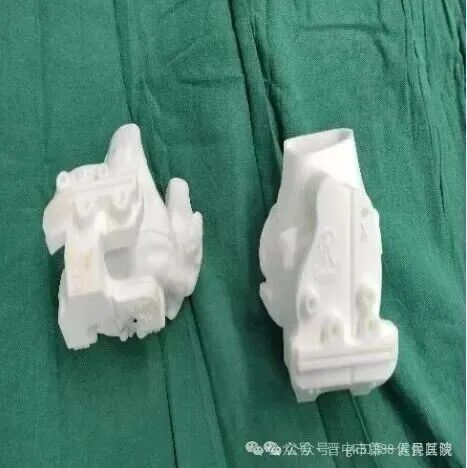
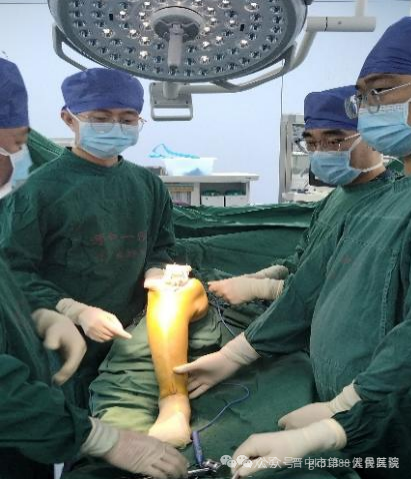 The application of the AI-driven design + 3D printed personalized osteotomy navigation template acts like a clear “execution roadmap” for the surgery, guiding the direction and position of the osteotomy, ensuring that the surgery proceeds according to the preset plan.The successful implementation of this surgery marks a transition in our orthopedic department from “experience-dependent” to “precision-customized” practices, further achieving the goals of precision, personalization, and minimally invasive development.