On August 27, the ultra-high frequency partial discharge online monitoring system built by State Grid Xinjiang Electric Power Co., Ltd. has been operating stably for 10 days after passing acceptance.
This system is the first of its kind in the five provinces of Northwest China to achieve networked monitoring, marking a breakthrough in the intelligent operation and maintenance of equipment in the Xinjiang power grid. By monitoring the internal status of circuit breakers and GIS equipment in real-time, it can accurately achieve early warning and diagnosis of partial discharge, significantly improving operation and maintenance efficiency, and providing a “smart eye” for the safe operation of the power grid.
GIS equipment (Gas Insulated Switchgear) is like a “capsule” for the power grid, enclosing live components within a metal shell filled with sulfur hexafluoride gas. As the core equipment of the power grid, circuit breakers can experience early failures due to insulation aging and electric field distortion, which cannot be directly observed with the naked eye. Long-term accumulation may lead to insulation breakdown or even power outages. In the past, operation and maintenance personnel acted as the “general practitioners” of the equipment, requiring regular manual inspections. However, the traditional model has obvious limitations; testing at a single monitoring point takes 20 seconds, making it difficult to capture sporadic discharge signals that occur only a few times a day. Fault location also requires repeated testing at adjacent points and manual calculations, often taking nearly a day to inspect a substation.
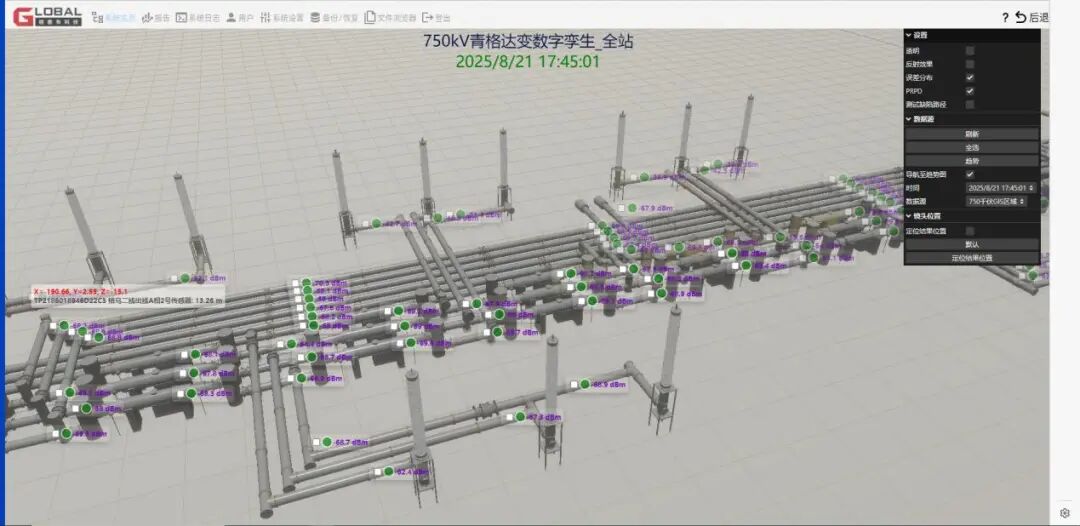
▲ Screenshot of the ultra-high frequency partial discharge online monitoring system page for the ultra-high voltage substation. (Photo by Zhao Hexiang)
To solve this problem, starting from July 2024, State Grid Xinjiang Electric Power initiated the construction of a “wired” network for GIS, HGIS, and tank-type circuit breaker equipment. The system has added functions such as “cumulative PRPD” and “PRPS” spectrum analysis diagnosis, and AI diagnosis of partial discharge spectra. Through online platform sound and light alarms, warning pop-ups, intelligent identification of discharge types, and three-dimensional twin model positioning, it achieves real-time uploading of circuit breaker partial discharge data, effectively reducing on-site testing time and errors.
The construction process was not smooth. “Just measuring the length of the busbar on-site before modeling requires a week of preparation for one substation,” said Zhang Licheng, head of the equipment department of State Grid Xinjiang Electric Power. The team also overcame issues such as slow loading of the three-dimensional model and insufficient realism of the images, ultimately enabling the system to achieve networked monitoring, with a technical level leading in the country.
The system records every signal emitted by the equipment in real-time, automatically alarming when sporadic signals accumulate to a threshold, completely solving the limitations of traditional inspections. By capturing weak electromagnetic wave signals inside the equipment with sensors, with a sensitivity of up to 10 millimeters, it analyzes the intensity, frequency, and location of partial discharge in real-time, triggering graded alarms upon detecting anomalies. Additionally, through a multi-sensor time-difference positioning algorithm, it automatically completes signal analysis between two points, achieving decimeter-level positioning within 15 minutes. Combined with the three-dimensional twin model, operation and maintenance personnel can accurately locate the fault point.
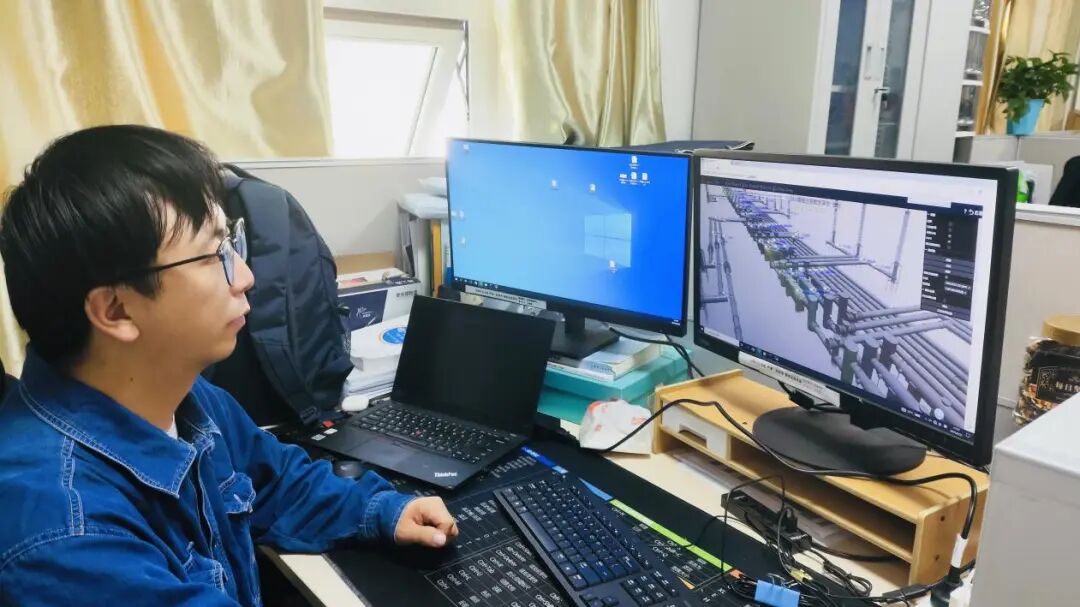
▲ Operation and maintenance personnel using the ultra-high frequency partial discharge online monitoring system for equipment status monitoring. (Photo by Zhao Hexiang)
“In the past, such internal discharge issues could only be discovered through on-site tests. Now, relying on the platform, our operation and maintenance personnel can monitor system alarms in real-time, significantly advancing the time for identifying potential hazards,” said Zhao Hexiang from the operation and maintenance department of State Grid Xinjiang Ultra-High Voltage Company. “Previously, it took one day to travel from Urumqi to the site for testing; now, analysis can be completed in 10 minutes from the office, greatly reducing the time for hazard detection.”
As of now, State Grid Xinjiang Electric Power has completed the installation of 1,873 points for 750 kV and 220 kV GIS, achieving a coverage rate of 65.3%. In the next step, State Grid Xinjiang Electric Power will further integrate the platform, incorporate monitored equipment information, and establish a database of typical cases of abnormalities for similar equipment. Through advanced digital models, it will comprehensively display and monitor the operational status of main equipment in 750 kV substations, providing a solid guarantee for the safe and stable operation of the ultra-high voltage power grid.
Source of information | State Grid Xinjiang Electric Power official website
Contributors | Shao Xinqiang, Zhao Hexiang
Editors | Liu Gege, Proofread by Zhou Yatao

Recommended for you
-
Glorious 70 Years, Advancing into a New Journey | Electric Warmth in the Alley
-
Glorious 70 Years, Advancing into a New Journey | From “On-Site Meter Reading” to “Done at Your Fingertips” for People’s Livelihood
-
Commuting at an Altitude of 3,800 Meters? Who is on This Bus?
-
[CCTV] Extreme Xinjiang | Surging Oasis
-
Glorious 70 Years, Advancing into a New Journey | Tiemenguan Hydropower Station: The Bright Mark Left by Steel Drills