
Introduction
In modern data centers, supercomputing clusters, and cloud computing platforms, there is a need for high-speed, low-latency, and stable interconnections between servers, switches, and storage devices. Among various interconnection solutions, DAC (Direct Attach Copper) and AOC (Active Optical Cable) are the two most widely used cable solutions. Although they may seem similar, they each have distinct characteristics in terms of structure, performance, and application scenarios. So how should one choose between DAC and AOC for data transmission?

1. Definitions of DAC and AOC
DAC (Direct Attach Copper) is essentially a copper cable with fixed optical devices integrated at both ends, directly transmitting electrical signals between device ports. Because it does not require optical-electrical conversion, it is a low-cost, low-power solution for short-distance data transmission.
AOC (Active Optical Cable) can be understood as a fiber optic cable that permanently integrates optical-electrical conversion modules at both ends. It converts electrical signals into optical signals at the sending end and transmits them through fiber optics, then converts the optical signals back into electrical signals at the receiving end, enabling longer-distance data transmission with stronger interference resistance.

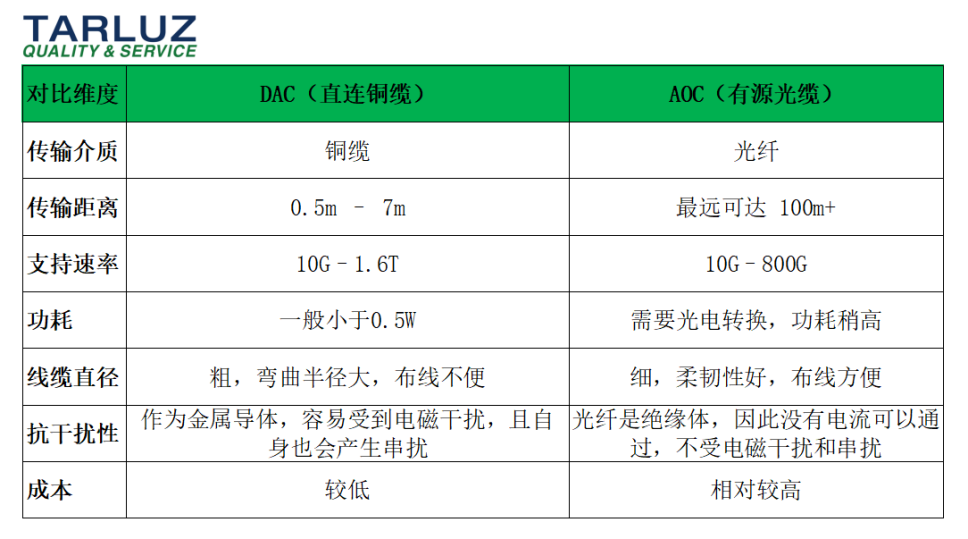
2. Performance Comparison: DAC vs AOC

3. Applicable Scenarios



4. Conclusion
In data transmission interconnections, both DAC and AOC have their advantages: DAC is more suitable for short distances, low cost, and low power scenarios; AOC, on the other hand, excels in long-distance, high-interference environments, and complex wiring applications. Therefore, when deploying in practice, one should weigh the choice based on transmission distance, wiring environment, budget, and power consumption to achieve an optimal balance between performance and cost.
END
Tailu Communication specializes in providing optical interconnection solutions for data centers and enterprise networks, offering a full range of data center cabling products including 1.25G/10G/25G/40G, 100G/200G, 400G/800G optical modules, high-speed IB optical modules, active optical cables (AOC), high-speed cables (DAC), high-density MPO pre-terminated fiber jumpers, high-density fiber distribution boxes, module boxes, adapter panels, and more.