Abstract In the cutting-edge field of modern integrated circuit (IC) design and manufacturing, the continuous increase in chip power density has made thermal management an increasingly severe challenge. From advanced process nodes with FinFET and GAA transistors to 3D integration and heterogeneous integration technologies, localized “hot spots” at the micron or even nanometer scale have become major bottlenecks that limit chip performance, accelerate failure mechanisms, and severely impact product reliability. Traditional contact temperature measurement methods, such as thermocouples and resistance temperature detectors (RTDs), struggle to accurately capture microscopic hot spots due to their probe size limitations and thermal bridge effects. Although non-contact infrared thermography can provide temperature distribution at a macroscopic level, it still falls short in high-precision detection at sub-micron or even nanometer scales.
To break through this bottleneck, Thermal Reflectance Imaging (TR) technology, with its unique non-contact measurement principle and excellent sub-micron spatial resolution, has become a highly valuable “eye of insight” for professionals in integrated circuit thermal management. TR technology can reveal the microscopic temperature distribution on the chip surface with extreme precision, providing unprecedented tools for hot spot identification, thermal conduction mechanism research, and heat dissipation design optimization. This article will delve into the theoretical foundation, measurement principles, main methods, advantages, and limitations of thermal reflectance imaging technology.
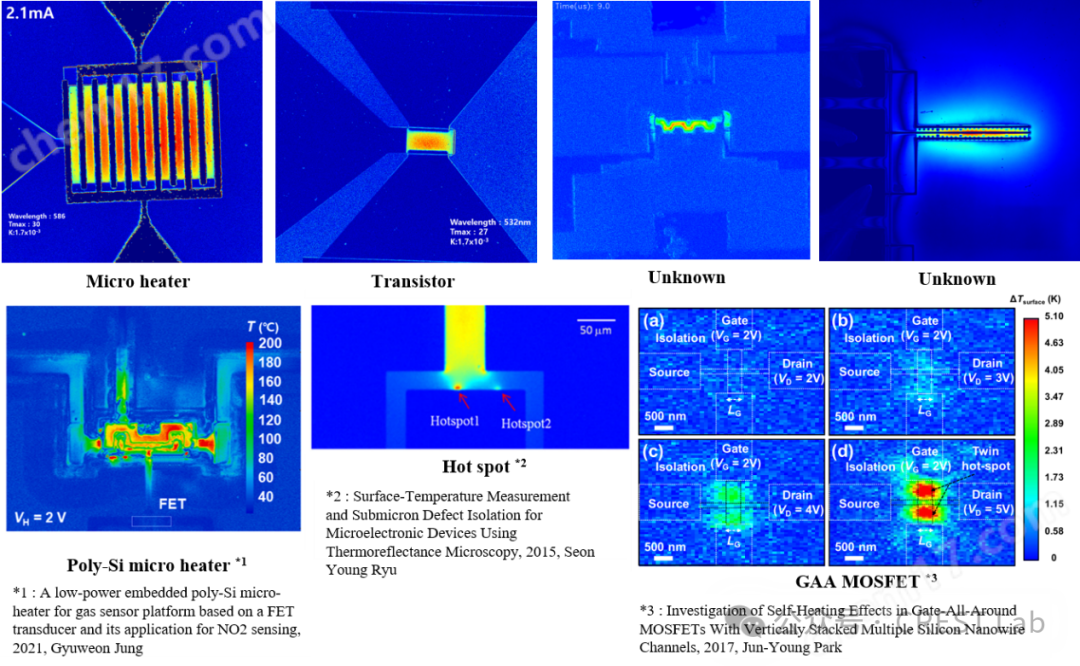
Image of TRM250 Thermal Reflectance Microscope
1. Theoretical Foundation: Thermo-reflectance Effect
The core physical principle of thermal reflectance imaging is the thermo-reflectance effect. In simple terms, the reflectivity of a material’s surface will change linearly or quasi-linearly with slight changes in its own temperature.
The microscopic origin of this phenomenon lies in the temperature dependence of the material’s optical constants (complex refractive index, usually denoted as n, where n is the refractive index and k is the extinction coefficient). When the temperature of the material changes:(1) Change in electronic band structure: As the temperature rises, the lattice atomic vibrations intensify, causing a slight shift in the band gap, which directly affects the material’s absorption and reflection of light at specific wavelengths.(2) Enhanced carrier scattering: Increased temperature leads to enhanced scattering between carriers (electrons, holes) and lattice vibrations (phonons), affecting the effective mass and lifetime of carriers, thereby changing the material’s conductivity and optical absorption.(3) Lattice expansion: Thermal expansion causes changes in lattice constants, further affecting electronic band and optical properties.
These microscopic changes ultimately lead to variations in the complex refractive index of the material at specific wavelengths, resulting in corresponding slight changes in its surface reflectivity to incident light.
Mathematically, the thermo-reflectance effect can be characterized by the thermo-reflectance coefficient, which defines the relationship between the relative change in reflectivity R and temperature change T:
where R/T is the partial derivative of reflectivity with respect to temperature.(1) Different materials, such as metals (aluminum, copper), semiconductors (silicon, gallium arsenide), may have different magnitudes and signs of thermo-reflectance coefficients.(2) For the same material, the thermo-reflectance coefficient also depends on the wavelength of the incident light (detection wavelength). Choosing a detection wavelength with a larger thermo-reflectance coefficient can improve measurement sensitivity.(3) In practical applications, to obtain stronger signals and broader applicability, a thin metal layer with a high thermo-reflectance coefficient (such as aluminum, gold, or titanium) is usually deposited on the surface of the chip as a transducer layer. This thin film can efficiently convert internal heat changes of the chip into detectable surface reflectivity changes.
2. Measurement Principle: Pump-Probe Technology and System Composition
The thermal reflectance imaging system is typically based on pump-probe technology, whose core idea is to use two independent but coordinated laser beams to perform heating and detection tasks:
1. Basic Workflow:(1) Pump Laser: A high-power laser (usually continuous wave or periodically modulated wave) is focused onto the chip surface to locally heat the sample, causing a temperature change.(2) Probe Laser: A low-power laser (usually continuous wave) is also focused on the same area, with its energy far lower than that of the pump laser to avoid additional heating. The probe laser is reflected by the sample surface, and its reflected light intensity will change slightly due to local temperature changes.(3) Signal Detection: The reflected probe laser is received by a detector. By precisely measuring the slight changes in reflected light intensity, combined with the pre-calibrated thermo-reflectance coefficient, the temperature change on the sample surface can be calculated.
2. Typical TR System Composition:A standard thermal reflectance imaging system typically consists of the following key components:(1) Laser Sources:
- • Pump Laser: Used to heat the sample, which can be a continuous wave (CW) laser (for steady-state measurements) or a pulsed laser (for transient measurements). Common wavelengths include 532 nm, 488 nm, etc. For transient measurements, the pump laser may need to be modulated at high frequency through an acousto-optic modulator (AOM) or use picosecond/femtosecond pulsed lasers.
- • Probe Laser: Used to measure reflectivity changes, typically a continuous wave low-power laser, such as red lasers (633 nm, 670 nm) or blue lasers (405 nm), with a wavelength different from the pump laser to allow separation through filters.
(2) Optical System:
- • Microscope: Typically an inverted or upright metallurgical microscope with high numerical aperture (NA) objectives, used to precisely focus the laser beam onto sub-micron areas and collect reflected light.
- • Beam Splitters: Used to separate and combine the pump laser, probe laser, and reflected light paths.
- • Filters: Including notch filters to block pump laser reflected light and bandpass filters to select reflected light from the probe laser to improve the signal-to-noise ratio.
- • Polarizers: Sometimes used to control the polarization state of the laser or enhance contrast.
(3) Detector & Signal Processing Unit:
- • High-Speed Photodiode: For single-point or transient measurements, with fast response speed.
- • CCD/CMOS Camera: For two-dimensional spatial scanning imaging, used to quickly capture the distribution of reflected light intensity.
- • Lock-in Amplifier: This is a crucial component in the TR system. Since the reflectivity change signal is very weak, the lock-in amplifier can precisely extract the weak periodic signal from background noise by synchronizing with the modulation frequency of the pump laser, greatly improving the signal-to-noise ratio and measurement sensitivity.
(4) Sample Positioning and Scanning Platform:
3. Core Measurement Modes and Methodology
Thermal reflectance imaging technology can be subdivided into various measurement modes based on its heating and detection characteristics to meet different thermal measurement needs:
1. Steady-State Thermal Reflectance (SSTR):(1) Principle: The pump laser continuously and stably heats the sample, while the probe laser continuously measures reflectivity. When the chip reaches thermal equilibrium, the steady-state change in surface reflectivity is obtained point-by-point by scanning the probe laser or moving the sample.(2) Application: Mainly used to map the two-dimensional temperature distribution of the chip under stable operating conditions, accurately identifying and locating persistent “hot spot” areas. This method is relatively simple and intuitive, commonly used for hot spot analysis.
2. Transient Thermal Reflectance (TSTR): Transient TR focuses on measuring the material’s response to thermal disturbances over time, revealing the dynamic processes of heat conduction and the thermal properties of materials.
(1) Time-Domain Thermoreflectance (TDTR):
- • Principle: TDTR is a typical representative of transient TR, utilizing two ultra-fast (picosecond or femtosecond) pulsed lasers. One “pump” pulse laser periodically heats the sample surface, while the other “probe” pulse laser arrives at the heated area with a variable delay time, measuring the surface reflectivity change caused by the pump pulse. As heat diffuses within the sample, the reflectivity signal decays over time.
- • Measurement: By systematically changing the time delay between the pump and probe pulses, the decay curve of reflectivity can be obtained.
- • Application: By fitting the measured reflectivity decay curve with theoretical heat conduction models, thermal properties such as thermal conductivity, interfacial thermal resistance in multilayer structures, and film thickness can be accurately extracted. TDTR has extremely high temporal resolution (up to picosecond level), enabling in-depth studies of phonon transport processes at the nanoscale.
(2) Frequency-Domain Thermoreflectance (FDTR):
- • Principle: FDTR uses a pump laser beam modulated by a sine or square wave to periodically heat the sample surface. The probe laser measures the phase delay and amplitude changes of the reflected signal. By changing the modulation frequency of the pump laser, the penetration depth of the thermal wave (thermal diffusion length) can be altered, allowing for the detection of thermal properties at different depths.
- • Measurement: Measure the phase and amplitude of the reflected signal relative to the pump signal as a function of modulation frequency.
- • Application: Similar to TDTR, FDTR can also be used to measure film thermal conductivity and interfacial thermal resistance. Its advantage lies in potentially simpler equipment configuration than TDTR, and by changing the modulation frequency, thermal depth profiling can be achieved, suitable for thermal property analysis of multilayer structures.
3. Scanning Thermal Reflectance (STR):(1) Principle: Whether in steady-state or transient mode, TR technology can obtain measurement signals point-by-point by precisely scanning the laser beam or moving the sample. By combining the temperature information from these discrete points, a two-dimensional temperature distribution map of the chip surface can be constructed.(2) Spatial Resolution: The spatial resolution of STR is mainly limited by the diffraction limit of the optical system and the size of the laser spot, typically reaching sub-micron levels (for example, using high numerical aperture objectives can achieve spatial resolutions of several hundred nanometers or even tens of nanometers).(3) Application: STR is a core method for drawing high-precision hot spot maps, clearly displaying temperature differences of small heating units within the chip, which is crucial for identifying and analyzing microscopic hot spots.
4. Key Advantages and Inherent Limitations
1. Core Advantages:(1) Non-contact Measurement: TR technology does not require physical contact with the sample throughout the measurement process, completely avoiding the “thermal bridge” effect that traditional contact temperature measurement methods may introduce, ensuring the authenticity of the measurements.(2) Extremely High Spatial Resolution: Capable of achieving sub-micron or even tens of nanometers spatial resolution, making TR technology an ideal tool for identifying and characterizing small hot spots in advanced process chips.(3) Excellent Temporal Resolution: Transient TR (especially TDTR) can achieve temporal resolution up to the picosecond to nanosecond level, capturing transient power changes and rapid heat conduction processes within the chip, which is critical for analyzing dynamic thermal behavior and thermal shock effects.(4) Quantitative Thermal Property Extraction: TDTR and FDTR can not only measure temperature but also quantitatively measure the thermal conductivity and interfacial thermal resistance of film materials, which is of significant guidance for the development of new materials and multilayer packaging design.(5) Broad Applicability: As long as materials exhibit the thermo-reflectance effect (which almost all materials do), and the surface is appropriately treated (such as depositing a thin metal layer), TR technology can be applied.
2. Inherent Limitations:(1) Surface or Near-Surface Sensitivity: Due to the limited penetration depth of the probe laser (usually several tens of nanometers), TR technology primarily measures the temperature at or near the surface of the sample. This makes it difficult to directly detect areas deep within the chip packaging or covered by opaque materials.(2) Calibration Required: The thermo-reflectance coefficient is a parameter related to the material and wavelength, requiring precise calibration through standard samples or at known temperatures. The accuracy of calibration directly affects the reliability of measurement results.(3) Surface Preparation Requirements: To enhance signal strength and measurement applicability, it is often necessary to deposit a thin metal layer with a high thermo-reflectance coefficient and good flatness (a few nanometers to tens of nanometers) on the chip surface, which increases the complexity of sample preparation.(4) Laser Heating Effects: Although the probe laser power is very low, the heating from the pump laser may also have unintended effects on the sample. Precise control of laser power and optimization of measurement strategies to minimize temperature disturbances introduced by the laser itself are crucial.(5) Weak Signals and Signal-to-Noise Ratio: Thermal reflectance signals are typically very weak, requiring high-performance detectors, lock-in amplification techniques, and strict noise reduction measures to ensure measurement accuracy.(6) Complexity and Cost of Equipment: A complete high-precision TR system typically includes various lasers, complex precision optical devices, and high-speed signal processing units, with relatively high acquisition and maintenance costs, and operation requires specialized knowledge.
Conclusion: Thermal reflectance imaging technology, as a high-precision non-contact optical temperature measurement method, has become an indispensable tool in the field of microscopic thermal management of integrated circuits. It empowers engineers and researchers with unprecedented capabilities to “see” the thermal world inside chips, accurately identify hot spots, understand heat conduction mechanisms, and optimize heat dissipation solutions. In the future, as the technology itself continues to mature, TR technology will play an even more critical role in promoting the development of high-performance, high-reliability integrated circuits, ensuring the “cool” operation of chips.