RS232 and RS485 are two popular serial data communication protocols established by the Electronic Industries Alliance (EIA) for communication between systems and peripheral devices. Although they have been largely replaced by the USB standard on the PC side, they are still widely used in the industrial control field.
What is the RS232 Protocol?
The RS-232 serial wiring interface was introduced in 1962. It is well known as the oldest wiring method for establishing connections between data terminal equipment and data communication equipment. For example, the connection between a computer system and a printer.
The diagram below illustrates the RS-232 interface between two devices:
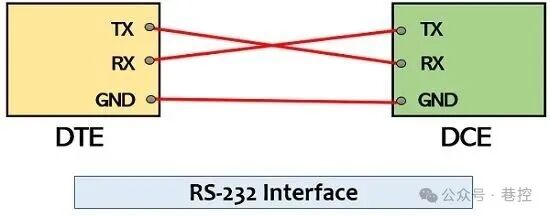
This clearly indicates that it has a single transmitter and a single receiver node along with a ground terminal. Commands sent from one end to the other use voltage signals. It defines logic 1 as a voltage level between –15 and –3V, while logic 0 is defined as a voltage level between +3 and +15V. The voltage range between -3 and +3V is an undefined state.
RS232 is an asynchronous protocol that does not provide a clock signal. Therefore, the unidirectional transmission method here is to first send a start bit, followed by the actual data sequence, to let the receiver understand the transmission. Additionally, this complete sequence is followed by a parity bit and a stop bit to signal the receiver that the sequence is complete.
What is the RS485 Protocol?
The RS-485 serial wiring interface, invented in 1998, is an advancement over RS-232 that is suitable for today’s technological advancements. This communication protocol can handle 32 connected devices, while RS-232 only supports 1. Therefore, it has 32 transmitters and 32 receiver terminals, allowing for easy connection of multiple devices in a single system.
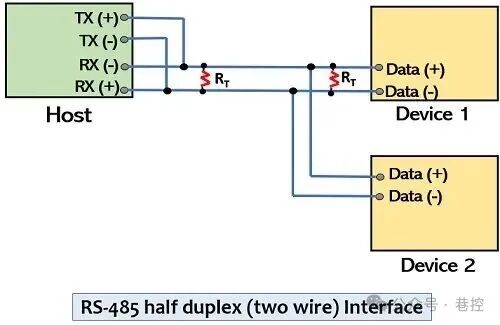
In RS-485, when the voltage level varies between -200mV and -6V, it is interpreted as logic 1. If it varies between +200mV and +6V, it will be logic 0.
When combined with RS-485, the twisted pair cable arrangement provides high-speed long-distance transmission suitable for various industrial applications. Before the advent of RS-485, another standard called RS-422 was invented. RS-422 also supports differential mode. However, the RS-422 protocol has some limitations, which RS-485 has eliminated, making it widely used in industry.
Typically, it is a two-wire half-duplex system, but sometimes four wires are used for full-duplex operation.
Differences Between RS232 and RS485:
1. RS-232 and RS-485 are types of data cables that facilitate data exchange between nodes in a network. Data transmission between nodes is categorized as single-ended and differential. RS-232 is a single-ended type of data transmission, but RS-232 provides very inefficient data transmission over long distances, necessitating the use of the differential type RS-485.
2. RS-232 supports a point-to-point network topology as it only connects two devices. In contrast, RS-485 supports a multipoint network topology, allowing multiple devices to be connected through this wiring method.
3. RS-232 has only 1 transmitter (driver) and 1 receiver. In comparison, RS-485 has 32 transmitters (drivers) and 32 receivers on a single bus.
4. RS-232 signaling type is unbalanced, while RS-485 provides balanced signaling type.
5. RS232 cable length is approximately 15m, which is relatively small compared to the cable length of 1200m for RS485. If the cable length of RS-232 exceeds 15m, resistance and voltage drop will become an issue.
6. RS485 provides a data transmission rate close to 20Mbps, while RS232 offers a data transmission rate of 10Kbps. A significant limitation of RS232 is its transmission speed, which led to the emergence of RS485.
7. RS-485 is used for longer transmission distances than RS-232. This is because RS232 has a lower transmission speed, making it inefficient for long-distance transmission.
8. Compared to RS-485, RS-232 has poorer immunity to noise, as RS485 operates in differential mode, reducing the effects of ground offsets and induced noise in the network. Additionally, this helps address issues related to data collisions.
9. RS232 provides a receiver input resistance range between 3K and 7K ohms. In contrast, RS485 has a relatively higher resistance value exceeding 12K ohms.
10. RS485 has a driver load of 60 ohms, which is lower than RS232‘s 3K to 5K ohms.
RS232 has advantages when short distances and low speeds are required. It is a simple and low-cost interface. When a simple communication interface is needed between two devices, RS232 can easily establish full-duplex communication. RS485 offers higher speeds over longer distances, making it commonly used in networks with multiple devices, allowing up to 32 devices in a single network over greater distances.