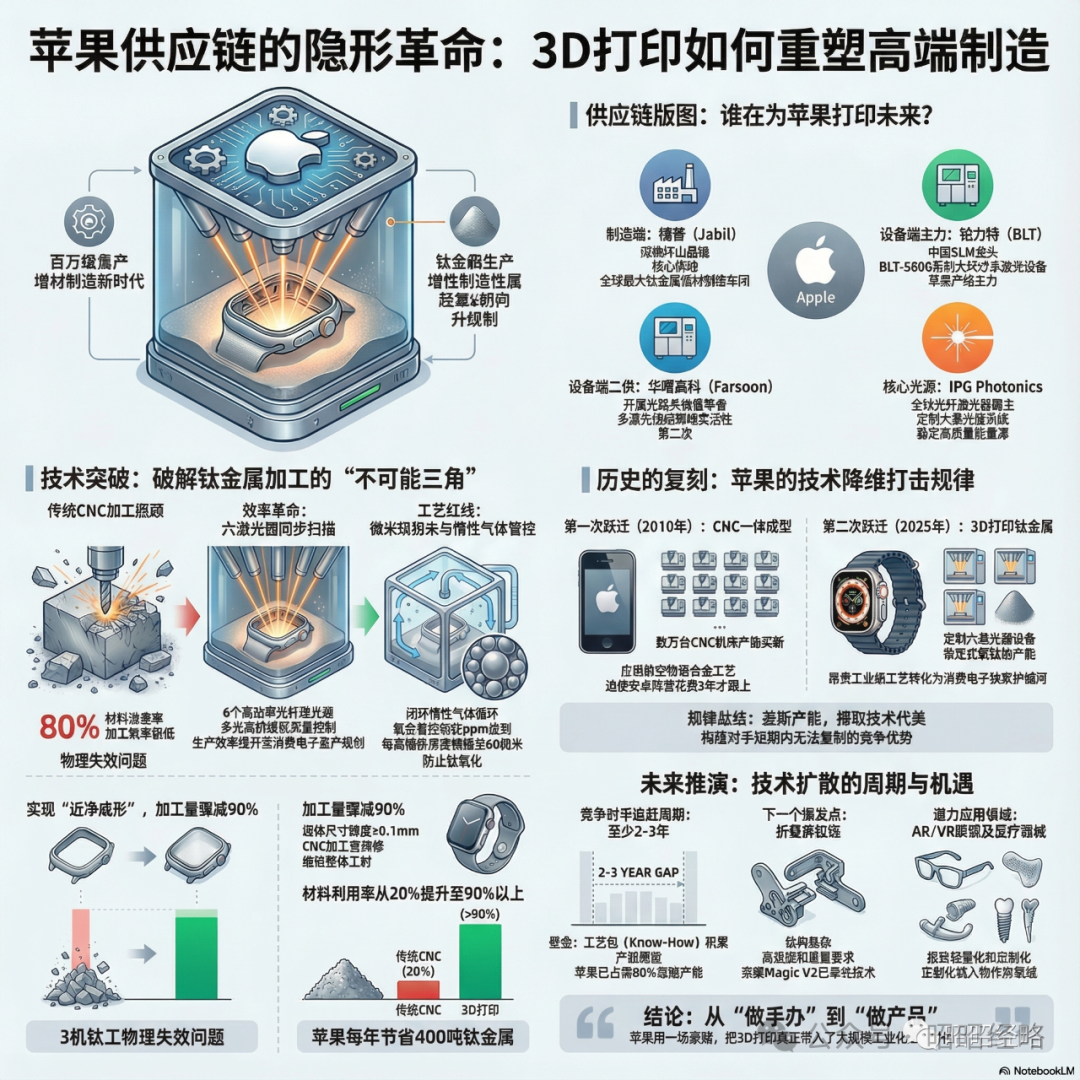
In November 2025, an official statement from Apple caused a greater stir in the manufacturing industry than the iPhone launch event:The Apple Watch Ultra 3 and Series 11 titanium versions will fully adopt3Dprinting technology for mass production.
This is not just a change in technology; it marks a watershed moment in the history of industrial manufacturing. It signifies that Additive Manufacturing has officially crossed the chasm of prototype validation and entered the deep waters of mass production at the million-unit level.
Today, we will peel back the marketing facade and deeply analyze Apple’s long-planned strategy from three dimensions: process logic, supply chain layout, and capacity barriers.
Part One: Violent Breakthrough — How to Solve the Impossible Triangle?
In the industrial sector, titanium processing has always faced the impossible triangle of cost, efficiency, and precision. The six-laser synchronous scanning SLM (Selective Laser Melting) technology adopted by Apple is a brute-force solution to break this triangle.
1. Pain Point:Physical Failure of CNC in Front of Titanium Titanium alloy (Ti-6Al-4V) has an extremely high specific strength, but its low thermal conductivity and high chemical reactivity make it a “tool killer.”
- Material waste rate up to 80%: Traditional CNC is subtractive manufacturing. To obtain a shell weighing a few grams, a solid titanium block weighing hundreds of grams must be cut away. For expensive aerospace-grade titanium, this is an unacceptable cost black hole (Apple saves 400 tons of titanium annually just from this).
- Processing efficiency bottleneck: Milling titanium requires extremely low feed rates to prevent overheating. The CNC processing time for a single shell can take dozens of minutes, which translates to astronomical machine investment for Apple Watch, with annual shipments in the tens of millions.
2. Breakthrough:Reconstruction of SLM Process Parameters Apple did not choose the seemingly faster Binder Jetting (binder jetting) but opted for the more technically challenging SLM. To address the slow and difficult issues of SLM, Apple redefined industrial standards:
- Efficiency revolution: Six-laser array (Multi-Laser System) Traditional single-laser SLM equipment cannot meet the rhythm of consumer electronics (Takt Time). Apple pushed equipment manufacturers to customize a printing system equipped with6 high-power fiber lasers.
- Core difficulty: It is not simply about adding laser heads but solving the metallurgical quality control in the multi-beam stitching area. Through dynamic focusing and airflow optimization, it ensures that the density of the overlapping area of the 6 laser beams during microsecond synchronous scanning is no different from other areas.
- Process red line: Micron-level powder control Titanium powder at a particle size of 50 microns has a high explosion risk. Apple has established a strict closed-loop inert gas circulation system:
- Oxygen content control: The oxygen content in the printing chamber is strictly locked at the ppm (parts per million) level to prevent titanium from oxidizing and becoming brittle.
- Layer thickness locking: The thickness of each powder layer is precisely controlled to60 microns.
- Near Net Shape: The printed blank has a dimensional accuracy of up to±0.1mm. This means that subsequent CNC processing has reduced from roughing to finishing, decreasing the processing volume by90%.
Part Two: Supply Chain Map — Who is Printing Apple’s Future?
Although Apple is tight-lipped about this, by cross-referencing import and export data, equipment manufacturers’ financial reports, and industry research reports, we can clearly outline this new titanium metal industry chain.
1. Manufacturing side: Jabil’s stronghold
- As a long-time supplier of aluminum/stainless steel structural components for Apple, Jabil’s base in Pingshan, Shenzhen, is widely regarded as the core site for this 3D printing mass production. Hundreds of industrial-grade metal printers are operating day and night, creating the world’s largest titanium metal additive manufacturing workshop.
2. Equipment side: Collective breakthrough of Chinese manufacturers
- BLT: This hardcore company from Northwestern Polytechnical University is the absolute leader in domestic SLM technology. ItsBLT-S800 series of equipment, with its large-size forming chamber and stable multi-laser control capability, is likely to occupy a main position in Apple’s production line.
- Farsoon: As an advocate of open-source optical systems, Farsoon’s flexibility in multi-laser sintering strategies makes it an indispensable second pole in Apple’s supply chain.
3. Light source side: IPG Photonics
- The six-laser system has extremely high requirements for beam quality stability. As the global leader in fiber lasers, IPG provides the core energy source behind this photothermal processing.
Part Three: Historical Recurrence — From CNC to 3D Printing Cycle
Looking back at Apple’s hardware innovation history over the past twenty years, we find a surprising pattern: Apple always builds a moat in consumer electronics by monopolizing the production capacity of certain aerospace-grade/industrial-grade processes.
First Leap: CNC Integrated Molding (2010)
- Background: Before the iPhone 4, CNC was mainly used in aviation and luxury goods.
- Apple’s Action: Apple bought out the production capacity of tens of thousands of Fanuc drilling and tapping centers at once.
- Result: This saturation attack, which made it impossible for competitors to purchase machines, forced the Android camp to spend three years to popularize all-metal bodies in budget phones.
Second Leap: 3D Printing Titanium (2025)
- Background: Titanium processing is difficult, with low yield and high costs.
- Apple’s Action: Apple collaborated with equipment manufacturers to customize six-laser equipment and secure high-quality titanium powder production capacity.
- Result: History is repeating itself. Apple is once again turning an expensive process into its own backyard.
Notably, Face ID (3D Structured Light): In 2017, Apple packed tens of thousands of laser points into the notch of the iPhone X. This technology was abandoned by most of the Android camp due to high costs and the trend towards full-screen displays. But this precisely proves that when a technology should have more application scenarios, as long as it is widely validated (such as facial payment), competitors find it hard not to follow.
Part Four: Future Projection — Time Lag of Technology Diffusion
1. Competitors’ Catch-up Cycle: At least 2-3 years This is not just about buying equipment.
- Process Package Barriers: How to lay each layer of 60 microns? How do 6 laser heads move? How does the airflow need to blow to carry away smoke and dust? These know-how were honed by Apple and its suppliers in the lab for years.
- Capacity Climbing Barriers: Equipment manufacturers’ capacity is also limited. When Apple occupies 80% of the high-end capacity of leading manufacturers like BLT, Huawei and Samsung must wait for the equipment manufacturers’ expansion cycle to obtain the same quality and quantity of equipment.
2. Dividend Spillover: Where is the next explosion point? The business logic of 3D printing is: The more expensive the material, the more complex the structure, and the higher the hardness, the more obvious the advantages. Based on this, we can predict the next explosive field:
- Foldable Screen Hinges: The axle cover structure is extremely complex and requires high strength and low weight (titanium alloy), making it an excellent scenario for 3D printing (Honor Magic V2 has already taken the lead).
- AR/VR Glasses Frames: They require extreme lightweight and customization, and titanium metal 3D printing will be the only solution.
Conclusion
Every technological revolution by Apple essentially exchanges the density of capital for technological advantages. While competitors are still figuring out how to cut faster with CNC, Apple has already changed tracks and started stacking atoms with lasers. This is the most brutal moat in high-end manufacturing.
- Hands-on business dissection: Want to know why customers say yes but vote with their feet? This article provides you with an interview manual that can extract users’ true feelings. Boss’s First Mirror: Customer Value Deep Interview Operation Manual Want to know how to scientifically copy homework and even surpass your competitors? This article gives you a set of attack and defense blueprints that can dissect any competitor from 360 degrees. Boss’s Second Mirror: Dissecting Competitors’ Moats, Choosing Offensive Strategies Manual Feeling like company growth has hit a ceiling and don’t know where to go next? This article provides you with a strategic map to find the second growth curve of the company. Boss’s Third Mirror: Hands-on Guide to Finding the Company’s Second Growth Curve Want to create a second startup within the company but fear being dragged down by old business? This article teaches you how to create a legal space for innovation to thrive. How a strong CEO uses OKR to carve a path for innovative business If you also enjoy reading methodology breakdowns like today: Masayoshi Son’s Yang Strategy: If you understand his abandonment of Nvidia, you understand SoftBank’s life-and-death game. The God of OKR’s Battle: See how Andy Grove used OKR to win a turnaround for Intel.
- Nvidia’s Yang Strategy: If you understand its investment in Nokia, you understand the AI war of the next decade.
- A 30-year antitrust war: How Apple, China, and Huawei challenge Qualcomm, the invisible empire.