Entrepreneurs need to follow the trends of the industry where they can hear the sound of gunfire.
By 2025, the global 3D printing industry is expected to exceed $40 billion, with an average annual compound growth rate of over 20%. In the first three quarters, China’s 3D printing equipment production increased by 40.5% year-on-year, significantly outpacing the two popular sectors of industrial robots and new energy vehicles.3D printing,known as the “manufacturing revolution,” is transitioning from the laboratory to industrialization at an unprecedented speed.
The keen sense of the capital market confirms this trend. Recently, technology giants have been investing in the 3D printing sector. DJI announced an investment of hundreds of millions of RMB in the 3D printing company Smart Pie, officially entering the consumer-grade 3D printing field; Meituan has invested in the desktop 3D printing company Snapmaker; Tencent Investment, and other well-known institutions have appeared in the shareholder list of Creality 3D.
With capital pouring in, does this mean that 3D printing has become a hot trend?
Technological breakthroughs ignite market opportunities
3D printing, also known as additive manufacturing, is a disruptive technology whose industrial explosion is driven by continuous breakthroughs in core technologies and rapid cost reductions. Breakthroughs in multi-material printing, large-format molding, and AI-driven design optimization are pushing the industry from prototype manufacturing to mass production.
Currently, the price of consumer-grade 3D printing equipment has decreased by over 60% compared to three years ago, with entry-level equipment prices dropping below 2000 RMB, significantly lowering the usage threshold. The introduction of AI modeling technology has further reduced the design difficulty from “professional” to “entry-level,” laying the technical foundation for the explosion of the personalized customization market.
According to a report by market agency CONTEXT, in the first quarter of 2025, global shipments of entry-level 3D printers are expected to exceed 1 million units, a year-on-year increase of 15%, with Chinese suppliers contributing 95% of the share, almost all of which come from Guangdong.
Guangdong’s layout at the forefront
As a major manufacturing province and innovation pioneer in China, Guangdong’s layout in the additive manufacturing field can be traced back to the 12th Five-Year Plan, when Guangdong had already initiated research and development of 3D printing technologies and industrialization; entering the 13th Five-Year Plan, this industry was officially included in the province’s strategic emerging industries and advanced manufacturing key cultivation categories. After more than a decade of deep cultivation, Guangdong has formed an industrial pattern centered on “Guangzhou-Shenzhen,” with cities like Foshan, Dongguan, and Zhuhai collaborating, accounting for over 30% of the national industrial scale and enterprise numbers, becoming the core gathering area of the domestic additive manufacturing industry.
At the beginning of the 14th Five-Year Plan, the province issued the “Action Plan for Cultivating Strategic Emerging Industry Clusters in Laser and Additive Manufacturing (2021-2025),” further clarifying the development goals: by 2025, the scale of the laser and additive manufacturing industry in the province is expected to exceed 180 billion RMB—doubling the industry scale within five years.
However, who would have thought that within this provincial strategic layout, Liwan District in Guangzhou would encounter a historical opportunity for the old city to break through.
Innovation transformation of an old industrial base
Guangzhou’s Liwan District has a manufacturing gene deeply rooted in the development context of modern industry— a number of China’s earliest industrial enterprises were born here, and the first diesel engine in China was manufactured here.
However, development challenges soon followed.
As urbanization progresses, Liwan, as the central urban area of Guangzhou, faces the common challenges of all old industrial areas: on one hand, there is a bottleneck in spatial resources. The saturation of land development in the central urban area has led to a scarcity of industrial land and rising costs, forcing locally grown enterprises to relocate when expanding production capacity, resulting in the risk of industrial “hollowing out.” On the other hand, there is pressure for industrial structure transformation. The proportion of traditional industries is too high, the cultivation of emerging industries is lagging, and the conversion of old and new driving forces is not smooth. How to maintain the “roots” of industry while introducing cutting-edge industries and activating existing resources has become the core issue for this old district.
Breaking through the dilemma starts with a systematic spatial reconstruction and industrial positioning upgrade.
As early as over a decade ago, the Liwan District government keenly captured the enormous potential of 3D printing technology:
In 2013, the Liwan District government hosted the “2013 Guangzhou International 3D Printing Technology and Application Forum,” gathering resources to seize development opportunities; shortly thereafter, in 2014, it promoted the establishment of the Guangdong 3D Printing Technology Industry Alliance, which was based in Liwan; in the same year, it established the only national-level incubator in Guangdong and one of the three in the country based on the 3D printing industry.
Liwan District has begun to take shape as the core area and source of Guangdong’s 3D printing industry.
At the beginning of 2023, it clearly identified additive manufacturing as the core breakthrough of modern urban industry, combining its industrial foundation with the geographical advantages of the core area of the Guangdong-Hong Kong-Macao Greater Bay Area, and gradually building a multi-level industrial carrying system:
In 2024, it successfully applied for Guangzhou’s first provincial-level additive manufacturing themed industrial park—the Guangzhou Liwan Industrial Park, creating a high-standard modern industrial carrier;
In the same year, the Liwan District laser and additive manufacturing industry cluster was recognized as a provincial-level characteristic industry cluster for small and medium-sized enterprises, forming a pattern of clustered development.
On November 24, 2025, the Guangzhou Laser and Additive Manufacturing Industrial Park officially opened, attracting hundreds of leading domestic enterprises and institutions to visit. Ruitong Additive, which holds over 70% of the domestic market share in the dental 3D printing field, and teams from institutions like the Chinese Academy of Sciences led by Academician Leng Jinsong and Harbin Institute of Technology participated in the co-construction of the Guangzhou Future Additive Manufacturing Research Institute, which was the first to settle in.
The industrial ecosystem formed through park construction, covering material research and development, core component manufacturing, equipment production, and application services, marks a new stage in the development of the additive manufacturing industry in Liwan District.
So, does this place have truly unique advantages for the industry?
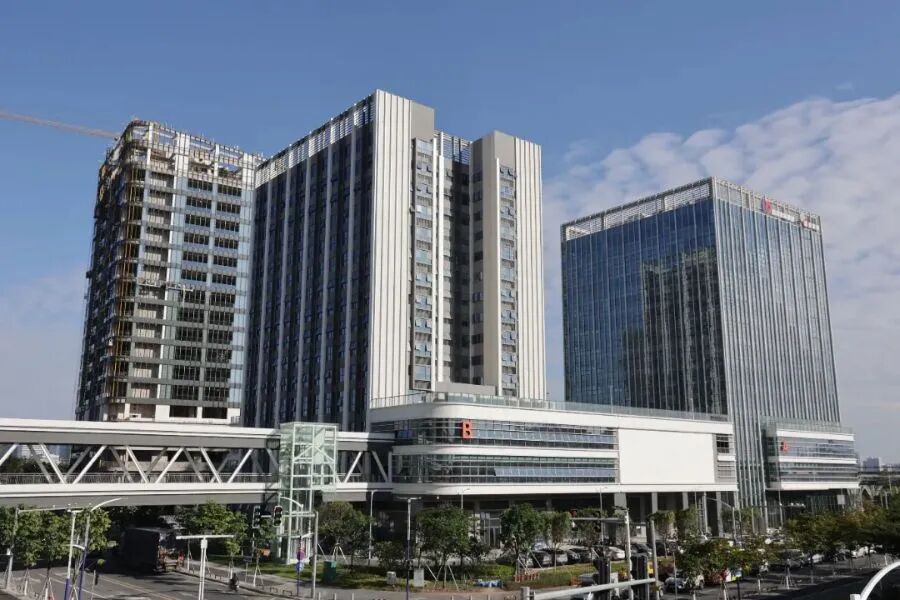
Guangzhou Laser and Additive Manufacturing Industrial Park
Under the commercial background, the new blue ocean of consumer-grade 3D printing industry
Liwan’s deep commercial heritage has opened up a “new track” for the consumer-grade application of additive manufacturing.
As the site of the Thirteen Factories during the Ming and Qing Dynasties, commerce has always been a core advantage here: in 2023, the growth rate of total retail sales of consumer goods reached 9.9%, and in 2024, the total sales of wholesale and retail goods in the district exceeded 363.5 billion RMB. It has nationally renowned professional markets like the Qingping Chinese Medicine Market, nurturing leading modern commercial enterprises like Vipshop and Miniso, forming a complete commercial ecosystem of “professional markets + e-commerce platforms + consumer scenarios.”
Currently, the consumer-grade 3D printing market is experiencing an explosion, with personalized customization becoming a new trend in consumption. Relevant officials in Liwan District stated, “3D printing has great application prospects in cultural and creative products, personalized consumer goods, and customized accessories, while Liwan’s Lingnan cultural heritage and active commercial circulation channels provide solid support for these innovative products.”
The expansion of the consumer-grade market has allowed the traditional advantages of the old district to complement cutting-edge technology, injecting more possibilities into industrial development.
From the laboratory to the industrial chain, from transformation confusion to the “new look” of the old district’s industry, in this process, the formation of a trend is by no means accidental, but rather the result of years of strategic layout and accumulation; being at the right place at the right time is not a coincidence, but stems from a deep insight into the industry and a thirst for development.
This process showcases a vivid example of the high-quality development of China’s manufacturing industry.