 In simple terms, 3D printed aluminum alloy parts are prone to cracking under sudden impact, making them not “sturdy” enough. Researchers found that changing the laser scanning method during printing—re-melting each layer at a faster speed and higher power after printing—can refine and homogenize the metal grains inside the parts, effectively weaving a stronger “net” for the parts, significantly enhancing their impact resistance and durability.
On March 20, 2025, a team led by Professor Zhao Yufan, Professor Yang Haiou, and Professor Lin Xin from Northwestern Polytechnical University published a research paper titled “Improving impact toughness of aluminum alloy through scanning strategy during laser powder bed fusion” in the internationally renowned journal Materials Science and Engineering: A. The study investigates the effects of different scanning strategies on the microstructural characteristics and mechanical properties of aluminum alloys, revealing the mechanisms by which scanning strategies regulate microstructures to improve impact toughness and identifying optimized scanning process parameters that effectively enhance the impact toughness of aluminum alloys.
Article Link:
https://doi.org/10.1016/j.msea.2025.148244
[Background Issue]
Aluminum alloy additive manufacturing (AM) has gained attention due to its high design freedom and short development cycle. Existing research has mainly focused on optimizing mechanical properties (such as strength and plasticity) under quasi-static loads, while high-load fields such as aerospace and high-speed trains impose stringent requirements on the dynamic performance of materials (especially impact toughness). However, AM aluminum alloys generally face issues such as columnar grain growth, uneven microstructure at the melt pool boundaries (e.g., fragmentation of cellular structures, segregation of Si particles), and a tendency to crack, resulting in significantly lower impact toughness compared to traditional cast/forged alloys. Although traditional post-heat treatment can optimize the microstructure, it can also lead to the dissolution of cellular structures and coarsening of brittle Si phases, exacerbating crack propagation under impact loads. Therefore, it is necessary to achieve microstructural regulation through process innovation to break through the bottleneck of impact toughness.
[Research Methodology]
This study uses gas-atomized AlSi10Mg alloy powder (15~53 μm) as raw material and employs laser powder bed fusion (LPBF) to prepare two sets of samples: one set using conventional LPBF processes (optimal parameter formation) and the other set using high-speed scanning re-melting (HSSR) processes (re-melting with higher laser power and scanning speed at a 67° rotation after each layer deposition). The relative density was measured using the Archimedes method, and the samples were processed into standard Charpy impact specimens (V-notch) for pendulum impact tests at room temperature (recording load-displacement curves). SEM/EBSD was used to analyze the impact fracture and near-fracture microstructure, comparing the mechanisms by which HSSR and conventional LPBF processes affect the impact performance of aluminum alloys.
[Innovations]
① Innovative Scanning Strategy: The high-speed scanning re-melting (HSSR) process is proposed, which uses high-power, high-speed laser re-melting for each layer, breaking the traditional regular fish-scale morphology of the melt pool and increasing the irregularity of the melt pool boundaries.
② Microstructural Regulation: HSSR reduces the temperature gradient at the solidification front and increases the growth rate, promoting the transition from columnar grains to equiaxed grains, refining the grain and cellular structures, and weakening the anisotropy of the microstructure.
③ Breakthrough in Impact Toughness: The optimized microstructure suppresses crack propagation along the melt pool boundaries, achieving an impact toughness of 6.88 J/cm², an increase of 76.9% compared to conventional LPBF, significantly outperforming traditional cast/heat-treated AM aluminum alloys and high-strength aluminum alloys.
[Visual Overview]
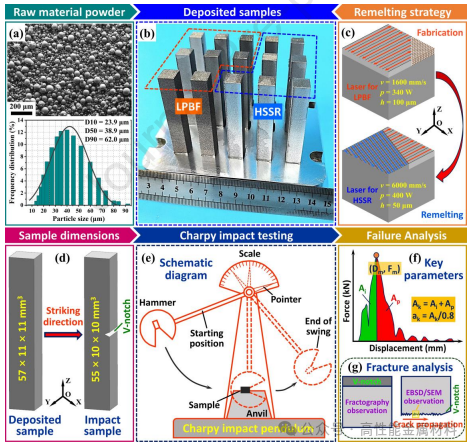 Sample manufacturing and Charpy impact tests; (a) SEM micrographs and size distribution of AlSi10Mg powder particles; (b) Physical photo of the samples; (c) Schematic diagram of LPBF and HSSR scanning strategies; (d) Schematic diagram of the impact sample with a V-notch; (e) Charpy impact test device; (f) Force-displacement curves and key parameters of the impact tests; (g) Graphical explanation of failure analysis using fracture images, EBSD, and SEM.
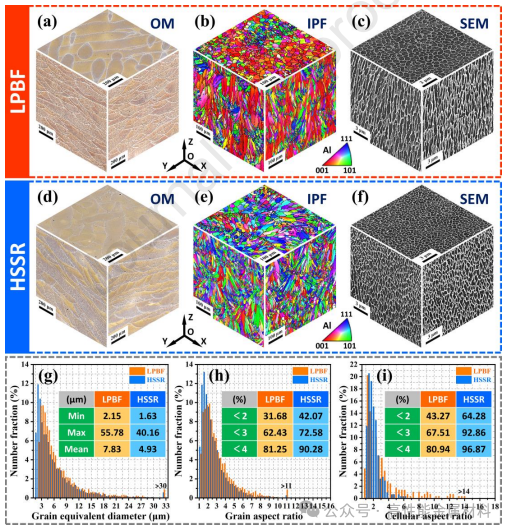 Comparison of microstructures before and after the HSSR strategy and typical size statistics; (a, d) 3D optical microscope (OM) images of melt pool morphology; (b, e) EBSD inverse pole figure (IPF) images showing aluminum grains; (c, f) SEM images showing cellular structures within grains (bright white for eutectic Si network, deep black for α-Al matrix); (g-i) Histograms of the distribution of particle equivalent diameter, particle aspect ratio, and cellular aspect ratio.
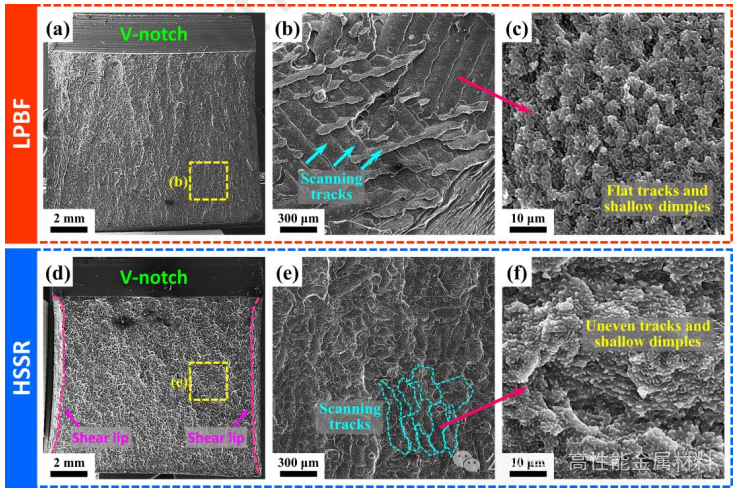 Charpy impact performance; (a) Impact energy-time curves for LPBF and HSSR samples; (b) Comparison of the impact toughness of the current HSSR sample with high-strength aluminum alloys, unmodified/modified Al-Si cast alloys, and LPBF constructed AlSi10Mg alloys (with/without heat treatment (HT)); (c, d) Force-displacement curves for the two samples; (e) k-values for samples 𝐴i, 𝐴p, and 𝐴.SEM fracture analysis after Charpy impact tests on the two samples; (a-c) LPBF samples; (d-f) HSSR samples.Microstructural analysis of the fracture profile; (a, e) OM images of the melt pool; (b-b’, f-f’) IPF and geometric necessary dislocation (GND) images of aluminum grains; (c-d, g-h) SEM images showing honeycomb structures located at the melt pool boundaries and inside.
[Summary and Outlook]
The HSSR strategy achieves homogenization and grain refinement of the microstructure of AM aluminum alloys by regulating the solidification behavior of the melt pool, effectively enhancing impact toughness and providing new ideas for the damage tolerance design of aluminum alloy components under dynamic loads. Future research can further explore the effects of the HSSR process on the anisotropy of impact behavior, extend it to other high-strength aluminum alloy systems (such as Al-Cu, Al-Mg alloys), and promote the industrial application of this technology in high-reliability fields such as aerospace and automotive through process parameter optimization.
“Here lies the valuable content you may need / warmth / thoughts, please follow, and find me directly for the next update~ If you find it useful, please give a thumbs up so that more like-minded people can see it, and let’s gather some light together~”
Previous Good Articles · Welcome to Read
Wuhan University IJEM: Science-level breakthrough! 600MPa aerospace aluminum alloy “Nano Galaxy” stunningly debuts, micro-aesthetics shocks the world.
Shandong University Int J Plast: Predicting the evolution and mechanical performance of stress-aging Al-Zn-Mg-Cu alloys through a complete process model.
Harbin Institute of Technology Acta Mater: Integrated TiAl-based alloys with excellent plasticity based on dynamic precipitate phase and crystal orientation evolution.
Note: This article is a literature interpretation. If there are any shortcomings or errors, please feel free to criticize and correct. If there are copyright issues, please contact us in a timely manner.
#AluminumAlloy #AlSi10Mg #3DPrinting #NorthwesternPolytechnicalUniversity #Alloy #Metal
[Cooperation Submission]This public account regularly publishes interpretations of materials science literature, valuable content, doctoral supervisor recruitment, job seeking information, etc. If you have content recommendations, please contact the editor through the backend. Thank you for your support.Contact: HighPerf_Mtl