In the wave of intelligent transformation in the manufacturing industry, 3D printing technology is undergoing a historic leap from a “niche tool” to “inclusive manufacturing.” As a leading company in the global consumer 3D printing market, Tuozhu Technology holds a 29% global market share, firmly ranking first in the industry, with a shipment volume of 1.2 million units and sales exceeding 5 billion yuan in 2024, far surpassing its competitors. Empowered by deep integration with artificial intelligence technology, this company, established only five years ago, has not only redefined the performance boundaries of 3D printing equipment but also accelerated the entire industry towards popularization, intelligence, and autonomy by building a full-stack ecosystem of “hardware + software + content + AI.”
Perceptual Intelligence Restructures Hardware Boundaries: From Mechanical Tools to Intelligent Manufacturing Hubs
Tuozhu Technology’s latest release, the H2D multifunctional manufacturing center, marks a complete transformation of 3D printing equipment from traditional mechanical tools to intelligent terminals. This device, which integrates multiple functions such as 3D printing, laser engraving, and CNC cutting, is equipped with four visual cameras, 36 sensors, and two servo motors, achieving micron-level motion control precision through advanced algorithms. Its innovative visual coding system, combined with 5µm resolution optical measurement technology, enables the device to achieve a motion accuracy of 50µm, independent of the movement distance across the entire workspace, an order of magnitude improvement over previous products—this means that printed parts can be assembled seamlessly with standard steel shafts without cumbersome post-adjustments.
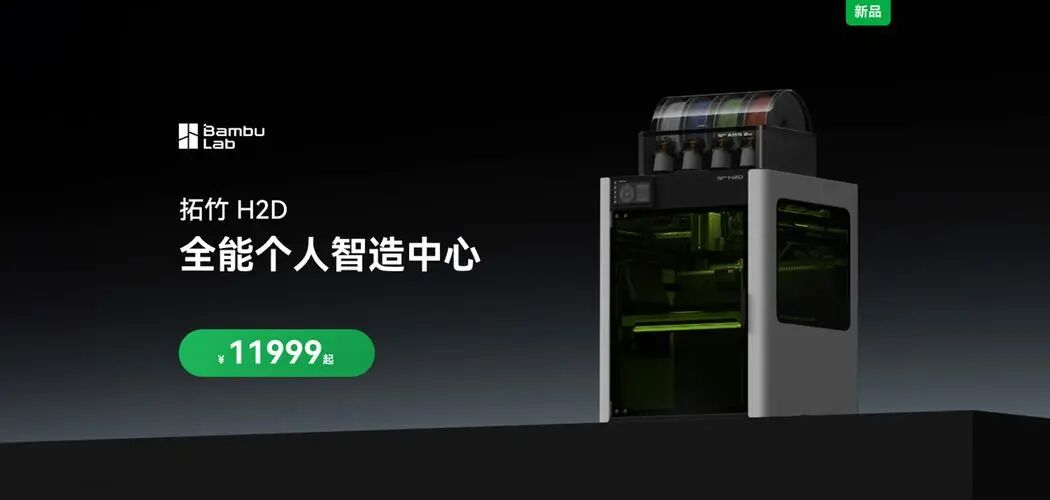
The AI-driven perceptual system is reshaping the quality control system of 3D printing. The AI nozzle camera equipped on the H2D continuously monitors the extrusion state, capable of instantaneously detecting material accumulation, extrusion deviations, and other faults; a smart network composed of 15 sensors tracks key parameters such as feed speed, material tension, and extrusion pressure throughout the process, combined with the HMS 2.0 health management system, forming a high-level fault location logic similar to automotive diagnostic codes. This “perception-analysis-feedback” closed-loop system transforms 3D printing from a “craft” reliant on operator experience into a standardized manufacturing process that can be precisely controlled, increasing product yield to over 95% and reducing material consumption by approximately 25%. This technological breakthrough resonates across fields with practices from peers like LianTai Technology in the industrial market.
The deep application of intelligent algorithms is breaking the speed bottleneck of 3D printing. The Tuozhu H2D achieves a stable printing speed of 600mm/s and a maximum flow rate of 65mm³/s, and with active vibration compensation and floating damping footpad technology, it maintains surface smoothness even during high-speed printing. This dual breakthrough in speed and precision is backed by AI’s real-time optimization of printing parameters—through analyzing millions of printing data, the trained neural network model can automatically adjust extrusion volume, temperature, and movement speed based on material type and model structure, achieving an industry breakthrough of “high speed without quality loss.”
Generative AI Restructures the Creative Ecosystem: From Professional Barriers to Universal Innovation
Tuozhu Technology’s strategic partnership with Tencent Cloud is completely dismantling the creative barriers of 3D printing. Its globally most active 3D model platform, MakerWorld, has fully integrated Tencent’s Hunyuan 3D generative model, allowing users to generate printable models with an accuracy of 0.1mm simply by inputting text descriptions or images, with expected monthly calls exceeding 100,000. This “what you think is what you get” creative model simplifies the traditional 3D modeling process, which previously required professional software and skills, into a creative expression that ordinary people can master, greatly expanding the application scenarios of 3D printing.
AI-generated models are addressing the long-standing “design-manufacturing” gap in 3D printing. The geometric resolution of Tencent’s Hunyuan 3D model reaches 1024 levels, ensuring perfect presentation of sharp edges and smooth surfaces when handling complex structures such as mechanical part spokes and human finger joints. This high-precision modeling capability allows the generated models to be directly used for printing without post-repair, significantly improving printing success rates and reducing material waste—this is a typical application of AI addressing the manufacturing industry’s “high trial-and-error costs” pain point.
Tuozhu’s “model-device” closed-loop ecosystem amplifies the application value of AI. Through the deep collaboration of Bambu Suite software and H2D hardware, user-generated 3D models can achieve “one-click printing,” with the system automatically completing professional steps such as slicing, support generation, and parameter optimization. This end-to-end intelligent experience enables ordinary users in education, cultural creativity, and handicrafts to quickly turn their ideas into physical objects, promoting the transition of 3D printing from an industrial production tool to a personal creative platform. Currently, Tuozhu Technology has served over 80% of top universities in China and more than 100,000 enterprises and institutions, with the integration of AI technology significantly enhancing the innovation efficiency of these users.
Data-Driven Restructuring of the Industry Landscape: From Equipment Sales to Ecological Leadership
With the support of AI technology, Tuozhu is building a data-driven 3D printing industry ecosystem. The massive model data and printing parameters accumulated on the MakerWorld platform form an evolving “creativity-manufacturing” knowledge graph—when users upload new successful printing cases, the system automatically extracts key information such as material type, temperature settings, and speed parameters to optimize other users’ printing plans. This mechanism of collective wisdom accumulation makes the advancement of 3D printing technology no longer reliant on individual experience but instead empowers the community through a data network.
AI technology is driving the transformation of 3D printing from equipment sales to a “device + service” model. The AI customer service system equipped on the Tuozhu H2D can resolve over 85% of common issues, and its automatic layout function optimizes cutting paths based on real-time images of materials, maximizing material utilization; the QR code recognition function for presetting materials simplifies parameter configuration for different materials. These intelligent features not only enhance user experience but also accumulate valuable equipment usage data, providing decision-making basis for Tuozhu to continuously optimize products and services.
The deepening of industry chain collaboration is accelerating the industrialization process of 3D printing. Encouraged by the Ministry of Industry and Information Technology’s “Artificial Intelligence + Manufacturing” action policy, Tuozhu is attracting upstream and downstream enterprises to jointly build an application ecosystem by opening its AI algorithm interfaces and equipment data. In the education sector, AI-driven 3D printing systems enable students to quickly turn mathematical models and physical structures into physical objects; in the cultural and creative industry, designers achieve personalized small-batch customization of products through AI-assisted tools; in the industrial sector, companies utilize AI-optimized 3D printing for rapid prototype verification—this cross-domain application expansion is reshaping the value chain of the manufacturing industry.
Future Outlook: A New Landscape of 3D Printing Defined by AI
As artificial intelligence technology continues to evolve, the 3D printing industry stands at a new inflection point. Practices from leading companies like Tuozhu Technology indicate that the integration of AI and 3D printing is not only a technological upgrade but also a revolution in manufacturing paradigms—it liberates production rights from a few large enterprises and empowers individuals and small and medium-sized enterprises with unprecedented manufacturing capabilities. In the future, with the development of multimodal AI models, 3D printing may achieve full-process automation from voice description to physical manufacturing; as digital twin technology matures, remote distributed manufacturing will become the norm; and with the combination of materials science and AI, functional printed products will expand into broader fields such as electronics and biomedicine.
In this transformation of intelligent manufacturing, Chinese enterprises represented by Tuozhu Technology have already seized the initiative. Through a three-step strategy of “hardware intelligence – design democratization – ecological openness,” they have not only consolidated their leading position in the consumer market but also accumulated valuable AI technology and data assets for industrial applications. With the in-depth implementation of the national strategy of “Artificial Intelligence + Manufacturing,” the 3D printing industry is expected to become a new engine for the transformation and upgrading of China’s manufacturing industry, and those enterprises that can deeply integrate AI into product innovation, ecosystem construction, and service upgrades will lead this intelligent revolution in manufacturing, reshaping the competitive landscape of global manufacturing.
The integration of 3D printing and artificial intelligence is writing a new chapter in the manufacturing industry. As intelligent perception makes devices more precise and reliable, as generative models unleash creativity more freely, and as data ecosystems enable more collaborative and efficient industries, an era of “everyone can manufacture” inclusive manufacturing is approaching. In this new manufacturing landscape defined by AI, the explorations of companies like Tuozhu Technology are not only reshaping the future of the 3D printing industry but also redefining the boundaries of human creativity and production.