Table of Contents
- What is 3D Printing?
- How 3D Printing Works
- The Development of 3D Printing
- Applications of 3D Printing
- Advantages and Challenges of 3D Printing
- Future Prospects of 3D Printing
- Interactive Q&A
Part One: What is 3D Printing?
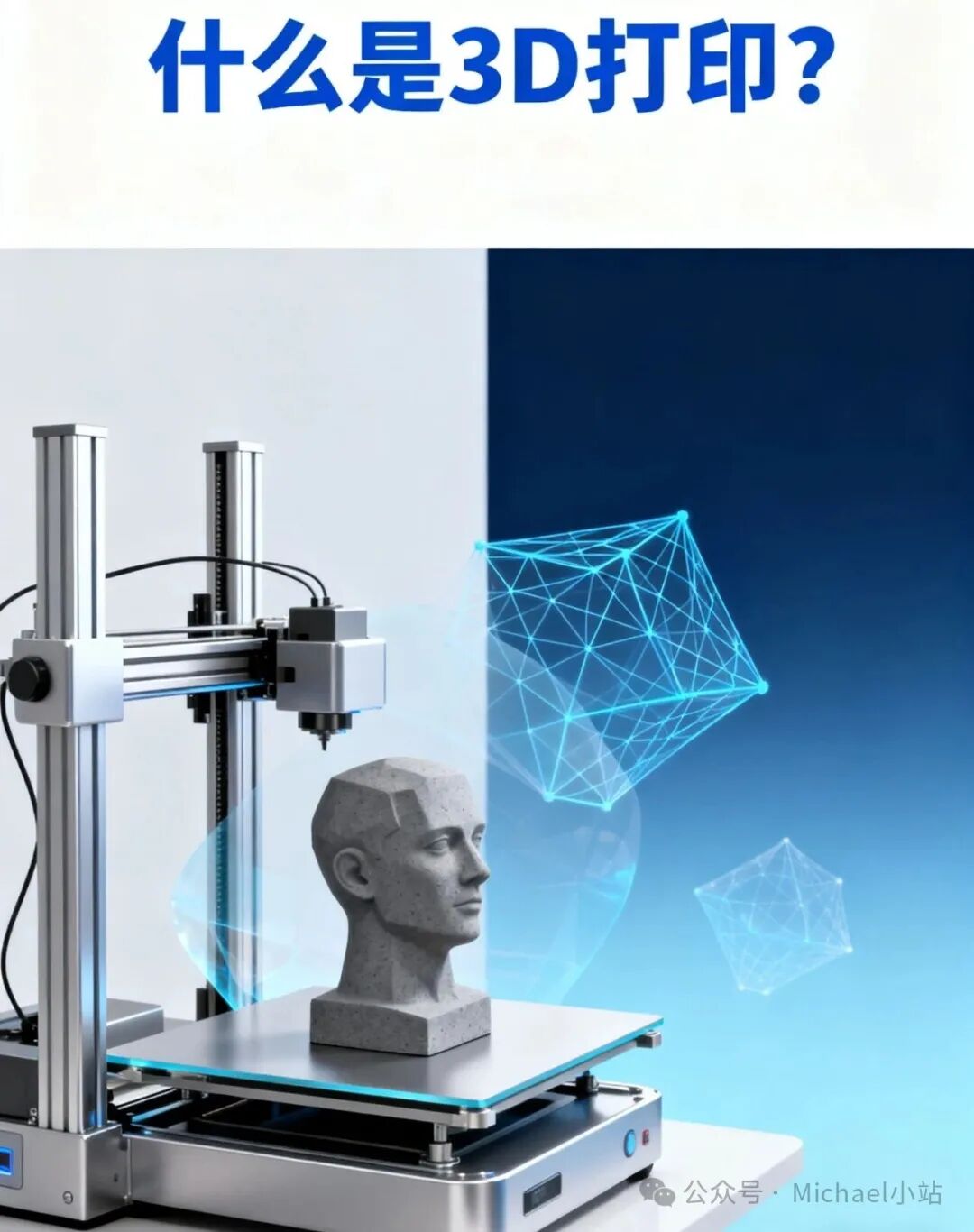
1.1 Definition of 3D Printing
- Core Concept: Additive manufacturing, forming materials layer by layer based on 3D CAD data
- Simple Explanation: The logic of three-dimensional manufacturing is “slicing + stacking slices”
- Essential difference from traditional subtractive manufacturing
1.2 Comparison of 3D Printing and Traditional Printing
- Traditional Printing: Two-dimensional output, limited to text and images
- 3D Printing: Three-dimensional entity manufacturing, covering the entire scene from models to functional parts
Part Two: How 3D Printing Works
2.1 Basic Workflow (Four-Step Closed Loop)
- 3D Modeling: CAD software design or 3D scanning to obtain models, which must meet printing parameter requirements
- Slicing: Slicing software divides the model and sets parameters such as layer thickness (0.05-0.3mm), fill density, etc.
- Physical Transformation: The printer accumulates materials layer by layer according to the path, including preheating and parameter debugging before printing
- Post-Processing: Removing supports, polishing, coloring, and other optimization processes
2.2 Key Technology Analysis (Three Mainstream Technologies)
|
Technology Name |
Core Principle |
Advantages |
Disadvantages |
Applicable Scenarios |
|
Fused Deposition Modeling (FDM) |
Thermoplastic is extruded layer by layer and solidified |
Low cost, abundant materials |
Lower precision, slow speed |
Prototype production, simple components |
|
Stereolithography (SLA) |
UV light cures liquid photosensitive resin |
High precision, smooth surface |
Limited materials, high cost |
Jewelry, fine molds, artworks |
|
Selective Laser Sintering (SLS) |
Laser sinters powdered materials (plastic/metal, etc.) |
Diverse materials, high strength |
Expensive equipment, complex control |
Aerospace, functional components |
Part Three: The Development of 3D Printing
3.1 Origins and Early Exploration (19th Century – 1980s)
- Technological Prototype: Photographic sculpture and terrain modeling technology
- Milestone: In 1986, Charles Hull invented the first 3D printer and founded 3D Systems
3.2 Technological Breakthroughs and Development (1990s – Early 21st Century)
- 1989: Selective Laser Sintering (SLS) technology was introduced
- 1990: MIT’s patent for “Three-Dimensional Printing Technology”
- Application Expansion: From prototype production to penetration into industrial fields
3.3 Commercialization and Widespread Application (Early 21st Century – Present)
- Industry Landscape: Stratasys and 3D Systems became global giants
- Application Explosion: Covering multiple fields including manufacturing, medical, and construction
Part Four: Applications of 3D Printing
4.1 Manufacturing Industry
- Rapid Prototyping: Shortening product development cycles (e.g., testing models for automotive parts)
- Custom Production: Low-cost manufacturing of small batches of components (e.g., high-end automotive interior parts)
4.2 Medical Field
- Custom Implants: Precise fitting for prosthetics, dental models, crowns, etc.
- Frontier Exploration: Bioprinting tissue models (for drug testing, surgical rehearsals)
4.3 Construction Industry
- Design Assistance: Rapidly creating architectural models to optimize communication efficiency
- Structural Printing: Printing concrete components to shorten construction cycles (e.g., building temporary shelters)
4.4 Education Sector
- Practical Teaching: Transforming abstract concepts into physical models (geometric shapes, mechanical structures)
- Innovation Cultivation: Students’ designs turned into physical objects, enhancing hands-on skills
4.5 Art and Fashion
- Art Creation: Achieving complex sculptural forms and installation art
- Fashion Design: Personalized clothing and shoe customization, breaking craft limitations
Part Five: Advantages and Challenges of 3D Printing
5.1 Core Advantages
- Customized Production: Meeting personalized needs without additional mold costs
- Material Savings: Additive manufacturing significantly reduces waste
- Design Freedom: Achieving complex structures that traditional processes cannot accomplish
- Rapid Iteration: Shortened prototyping cycles accelerate product innovation
5.2 Existing Challenges
- Cost Issues: High prices for equipment and materials, insufficient cost-effectiveness for large-scale production
- Material Limitations: Limited selection of high-performance, special-function materials
- Printing Speed: Long printing times for large/complex models
- Technological Maturity: Safety certifications in high-end fields (aerospace, medical) need improvement
Part Six: Future Prospects of 3D Printing
6.1 Directions for Technological Innovation
- Material Breakthroughs: Developing high-performance materials such as biocompatible and high-temperature resistant materials
- Multi-Material Printing: Achieving integrated manufacturing of materials with different properties (e.g., metal + plastic composite parts)
- Smart Upgrades: AI optimizing printing paths, automatic fault diagnosis, and parameter adjustments
6.2 Impact on Future Life
- Manufacturing Revolution: Mass customization becoming mainstream, production more flexible
- Upgraded Lifestyle: Personalized products and customized medical solutions becoming widespread
- Innovation Ecosystem Reconstruction: Lowering barriers to creation, stimulating design vitality among the public
Part Seven: Interactive Q&A
- Open Q&A Session
- Communication and Discussion
- Thank You Note: Thank you for listening!