The school district utilizes an open-source design called Hovalin, which can produce durable, functional violins at a material cost of approximately $50, demonstrating that affordable access to music can indeed be ‘printed’.
Teachers recognize that learning an instrument has cognitive benefits for children, enhancing memory, attention, language skills, reasoning abilities, and brain development. However, funding for purchasing instruments is often limited. This did not deter an innovative school administrator in Pennsylvania from the idea of 3D printing violins.
Laura Jacob, the director of a school district in Washington State, initiated a project that has provided hundreds of 3D-printed violins to local children, each costing about $50. Elementary students can use these instruments for free, saving hundreds of dollars in traditional violin rental fees each year. Jacob’s violin project received charitable support from the Benedum Foundation and the Grable Foundation to cover material and printer costs.
Cost is the key breakthrough
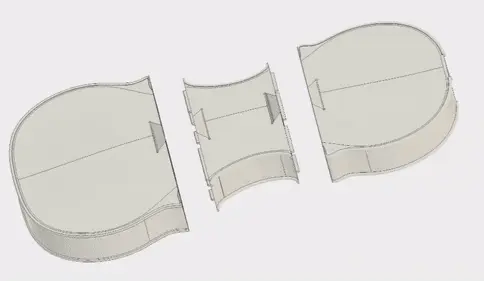
Before discovering Hovalin, Jacob attempted several digital files for violins without success. Hovalin is an open-source, widely used design for a 3D-printable acoustic violin launched by Hova Labs. This design consists of seven parts as a basic template, which Jacob modified into a two-part instrument.
The parts are manufactured using PLA (polylactic acid) material on consumer-grade printers (primarily Prusa brand) and assembled with off-the-shelf strings, wooden bridges, and common tuners. From the first print to final tuning, it takes about three days to complete a violin. Jacob told CBS News that printing the body takes two days, while the neck takes about eight hours.
While beginner students typically start with the printed instruments, if they are motivated to continue learning, they can later upgrade to wooden instruments. However, mastering musical skills is not the core goal of this project. The aim is to provide opportunities and access to instruments that low-income families in the area cannot afford. The school district’s approach is part of a broader movement to democratize orchestral instruments through modern manufacturing technology. In 2022, the AVIVA Young Artists Program showcased a low-cost 3D-printed violin through the Acoustical Society of America, highlighting its durability and affordability for educational purposes; other universities and maker projects have followed a similar path.
The school district also operates a Friday 3D-printed violin orchestra club after school, providing students with regular practice time and serving as an entry point into broader music programs. For a rural public school district, the results are evident: more students are trying string instruments, more instruments are circulating, and fewer families are excluded due to cost barriers.
How does a plastic violin sound?
As shown in the video from the Ottawa Symphony Orchestra below, the sound of the 3D-printed violin is surprisingly close to that of a wooden violin. Its volume is comparable, and the overall experience is solid for new learners, even if the tone is not exactly the same. The Ottawa Symphony Orchestra used instruments printed on a Stratasys 400 FDM printer.
Violinist Ray Chen 3D printed his own Hovalin violin and tested it on YouTube, performing Brahms’ Violin Concerto and switching back to his traditional wooden violin for comparison. The sound difference is noticeable, but he said, ‘It sounds a bit better than I expected.’


 @ 3D Printing Insights
I am Xu Fanglei, a design professional, PhD, Fellow of the Royal Society of Arts, focusing on industrial design, additive manufacturing, and business models. Here, I will use my expertise and experience to take you deep into the world of 3D printing, sharing the latest industry trends, interpreting cutting-edge technologies, and discussing business applications.
 END
END



 Welcome to add the editor’s WeChatto learn about the latest developments in the 3D printing industry
 About 3D Printing Technology
We integrate timely insights, technological trends, application scenarios, competitive strategies, and in-depth dynamics from the 3D printing and AI industries in China, the US, and globally, providing high-value information. We are passionate about 3D printing and welcome contributors from around the world.
Disclaimer:3D Printing Technology has no commercial cooperation, sponsorship, employment, or other interests with the companies mentioned in this article.3D Printing TechnologyImages and videos are sourced from the internet and are for auxiliary reading purposes only, with no commercial intent.All rights belong to the original authors; if there are any infringement issues, please contact the rights holders promptly, and we will delete them immediately. The copyright of the images in this article belongs to the copyright holders,3D Printing Technologywatermarks are automatically added for auxiliary reading and do not represent ownership of the images; for image usage, please consult the copyright holders.3D Printing TechnologyThe article does not constitute any investment advice,3D Printing Technologyis not responsible for any direct or indirect losses caused by the use of the information in this article.For more exciting content, please follow us