🔬 Introduction
From Paul Ehrlich’s concept of the “magic bullet” in the early 20th century to the approval of the first ADC drug Mylotarg in 2000, antibody-drug conjugates (ADCs) have undergone a century of evolution and have become a “star therapy” in the field of precision oncology. This “biological missile,” which combines the targeting ability of antibodies with the cytotoxicity of toxins, is driving cancer treatment into a new era. This article will dissect the technical composition, development history, and global research layout of ADCs, providing you with a comprehensive view of this golden track.
01
—
🧩 Core Technical Landscape: The “Trinity” Structure of ADCs
ADCs consist of three core components: monoclonal antibodies (navigation system), linkers (bridges), and cytotoxic payloads (warheads). The synergistic optimization of these three components determines the drug’s final efficacy and therapeutic window.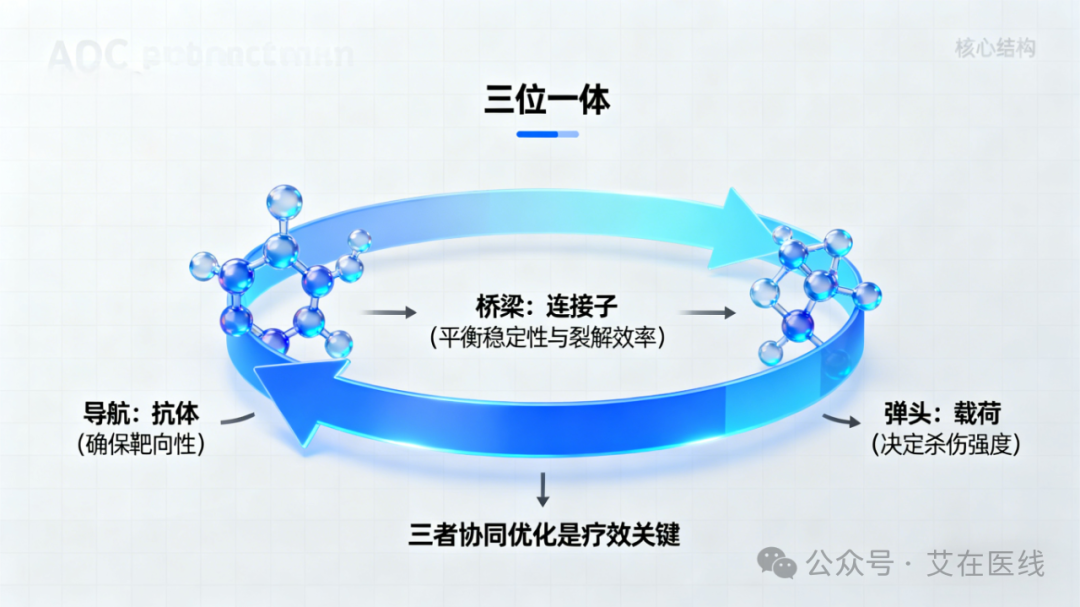
- Monoclonal Antibodies: The “Scope” for Precise Navigation
-
Function: Specifically recognize tumor cell surface antigens (such as HER2, TROP2) to ensure targeted drug delivery.
-
Evolution: From murine antibodies to chimeric antibodies to humanized antibodies, immunogenicity has continuously decreased, and serum half-life has been extended. Currently, AI tools (such as AlphaFold3) are being used for rational design of antibody structures, significantly shortening the R&D cycle.
-
Linkers: Stable and Efficient “Control Switches”
-
Core Requirements: Maintain extremely high stability in the bloodstream (to avoid “off-target toxicity”) and precisely cleave in the tumor microenvironment (such as high enzyme concentration).
-
Main Types: Cleavable linkers (such as enzyme-cleavable GGFG peptide linker) and non-cleavable linkers, with the former more likely to produce a “bystander effect.”
-
Cytotoxic Payloads: The “Warheads” of Potent Killing
-
Categories: Evolved from early chemotherapeutic agents to microtubule inhibitors (MMAE/DM1), and now to DNA damaging agents (such as TOP1 inhibitor Deruxtecan).
-
Key Indicators: Drug-antibody ratio (DAR), with an optimization range typically between 4-8 to balance efficacy and toxicity. Iteration direction focuses on new payloads with high toxicity and low immunogenicity.
02
—
📈 Global Development Overview: From Concept Validation to Platform Explosion
According to the latest industry analysis for 2025, the global ADC (antibody-drug conjugate) R&D pipeline is unprecedentedly active, with rapid technological iteration. Market competition has deepened from simple target expansion to innovations in core technologies such as linkers and payloads, leading to the emergence of next-generation technologies like bispecific ADCs and dual payload ADCs.
The table below clearly outlines the current global ADC R&D landscape and core trends.
| Analysis Dimension | Specific Situations and Core Data | Key Insights |
|---|---|---|
| Overall R&D Scale | Approximately 1850 traditional ADC drugs in the global pipeline, with a large number of new conjugates (such as bispecific ADCs, DACs, etc.) under research. | R&D activities are highly concentrated, but competition is fierce, with nearly half of the projects having stopped development in the trial phase. |
| Clinical Stage Progress | In 2024, an additional 83 ADC clinical projects were added, setting a record. As of October 2025, there are 21 ADC drugs on the market globally. | The industry is entering a period of accelerated conversion of results, with both regulatory approvals and clinical advancement speeds increasing. |
| Popular Target Distribution | HER2, TROP2, CLDN18.2, B7-H3 are the current core targets under development.HER3 has become a newly popular target in 2024. | The target layout shows characteristics of both “concentrated breakthroughs” and “differentiated positioning,” with companies avoiding homogenization competition through cancer type segmentation. |
| Technological Iteration Directions | – Bispecific ADCs: The world’s first bispecific ADC (Bai Li Tian Heng BL-B01D1) has submitted a market application.– Dual Payload ADCs: Such as Innovent Biologics’ IBI3020, which has entered the clinical stage.– New Payloads: Topoisomerase I inhibitors have become the main payloads for new ADC projects. | The technological competition for the next generation of ADCs focuses on overcoming tumor heterogeneity and drug resistance, while enhancing treatment precision. |
| Role of Chinese Enterprises | In the late-stage R&D pipeline, domestic original products account for over 55%. Companies such as Kelun-Botai, Ying’en Biologics, and Innovent Biologics are collaborating with international giants through License-out. | Chinese pharmaceutical companies have transformed from “followers” to an “innovation hub” that cannot be ignored in the global ADC field. |
-
Three Stages of ADC Development
Stage Time Frame Key Events and Representative Drugs Industry Impact Emergence Phase 2000-2010 The first ADC (Mylotarg) was approved but withdrawn from the market due to toxicity Validated the concept and exposed technical flaws Growth Phase 2011-2020 Adcetris and Kadcyla were launched, with upgrades in linker/antibody technology Established treatment positions in lymphoma and breast cancer Explosion Phase 2021 – Present Super ADCs like DS-8201 and Trodelvy were launched, with AI-driven R&D Over 360 clinical trials globally, covering more than 20 cancer types
03
—
🌐 Next-Generation ADC Technologies: Tackling Drug Resistance and Heterogeneity Challenges
-
To address the two major clinical challenges of tumor drug resistance and heterogeneity, ADC technology is undergoing revolutionary innovations in the following directions:
-
Bispecific ADCs: These drugs are widely regarded as the future of ADC development. They are like equipping missiles with dual-mode guidance systems, capable of simultaneously recognizing two targets (such as EGFR/HER3) or two different epitopes of the same target. This not only enhances the accuracy of tumor cell recognition but also effectively prevents drug resistance caused by the loss of a single target and accelerates drug internalization into cells.
-
Dual Payload ADCs: Like smart bombs carrying two different warheads, dual payload ADCs can simultaneously release two cytotoxic drugs with different mechanisms of action (for example, damaging DNA and inhibiting RNA synthesis) within tumor cells, attacking cancer cells through multiple pathways and significantly reducing the likelihood of resistance.
-
Linker Innovations: Linkers are key components determining the safety of ADCs. Innovative linker technologies aim to maintain absolute stability in the bloodstream to prevent “off-target” toxicity while ensuring efficient activation and payload release in the tumor microenvironment. For example, cleavable linkers can utilize the tumor-specific acidic environment or high enzyme concentrations to trigger drug release.
-
New Payloads and Modalities: In addition to traditional cytotoxins, researchers are exploring the use of immune stimulants, protein degraders (PROTAC), and even oligonucleotides as new payloads for ADCs, thereby opening up new mechanisms of action.
04
—
🗺️ Future Trends and Challenges
Looking ahead, the development of ADCs will exhibit the following trends:
-
Indication Expansion: The application of ADCs is shifting from late-stage cancer to early adjuvant/neoadjuvant therapy, and exploring non-oncological fields such as autoimmune diseases and infectious diseases.
-
Combination Therapies: The combined use of ADCs with immune checkpoint inhibitors (such as PD-1/L1 antibodies) and targeted drugs is an important clinical strategy to overcome tumor resistance and enhance efficacy.
-
Core Challenges: The development of cutting-edge technologies also comes with challenges. While pursuing stronger efficacy, bispecific ADCs face the dilemma of balancing safety and avoiding side effects such as hepatotoxicity. Additionally, the complex molecular structures pose higher demands and challenges for production processes.
Upcoming Preview: A deep dive into how DS-8201 redefines HER2-targeted therapy—from HER2-positive to low HER2 expression, exploring how “super ADCs” break through traditional target definitions.
Interactive Topic What do you think will be the biggest breakthrough direction for ADC technology in the next five years? Is it new targets, safer linker technologies, or cross-disciplinary combination therapies? Feel free to share your insights in the comments!
I am Amy, focusing on the forefront of medicine and delivering deep insights.
Copyright Notice:
The articles published by this public account, whether original or reprinted, are for learning and communication purposes only, with no commercial use. Reprinted articles will be marked with the source and author. If you do not wish to be reprinted, please contact the author of this account for deletion.