 Column Guide
INTRODUCTION
From September 4 to 6, 2023, the China International Intelligent Industry Expo (referred to as the “2023 Intelligent Expo”) was successfully held in Chongqing. Chongqing University, as the representative of higher education in the regional cooperation exhibition area, showcased 58 technological achievements in the largest exhibition hall of the university, covering multiple fields such as intelligent vehicle networking, smart energy, intelligent construction, smart health, intelligent perception, future energy, advanced manufacturing, and green sustainability. The WeChat public account of the Chongqing University Industrial Technology Research Institute will continue to push the exhibition results, allowing you to experience “black technology”. Please stay tuned!

On-Chip Deep Learning Brain-Like Visual Processing Chip
Brain-like models and brain-like information processing simulate the neural networks corresponding to biological intelligence in areas such as auditory and visual perception, thereby constructing a method system for validating brain visual intelligence and chip functions, exploring the mechanisms of brain information processing, and laying a theoretical foundation for the perception, understanding, and autonomous decision-making in brain-like natural environments. The project developed the “on-chip deep learning brain-like visual processing chip” which can significantly enhance the real-time performance and energy efficiency of visual image information processing and learning at the edge by running a self-developed Spiking Neural Network (SNN) model, introducing a new integrated paradigm of “storage, computation, and learning” similar to the human brain for artificial intelligence and machine learning, with clear scientific significance and broad practical prospects.The project focuses on key technologies such as new brain-like chip architecture, bionic learning rules, high-speed computing circuits, and on-chip storage resource compression, designing a digital neuromorphic brain-like chip with rapid on-chip deep learning capabilities. Test results show that the chip can achieve rapid on-chip deep learning at a low power consumption of 61mW, reaching on-chip learning and inference speeds of 802 and 2270 frames per second, respectively, with an energy consumption of only 0.43uJ per image recognized, achieving high energy-efficient computation.This brain-like chip closely mimics the functional mechanisms of the cerebral cortex, boasting advantages such as high energy efficiency, fast processing speed, small area, and low cost, making it suitable for edge intelligent application scenarios with high requirements on chip costs and energy consumption, such as low-orbit satellite cloud image detection, odor recognition systems, identity recognition systems for new energy vehicles, smart locks, smart alarm systems, intelligent monitoring, smart wearable systems, and smart homes, with broad application prospects.Currently, the project has completed the iterative upgrade and validation of three generations of neuromorphic brain-like chips, with plans to develop corresponding SoC system-level brain-like chips in 2024 to meet vertical market demands, achieving practical applications for end customers; in 2025, it aims to expand towards the developer market for horizontal development, fostering an ecosystem and outputting core boards and core solutions; and in 2026, the technology is expected to mature, achieving large-scale wafer production and deployment.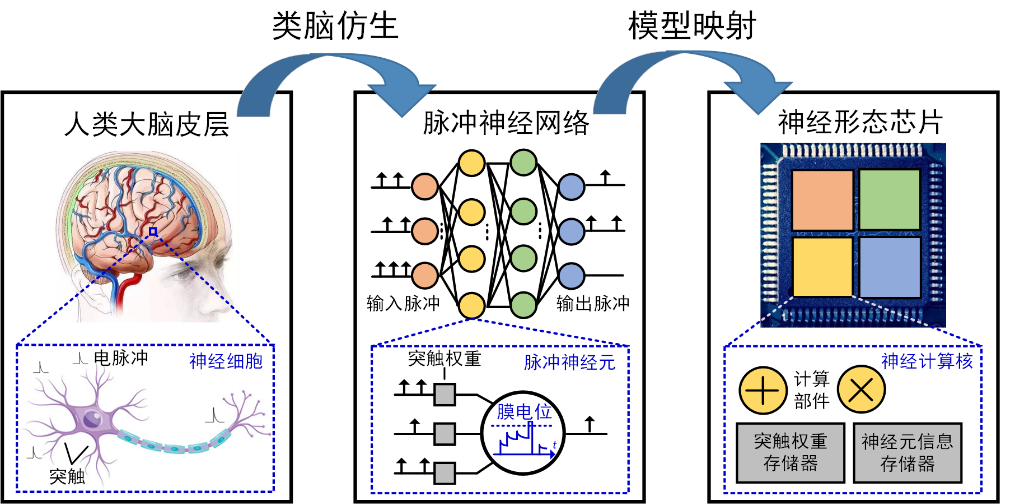 Brain-like Spiking Neural Networks and Neuromorphic ChipsThe human cerebral cortex contains approximately 86 billion neurons, which use sparse electrical pulses in time and space to encode, transmit, and process sensory input information, requiring very little computational effort, consuming only about 20W of power to complete advanced cognitive processes such as real-time learning and inference recognition, demonstrating high energy efficiency. In a Spiking Neural Network, a single neuron receives pulse signals from other neurons through synapses and accumulates them to its own membrane potential. When the membrane potential exceeds a certain threshold, it emits a pulse to other neurons, enabling information processing and interaction, as shown in the figure above. Neuromorphic brain-like chips improve the energy efficiency of intelligent systems by simulating the working mechanisms of the human brain and running Spiking Neural Networks (SNN).
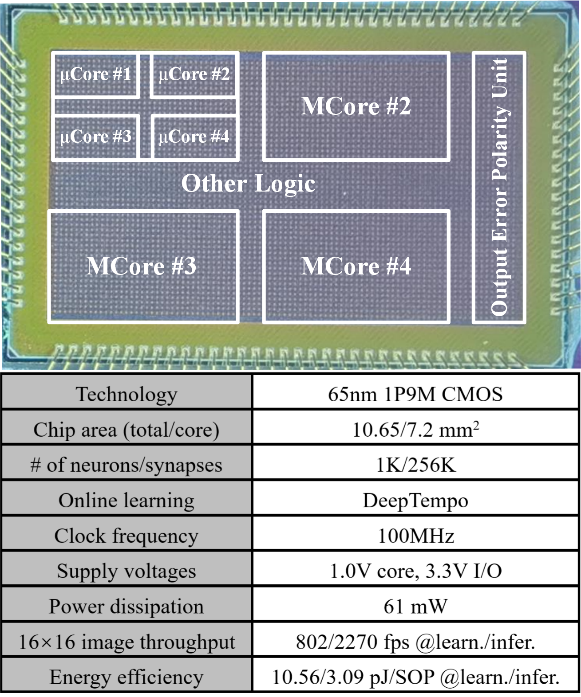 Microscopic Photos and Test Results of the Developed “Magic Wand” ChipThe project has conducted in-depth optimizations around key directions such as on-chip learning rules, chip architecture, high-speed computing circuits, and on-chip storage resource compression, designing a digital neuromorphic brain-like chip with rapid on-chip deep learning capabilities. This chip occupies only about 10mm2, supports running a maximum of 1,000 spiking neurons and 260,000 synapses, and can perform rapid on-chip deep learning at a low power consumption of 61mW, achieving on-chip learning and inference speeds of 802 and 2270 frames per second, respectively, with an energy consumption of only 0.43uJ per image recognized, demonstrating extremely high area and energy efficiency.
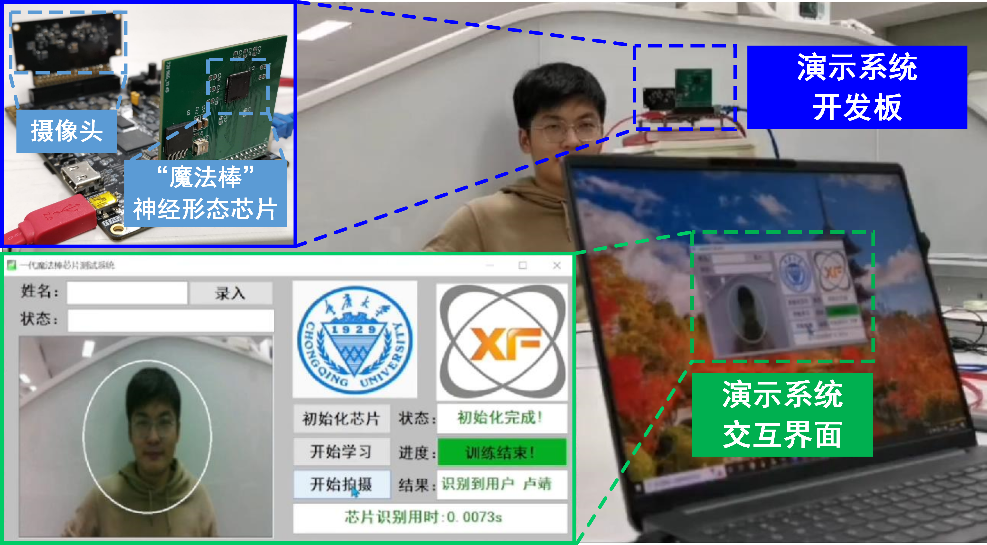 Demonstration System for Edge Intelligent Visual Recognition BuiltThe above figure shows the edge intelligent visual recognition system built using the “Magic Wand” brain-like chip. It captures user facial information in real-time through a camera, encodes it into pulse signals, and sends it to the chip for real-time learning or inference. The chip can learn facial information from dozens of users, and once the learning is complete, it can recognize the identity of registered users in real-time.
 Contact for Cooperation
Contact Person: Mr. Xian
Contact Phone: 17338670512