When it comes to cybersecurity, many people think of “firewalls” and “antivirus software,” but behind the scenes, there is a well-defined “special forces” team—the Security Operations Center (SOC) team. Today, let’s clarify the responsibilities of different roles within the SOC in just 5 minutes.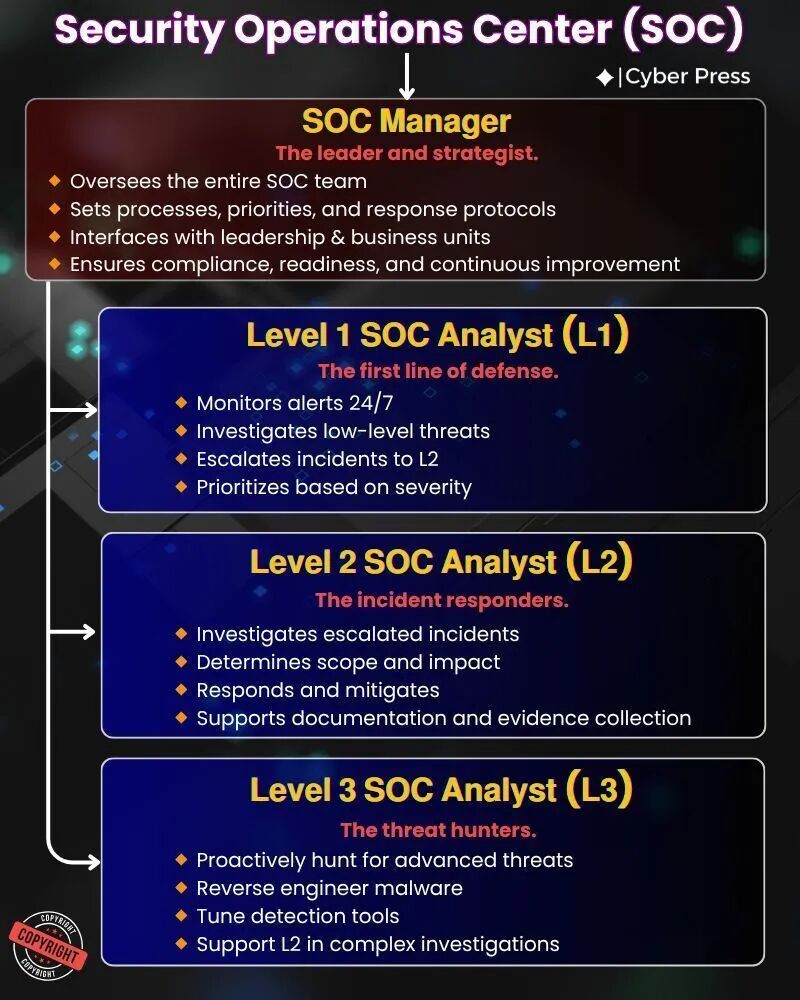 SOC Manager: The Team’s “Commander”The SOC Manager is the leader and strategist of the entire team. Their role is not to monitor screens for vulnerabilities but to oversee from a higher level:
- Manage the entire SOC team and clarify each person’s responsibilities;
- Develop security processes, priorities, and emergency response plans (for example, what to do first in the event of a ransomware attack);
- Communicate with company management and business units to align security policies with business needs;
- Ensure the team complies with industry regulations (such as information security regulations in the financial sector) while promoting continuous improvement within the team.
Level 1 SOC Analyst (L1): “The First Line of Defense”The L1 analyst is the frontline of security protection, known as the “24-hour sentinel.” Their work focuses on basic monitoring and initial response:
- Monitor security alerts year-round (after all, hackers do not choose “business days” to attack);
- Investigate low-level threats (such as common phishing emails and small-scale port scans);
- If they encounter an issue they cannot resolve, they escalate the incident to the Level 2 analyst;
- They must also prioritize alerts based on the severity of the threat, addressing high-risk alerts first.
Level 2 SOC Analyst (L2): “Incident Responders”The L2 analyst is the “emergency response team,” specifically handling incidents escalated from L1. Their responsibilities lean more towards in-depth investigation and resolution:
- Carefully study the escalated security incidents to determine the extent of the attack (for example, whether one server has been compromised or if the entire internal network is at risk);
- Assess the impact of the attack on the business (will it lead to system downtime or data breaches);
- Take direct response measures to “extinguish the fire” (such as isolating infected devices and removing malicious programs);
- Assist in documenting the incident and collecting evidence (which is crucial for subsequent tracing and accountability).
Level 3 SOC Analyst (L3): “Threat Hunters”The L3 analyst is the “technical expert” in the team, responsible for proactively hunting advanced threats:
- Not just waiting for alerts, they actively search for hidden advanced threats (such as APT attacks and 0-day exploits);
- Conduct “reverse engineering” of malware—disassembling malicious programs to analyze their behavior logic;
- Optimize security detection tools (for example, adjusting intrusion detection system rules to make them more precise);
- In cases of particularly complex investigations, they also provide technical support to L2 analysts.
After reading this, don’t you think the SOC operates like a closely coordinated military unit? From the “commander” to the “sentinel,” “emergency team,” and “technical expert,” each role is dedicated to safeguarding the organization’s cybersecurity. If you are interested in the specific work of any of these roles or want to learn how SOC tools operate, feel free to discuss in the comments!