First Author: Guojie Chao (Jiangnan University), Wei Zong, Jiexin Zhu (University of Toronto), Haifeng Wang (Donghua University)
Corresponding Authors: Wei Zong (University of Oxford/UCL), Longsheng Zhang (Jiangnan University), Guanjie He (UCL), Tianxi Liu (Jiangnan University)
Research BackgroundAmmonia (NH₃) is one of the most important basic chemicals globally. The traditional Haber-Bosch process is energy-intensive and has high carbon emissions, leading to increased interest in green electrochemical synthesis of ammonia. Nitrates (NO₃⁻) are widely found in industrial wastewater and agricultural runoff, and their electro-reduction to ammonia can both restore the nitrogen cycle and achieve “waste-to-treasure”. Cu-based catalysts have been shown to efficiently activate NO₃⁻, but the low concentration of NO₃⁻ in real wastewater and high industrial current density create electrostatic repulsion at the electrode interface, making it difficult for NO₃⁻ to approach, while water molecules occupy the surface, leading to intense competition for hydrogen evolution and a sharp drop in ammonia Faradaic efficiency. Overcoming the mass transfer bottleneck under low concentration and high current density has become the core challenge for NITRR to move towards practical applications.
Research ObjectiveTo construct a “nitrate enrichment-water molecule exclusion” Janus-type metal-polymer interface that maintains >90% ammonia Faradaic efficiency even at low NO₃⁻ concentrations and industrial current densities, and to verify its dual functionality of simultaneous ammonia production and power generation in Zn-nitrate batteries.
Experimental MethodRoom temperature interface synthesis of Cu-based terephthalic acid coordination polymer (CuBDC) was performed, followed by in situ electro-reduction to anchor Cu/Cu₂O nanoparticles on the polymer surface, resulting in the E-CuBDC catalyst; combined with electrochemical testing, in situ ATR-SEIRAS, DEMS, synchrotron radiation XAFS, molecular dynamics, and finite element simulations, the regulation of the interface microenvironment on mass transfer-reaction mechanisms was systematically analyzed.
Main Findings
-
Janus interface breaks through mass transfer limits E-CuBDC maintains >90% FE_NH₃ across a range of 7.1–100 mM NO₃⁻, continuously producing ammonia for 100 hours at an amperage level of 1.2 A cm⁻² without degradation. When NO₃⁻-N is only 25 mg L⁻¹, the ammonia production rate is comparable to that of Cu/Cu₂O at 100 mg L⁻¹, demonstrating significant interface enrichment effects.
-
In situ spectroscopy locks in the “nitrate enrichment-water exclusion” mechanism ATR-SEIRAS shows that the intensity of the NO₃⁻ characteristic peak is twice that of Cu₂O, while the water oxidation signal is suppressed; molecular dynamics indicate that the NO₃⁻ concentration on the CuBDC surface is three times that of Cu₂O, with water molecules being excluded from the surface.
-
Theoretical calculations reveal a sharp drop in reaction energy barriers DFT confirms that the rate-determining step *NH₂OH→*NH₂ energy barrier drops from 0.24 eV to 0.10 eV; the NO₃⁻ adsorption energy increases from -2.82 eV to -4.24 eV, with the positively charged polymer substrate promoting anion enrichment.
-
Zn-nitrate battery achieves record dual output The battery with E-CuBDC as the anode achieves a power density of 17.9 mW cm⁻², 82.2% FE_NH₃, and stable discharge for 140 hours, outperforming all reported Zn-NO₃⁻/NO₂⁻/N₂ systems.
Figure Interpretation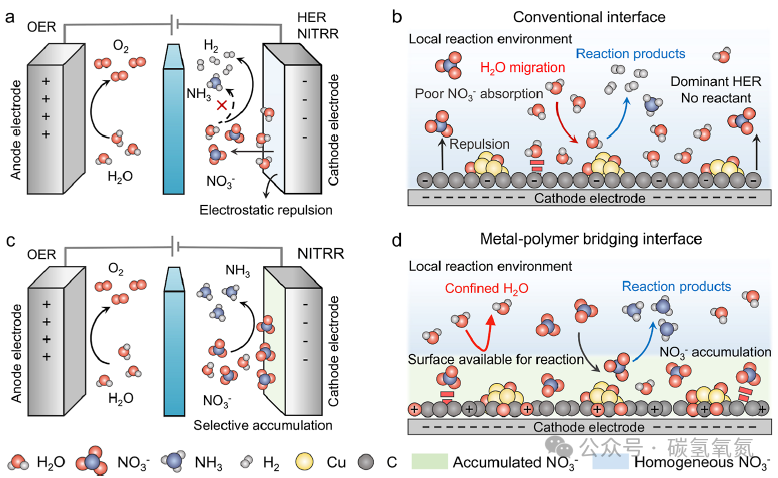
Figure 1 Schematic of mass transfer at traditional interface versus metal-polymer bridging interfacea) Traditional interface: Electrostatic repulsion at the cathode surface prevents NO₃⁻, while water molecules migrate randomly, favoring HER.b) Local reaction environment at traditional interface: NO₃⁻ is repelled, water molecules cover active sites, leading to low NH₃ yield.c) Metal-polymer bridging interface: CuBDC’s positive potential attracts NO₃⁻, forming a nitrate-rich, water-deficient microzone.d) Local reaction environment at bridging interface: NO₃⁻ selectively accumulates, water molecules are restricted, enabling efficient NITRR.
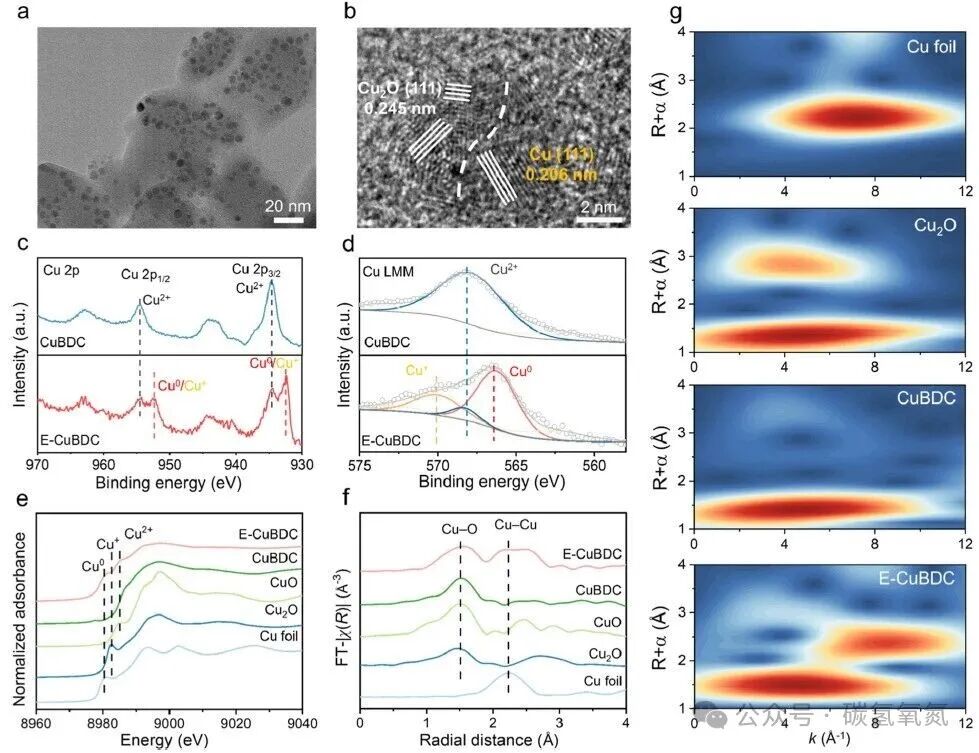
Figure 2 Material synthesis and characterizationa) Low-magnification TEM: CuBDC surface uniformly distributes bright spots of 4–8 nm (Cu/Cu₂O).b) High-magnification TEM: Lattice spacings of 0.206 nm correspond to Cu(111), and 0.245 nm correspond to Cu₂O(111).c) Cu 2p XPS: New peaks at 932.4 eV and 952.5 eV in E-CuBDC attributed to Cu⁰/Cu⁺.d) Cu LMM Auger: Peaks at 570.1, 568.3, and 566.4 eV correspond to Cu⁺, Cu²⁺, and Cu⁰, respectively.e) Cu K-edge XANES: E-CuBDC absorption edge shifts to lower energy, confirming Cu⁰/⁺ formation.f) SR-EXAFS: E-CuBDC shows a Cu-Cu scattering peak at 2.2 Å, confirming the presence of metallic Cu.g) Wavelet transform: E-CuBDC shows both Cu-O and Cu-Cu signals, verifying the coexistence of Cu/Cu₂O.
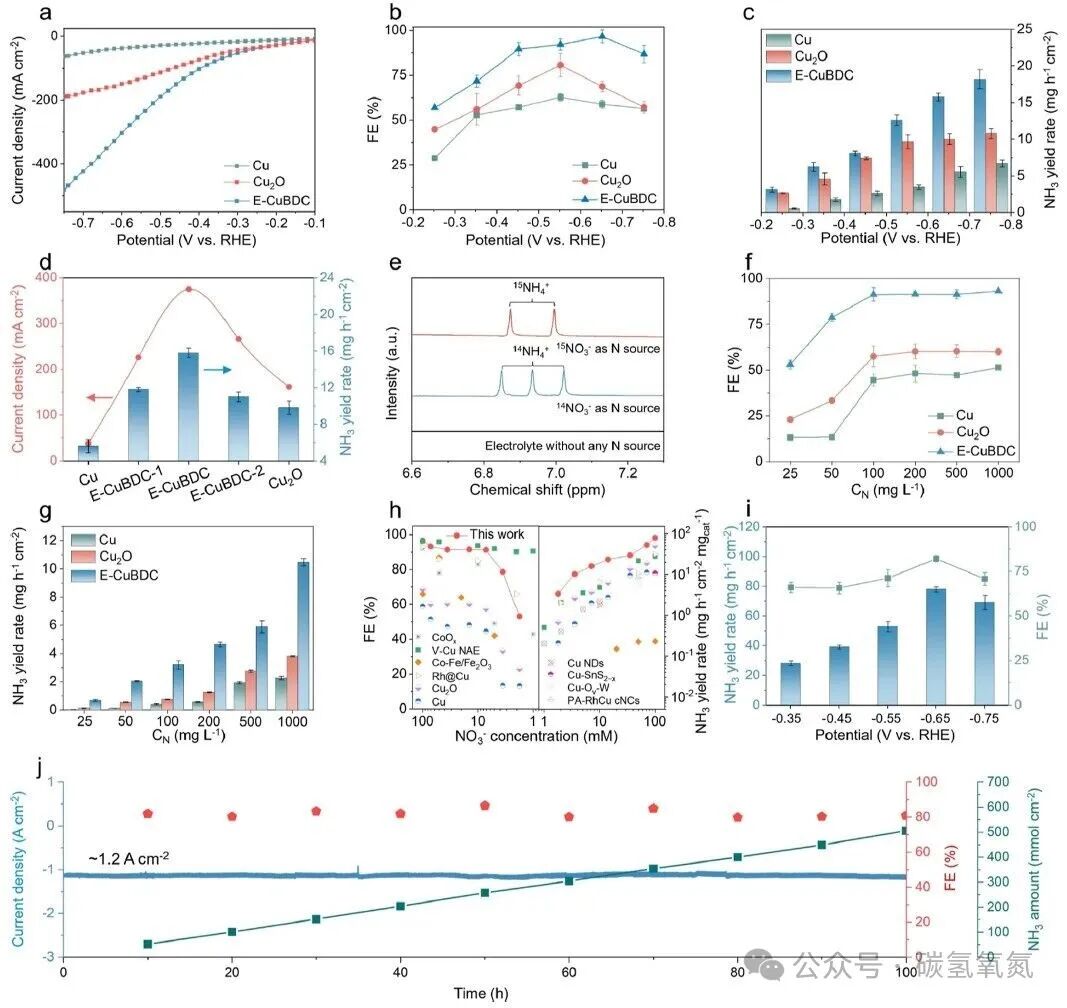
Figure 3 Electrochemical NITRR performancea) LSV: E-CuBDC shows higher current density than Cu and Cu₂O, indicating enhanced activity.b) FE_NH₃ potential curve: E-CuBDC reaches 96.6% at -0.65 V.c) NH₃ production rate potential curve: At the same potential, E-CuBDC produces 15.7 mg h⁻¹ cm⁻².d) j_NH₃ and production rate of samples with different Cu/TA ratios: The 2:1 ratio (E-CuBDC) shows a volcano peak.e) ¹⁵N isotope ¹H NMR: Only ¹⁵NH₄⁺ double peaks appear, proving that the nitrogen source comes entirely from NO₃⁻.f) FE_NH₃ at different NO₃⁻-N concentrations: Maintains >90% across the range of 25–1000 mg L⁻¹.g) Corresponding NH₃ production rate: At 25 mg L⁻¹, E-CuBDC’s production rate equals that of Cu at 100 mg L⁻¹.h) Comparison radar chart with literature: E-CuBDC leads in production rate and FE in the low concentration region.i) E-CuBDC@Ni foam’s production rate and FE: 77.9 mg h⁻¹ cm⁻², FE 82.1%.j) 100 h stability: Current ~1.2 A cm⁻², FE_NH₃ remains >80%, total ammonia continues to rise.
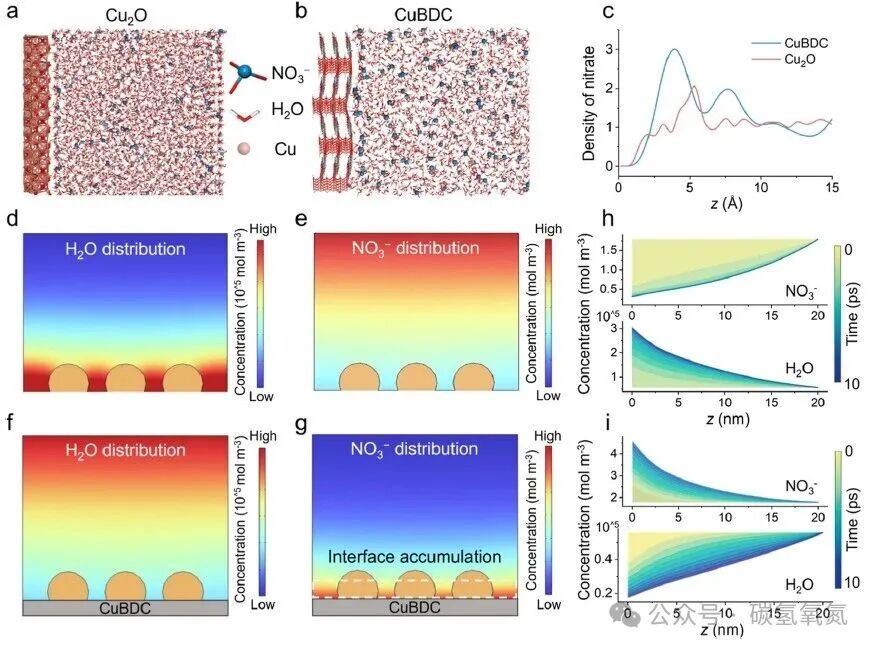
Figure 4 Molecular dynamics and COMSOL simulationsa) Cu₂O model snapshot: Sparse NO₃⁻ at the interface.b) CuBDC model snapshot: Significant NO₃⁻ enrichment at the interface.c) Interface NO₃⁻ accumulation density curve: CuBDC region peaks nearly 3 times higher than Cu₂O.d) Cu₂O model 10 ps water distribution: Water molecules tightly adhere to the surface.e) Cu₂O model 10 ps NO₃⁻ distribution: NO₃⁻ is far from the surface.f) E-CuBDC model 10 ps water distribution: Water molecules are excluded from the surface.g) E-CuBDC model 10 ps NO₃⁻ distribution: NO₃⁻ significantly accumulates at the interface.h) 3D graph of surface concentration-distance-time for Cu/Cu₂O: NO₃⁻ concentration decreases over time, while water increases.i) 3D graph of surface concentration-distance-time for E-CuBDC: NO₃⁻ concentration increases over time, while water decreases.
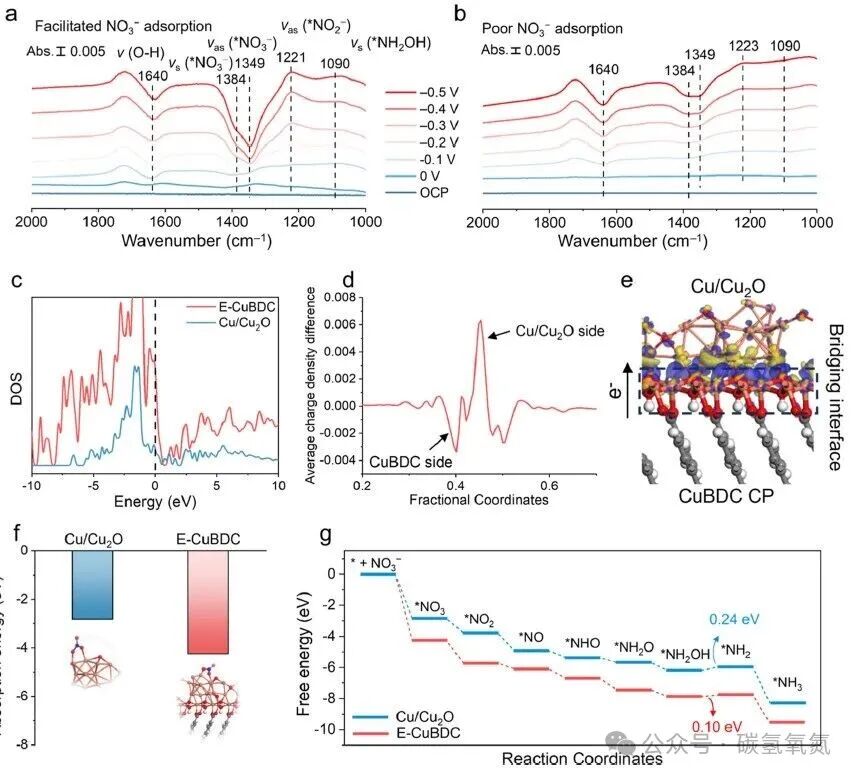
Figure 5 In situ ATR-SEIRAS and DFTa) E-CuBDC in situ infrared: *NO₃⁻ peak begins to decrease 200 mV earlier, with strong *NH₂OH signal.b) Cu₂O in situ infrared: *NO₃⁻ consumption lags, with *NH₂OH nearly invisible.c) DOS: E-CuBDC’s density of states near the Fermi level is higher than that of Cu/Cu₂O, facilitating electron transfer.d) Plane-averaged charge density difference: Electrons flow from CuBDC to Cu/Cu₂O, forming an interfacial electric field.e) Side view charge density difference: CuBDC is positively charged, attracting NO₃⁻.f) NO₃⁻ adsorption energy: E-CuBDC -4.24 eV, significantly stronger than Cu/Cu₂O -2.82 eV.g) Free energy profile: *NH₂OH→*NH₂ energy barrier for E-CuBDC is 0.10 eV, while for Cu/Cu₂O it is 0.24 eV.
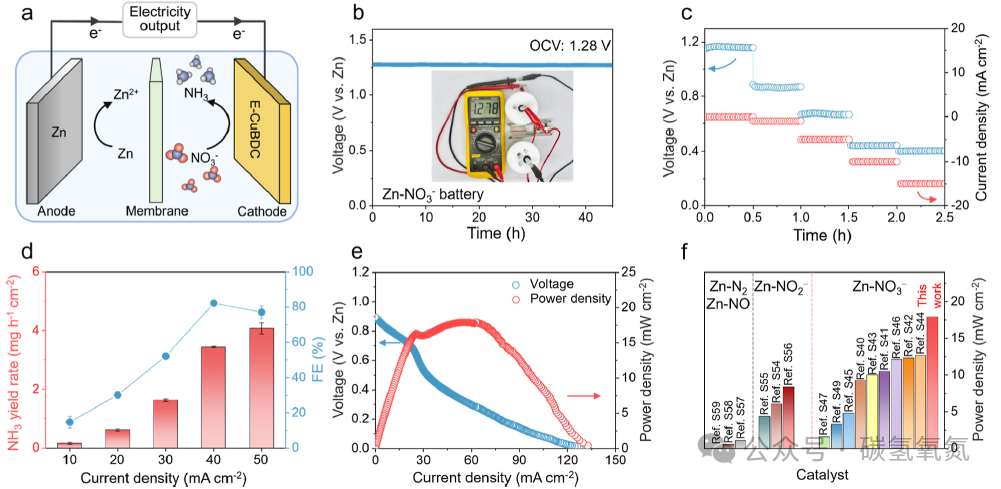
Figure 6 Zn-nitrate battery performancea) Battery schematic: Zn anode || E-CuBDC cathode, discharging while simultaneously producing NH₃.b) Open circuit voltage: 1.28 V, stable for 45 hours.c) Rate discharge: 40 mA cm⁻² still maintains a stable platform.d) FE and production rate at different current densities: At 40 mA cm⁻², FE is 82.2%, production rate is 3.4 mg h⁻¹ cm⁻².e) Power density curve: Peak at 17.9 mW cm⁻², higher than Cu₂O (8.1) and Cu (5.4).f) Comparison bar chart with literature: E-CuBDC ranks first in both power density and FE.
Conclusion and Outlook The metal-polymer Janus interface strategy proposed in this work simultaneously achieves “nitrate enrichment + water exclusion + energy barrier reduction”, maintaining >90% ammonia selectivity across low concentration to industrial current ranges, and can be integrated into Zn-nitrate batteries for a win-win in ammonia production and power generation. This interface design provides a general approach to overcoming the mass transfer bottleneck in wastewater electrochemical nitrogen fixation and can be extended to other anion electro-reduction systems and scalable flow reactors in the future.
Chao, G., Zong, W., Zhu, J., Wang, H., Chu, K., Guo, H., Wang, J., Dai, Y., Gao, X., Liu, L., Guo, F., Parkin, I. P., Luo, W., Shearing, P. R., Zhang, L., He, G., & Liu, T. (2025). Selective mass accumulation at the metal–polymer bridging interface for efficient nitrate electroreduction to ammonia and Zn–nitrate batteries. Journal of the American Chemical Society, 147, 21432–21442. https://doi.org/10.1021/jacs.5c00400