
【Research Background】
-
The challenges of lithium-ion battery cathode materials: The cathode materials of lithium-ion batteries, especially lithium and manganese-rich layered oxides (LMR), undergo irreversible oxygen loss during charge and discharge cycles, which is one of the main reasons for battery performance degradation. Oxygen loss not only alters the redox couple of the electrode material but also reduces battery voltage and leads to cation disorder in the lattice.
-
Existing understanding of oxygen loss: Previous studies have typically considered that oxygen loss mainly occurs when the battery is charged to high voltages (e.g., above 225mAh g⁻¹), while at lower states of charge (SoC), oxygen is relatively stable. However, this understanding overlooks the instability of oxygen at moderate charge states.
-
The thermodynamic basis of oxygen loss: Early studies indicated a relationship between the reactivity of oxygen in lithium transition metal oxide electrodes and voltage, suggesting that oxygen may be thermodynamically unstable throughout the entire charge and discharge process of LMR materials.
【Research Content】
-
Research objective: This study aims to explore the mechanism of oxygen loss in LMR cathode materials at moderate charge states (e.g., from 135mAh g⁻¹ to 265mAh g⁻¹) and the influence of lithium content on oxygen loss.
-
Experimental methods: Researchers employed various experimental techniques, including X-ray absorption spectroscopy (XAS), scanning transmission X-ray microscopy (STXM), and X-ray diffraction (XRD), to analyze LMR-NMC electrodes at different charge states. During the experiments, the electrodes were subjected to long-term open-circuit voltage (OCV) resting at different charge states to simulate calendar aging in actual use.
-
Theoretical calculations: To understand the formation mechanism of oxygen vacancies, researchers also conducted density functional theory (DFT) calculations to analyze the formation energy of oxygen vacancies at different crystallographic sites and the impact of oxygen non-stoichiometry on lattice volume.
【Illustrated Guide】
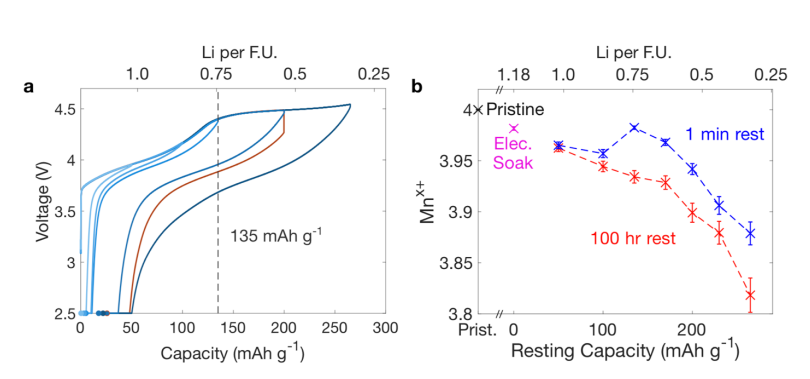
Figure 1: Relationship between transition metal reduction and lithium content a. Charge and discharge curves of original LMR-NMC at different charge states (SoC). The high voltage plateau begins after approximately 135mAh g⁻¹ of charge during charging. The blue curve indicates a 1-minute OCV resting between charge and discharge. The red curve indicates a 100-hour OCV resting after charging. Each circular point on the curves represents the voltage at the end of the constant voltage hold phase during discharge. b. Relationship between manganese oxidation state and electrochemical protocol. In batteries charged to higher capacities (lower lithium content), more manganese is reduced. Batteries that underwent 100 hours of OCV resting after charging show more manganese reduction, especially at higher SoC. It is noted that each discrete data point in the figure comes from individually tested batteries.
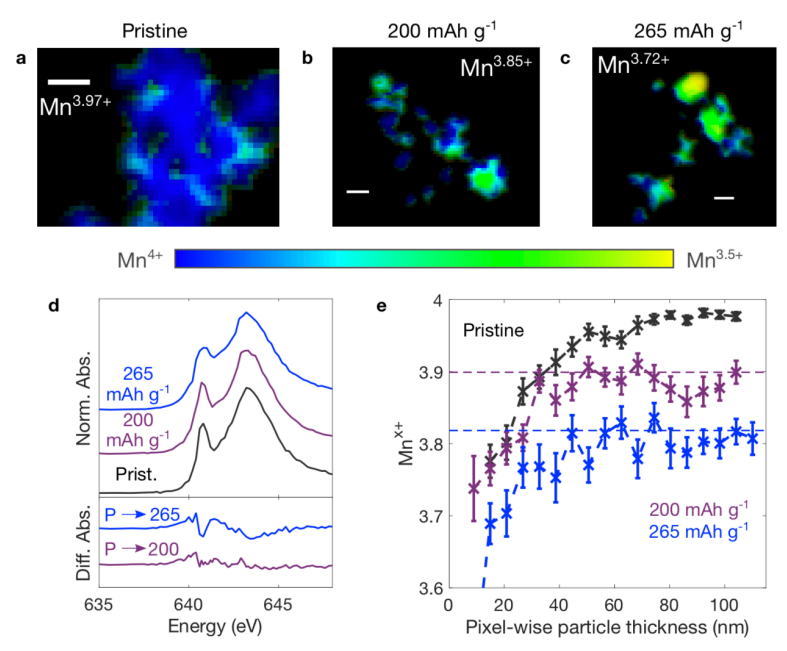
Figure 2: Spatial dependence of manganese oxidation state a. Electrode of the original material. b. Electrode discharged after charging to 200mAh g⁻¹. c. Electrode discharged after charging to 265mAh g⁻¹. The electrodes in (b) and (c) underwent 100 hours of OCV resting between charge and discharge. The scale bar in each image is 400nm. d. Batch-averaged spectra show that electrodes charged to higher capacities exhibit lower manganese oxidation states at the end of discharge (also see Supplementary Figure 11). e. The proportion of Mn³⁺ terminal spectra in each electrode determined by pixel-level particle thickness (see methods) as a function of pixel-level particle thickness. Significant manganese reduction is observed even in thicker regions, indicating that some degree of bulk phase reduction occurs within a single electrochemical cycle. The dashed line corresponds to the average oxidation state of the electrode determined by Mn K-edge spectroscopy (Figure 1b). Only weighted averages from more than 10 pixels are included to avoid misinterpretation of results from a few individual pixels.
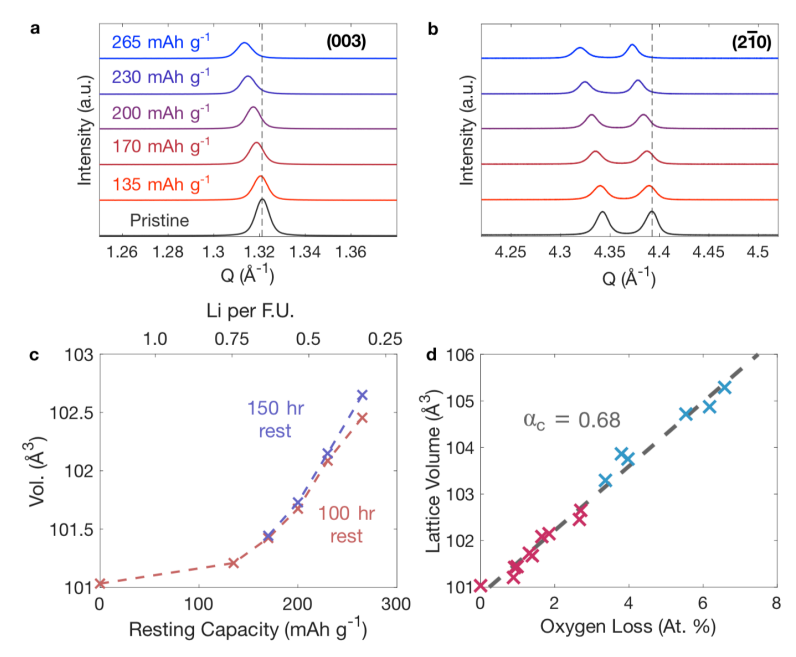
Figure 3: Relationship between lattice expansion and upper capacity cutoff a. The (003) peak of the lithiated material indicates that the material retains its original layered phase after completing the electrochemical protocol (also see Supplementary Figure 1). For batteries experiencing higher upper capacity cutoffs, the two peaks shift to lower Q values, indicating lattice expansion (Supplementary Figure 2). b. The (210) peak of the lithiated material indicates that the material retains its original layered phase after completing the electrochemical protocol. For batteries experiencing higher upper capacity cutoffs, the two peaks shift to lower Q values, indicating lattice expansion. All electrodes underwent 100 hours of open-circuit resting. Note that the lower Q value peak (Q ≤ 4.35 Å⁻¹) in panel b is the (1080) peak. c. Lattice volume increases with increasing upper capacity cutoff, attributed to oxygen loss. Longer resting times at the upper capacity cutoff lead to more lattice expansion, although there is little difference between electrodes that underwent 100 hours and 150 hours of resting. d. Lattice volume is highly correlated with the amount of oxygen loss (see Supplementary Tables 2 and 3), indicating that the lattice volume at full discharge can be used to estimate the amount of oxygen loss. Note that the six blue data points in the figure come from previous studies (11) that examined the same materials after up to 500 electrochemical cycles. The oxygen loss of the original electrode was zero, consistent with previous studies (11). The Pearson correlation coefficient for the data in the figure is 0.98. These data suggest that the lattice expansion coefficient due to oxygen non-stoichiometry is αc = 0.68, calculated using the formula ε = αc[V₀⋅⋅].
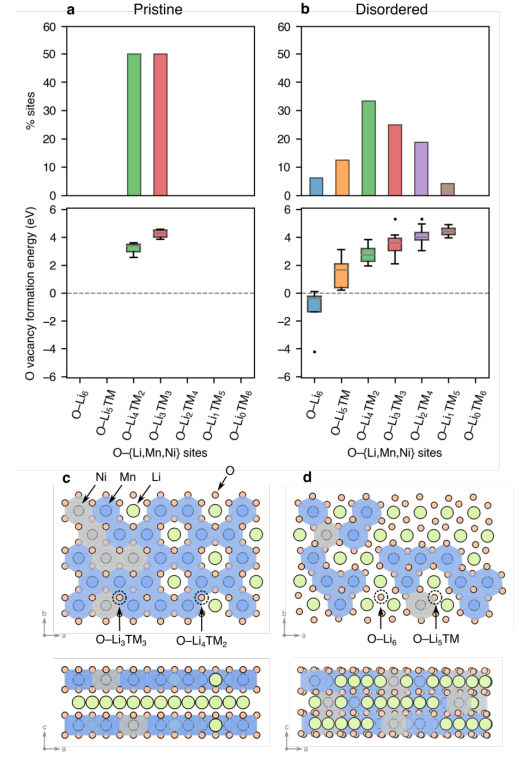
Figure 4: Oxygen environment and oxygen vacancy formation energy a. (Top) Distribution of oxygen coordination environments in the original Li1.16Mn0.67Ni0.16O2 obtained through cluster expansion and Monte Carlo simulations; all sites are O–Li3TM3 or O–Li4TM2. (Bottom) Formation energy ∆E(Ovac) of oxygen vacancies at six sites in the original structure as a function of oxygen coordination environment. b. (Top) Distribution of oxygen coordination environments in the special quasi-random structure (SQS) model, which represents the configurational disorder of sites in the cycled electrode. The SQS model includes new O–Li6, O–Li5TM, O–Li2TM4, and O–LiTM5 environments. (Bottom) Formation energy of oxygen vacancies at 48 oxygen sites in the SQS structure. c. Structure of the original material (top view and side view). d. Structure of the cycled material (top view and side view).
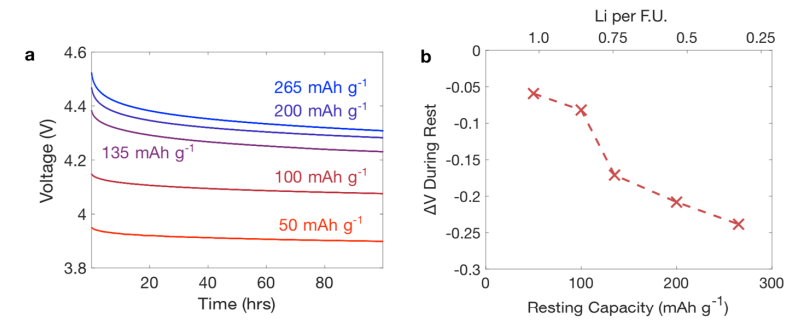
Figure 5: Voltage drop during open-circuit relaxation a. Voltage decay during the 100-hour open-circuit relaxation process at different charge states (SoC). b. Change in open-circuit voltage during the relaxation process as a function of the resting capacity achieved during charging. We believe this cannot be explained solely by the slight self-discharge that may occur during OCV resting (Supplementary Figure 7).
【Research Highlights】
-
Oxygen loss at moderate charge states: The study found that significant oxygen loss occurs even at moderate charge states (e.g., from 135mAh g⁻¹ to 265mAh g⁻¹) in LMR-NMC electrodes. For instance, at a charge state of 265mAh g⁻¹, the oxygen loss can be as high as 2.7at.%, equivalent to more than 7mL of oxygen loss per gram of LMR-NMC after 100 hours of resting.
-
Thermodynamic instability of oxygen loss: Experimental results indicate that oxygen is thermodynamically unstable at moderate charge states, consistent with earlier findings regarding the relationship between oxygen reactivity and voltage. Even at lower charge states, oxygen may escape from the lattice by forming oxygen vacancies.
-
Formation energy of oxygen vacancies: DFT calculations show that oxygen vacancies are more likely to form at oxygen sites with more lithium (non-transition metal) neighboring atoms. These sites only appear after cation disordering, and their formation energy for oxygen vacancies is even negative at full lithiation, indicating that the formation of oxygen vacancies is thermodynamically favorable.
-
Lattice expansion and oxygen non-stoichiometry: The study also found that LMR-NMC materials exhibit an unusually large lattice expansion coefficient of about 0.68 at full discharge, significantly higher than typical fluorite and perovskite oxides. This lattice expansion is directly related to oxygen non-stoichiometry, indicating that oxygen loss can lead to mechanical degradation of the material, such as particle cracking.
【Research Conclusions】
-
Universality of oxygen loss: Significant oxygen loss occurs in LMR-NMC materials at moderate charge states, a phenomenon that has been underestimated in previous studies. Oxygen loss occurs not only during high voltage charging but is present throughout the entire charge and discharge cycle.
-
Thermodynamic driving force of oxygen loss: The thermodynamic instability of oxygen is the main reason for oxygen loss, especially at moderate charge states. The low formation energy of oxygen vacancies indicates that the escape of oxygen is thermodynamically favorable under these conditions.
-
Lattice expansion and mechanical degradation: Lattice expansion caused by oxygen non-stoichiometry may accelerate the mechanical degradation of the material, such as particle cracking, further reducing battery performance and lifespan.
-
The importance of calendar aging: The study emphasizes the importance of calendar aging in assessing the oxygen stability of electrode materials. Even at lower charge states, prolonged calendar aging can lead to significant oxygen loss.
-
Implications for future research: The findings suggest that strategies to prevent oxygen loss in LMR materials need to shift from thermodynamic stabilization to suppressing the kinetics of oxygen diffusion and escape. This may require the development of new coating technologies or optimization of battery operating conditions to reduce the risk of oxygen loss.
【Article Information】
Csernica P M, McColl K, Busse G M, et al. Substantial oxygen loss and chemical expansion in lithium-rich layered oxides at moderate delithiation[J]. Nature Materials, 2025, 24(1): 92-100.
https://doi.org/10.26434/chemrxiv-2024-lj9jk