Article Overview
Article Information
-
Title: Synergy of Single Atoms and Lewis Acid Sites for Efficient and Selective Lignin Disassembly into Monolignol Derivatives
-
Authors: Ge Meng, Wu Lan, Lilong Zhang, Shibin Wang, Tanhao Zhang, Shuo Zhang, Ming Xu, Yu Wang, Jian Zhang, Fengxia Yue* (South China University of Technology, Fengxia Yue), Yulong Wu* (Tsinghua University, Yulong Wu), and Dingsheng Wang* (Tsinghua University, Dingsheng Wang)
-
Journal: J. Am. Chem. Soc. (2023)
-
DOI: 10.1021/jacs.3c04028
-
Citations: 72 (Google Scholar, 2025.9)
Statement: This interpretation is for research communication and sharing only, and the copyright belongs to the original authors and publishers. If there is any infringement, please contact for removal.
Introduction
Lignin is the most abundant natural aromatic polymer resource on Earth, and its efficient catalytic conversion is crucial for biomass refining and the production of high-value chemicals. However, the complex structure of lignin and the diverse reaction pathways make it a significant scientific challenge to depolymerize it efficiently and selectively into specific monomers (especially lignol derivatives that retain unsaturated double bonds in side chains) under mild conditions. Traditional catalytic systems (such as noble metal catalysts) often involve harsh reaction conditions (such as high-pressure hydrogen) and struggle to suppress the excessive hydrogenation, oxidation, or condensation of side chain double bonds, leading to poor yields and selectivity of target products.
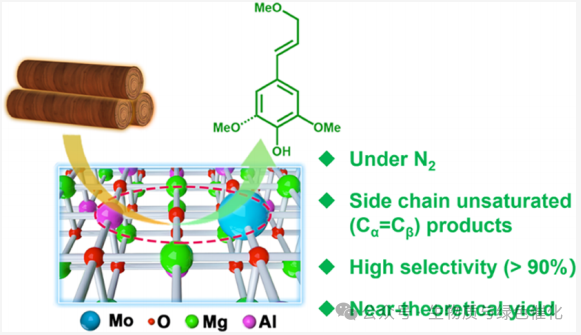
To address these challenges, Professor Dingsheng Wang and Researcher Yulong Wu from Tsinghua University collaborated with Professor Fengxia Yue’s team from South China University of Technology to innovatively design and synthesize a bifunctional catalyst (Mo₁Al/MgO) supported on magnesium oxide (MgO), featuring atomically dispersed Mo centers and Al Lewis acid sites. This catalyst cleverly utilizes the synergistic effect of single atoms and Lewis acid sites to achieve the efficient cleavage of β-O-4 ether bonds in eucalyptus lignin under inert atmosphere, obtaining high-value softwood/mustard tree methyl ethers with yields (46%) close to theoretical values and ultra-high selectivity (92%). This work provides a new approach for designing efficient, low-cost, and safe biomass conversion catalysts.
Key Points Analysis
1. Careful Construction of Mo Single Atom and Al Lewis Acid Bifunctional Site Catalyst
Key Point Overview: The research team successfully synthesized a bifunctional catalyst (Mo₁Al/MgO) with atomically dispersed Mo atoms on Al-doped MgO support through a two-dimensional spatial confinement strategy based on layered double hydroxides (LDH).
The researchers first prepared the MoO₄²⁻ intercalated MgAl-LDH precursor via co-precipitation, followed by thermal reduction in a hydrogen atmosphere. This strategy effectively suppressed the agglomeration of Mo species during high-temperature treatment by utilizing the electrostatic repulsion between LDH layers, ensuring the single atom dispersion of Mo. As shown in Figure 1, transmission electron microscopy (TEM) and spherical aberration-corrected high-angle annular dark field scanning transmission electron microscopy (AC-HAADF-STEM) images clearly confirm the nanosheet morphology of the catalyst, with a large number of isolated Mo single atoms (highlighted points in the figure) uniformly distributed on the Al/MgO support, with no visible Mo nanoparticles or clusters formed. X-ray diffraction (XRD) patterns indicate that the support has a cubic phase structure of MgO with Al³⁺ ions successfully doped into the lattice. This unique structural design lays a solid foundation for the subsequent realization of Mo-Al synergistic catalysis.
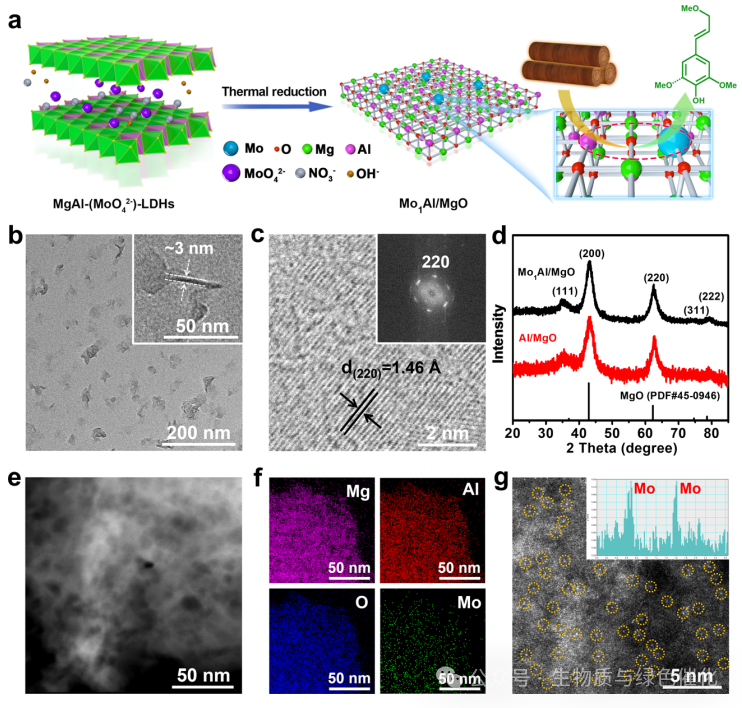
Figure 1. (a) Schematic diagram of the synthesis of Mo₁Al/MgO catalyst for selective depolymerization of lignin using a two-dimensional confinement strategy. (b, c) TEM and HRTEM images of Mo₁Al/MgO. (d) XRD patterns of Mo₁Al/MgO and Al/MgO. (e, f) HAADF-STEM images and elemental distribution maps. (g) Atomic resolution HAADF-STEM image of Mo₁Al/MgO, clearly showing the Mo single atoms.
2. X-ray Absorption Spectroscopy Reveals the Structure of Mo₁-O₅ Single Atom Active Center
Key Point Overview: A comprehensive application of various spectroscopic techniques, including X-ray absorption fine structure spectroscopy (XAFS) and X-ray photoelectron spectroscopy (XPS), accurately elucidated the local coordination environment and electronic state of Mo single atoms, determining its active structure as Mo₁-O₅ center.
To further investigate the structure of the active site of the catalyst, the research team conducted detailed synchrotron radiation characterization. The Mo K-edge X-ray absorption near-edge structure (XANES) spectrum in Figure 2 shows that the oxidation state of Mo atoms in Mo₁Al/MgO is close to +6, similar to MoO₃. More critically, the extended X-ray absorption fine structure (EXAFS) spectrum analysis indicates that there is only one Mo-O coordination peak located at about 1.3 Å in Mo₁Al/MgO, with no signal of Mo-Mo metallic bonds, which again confirms the isolated dispersion state of Mo at the atomic level. By fitting the EXAFS data, the researchers precisely determined the coordination structure of Mo atoms: each Mo single atom coordinates with about 5 oxygen atoms, forming a stable Mo₁-O₅ active center with an average bond length of 2.1 Å. This unique, highly dispersed, and structurally defined single atom configuration is key to achieving high catalytic activity and selectivity.
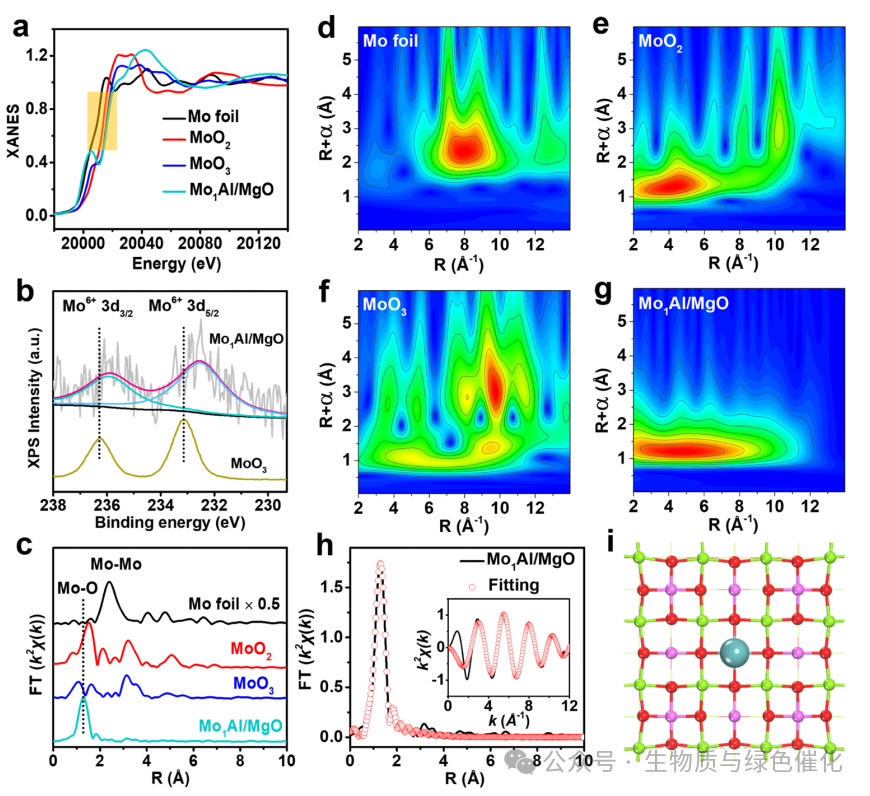
Figure 2. (a) Mo K-edge XANES spectra of Mo₁Al/MgO and reference samples. (b) Mo 3d XPS spectrum. (c) Fourier transform EXAFS (FT-EXAFS) spectrum showing only Mo-O coordination in Mo₁Al/MgO. (h) EXAFS fitting curve. (i) Optimized schematic diagram of Mo₁-O₅ center structure.
3. Mo-Al Synergistic Catalysis Achieves Near-Theoretical Yield of Monophenol Conversion from Eucalyptus Lignin
Key Point Overview: In an inert atmosphere and methanol solvent, the Mo₁Al/MgO catalyst exhibited outstanding performance in the depolymerization of real eucalyptus lignin, achieving a monophenol yield of up to 46%, with selectivity for target products exceeding 90%, and good catalyst stability.
The practical application effect of this catalyst is the core measure of its value. As shown in Figure 3a, under the reaction conditions of 200°C and nitrogen atmosphere for 8 hours, the Mo₁Al/MgO catalyst degraded eucalyptus lignin, achieving a monomer yield of 46%, which is very close to the theoretical maximum yield based on the content of β-O-4 bonds. More importantly, 92% of the products retained the side chain Cα=Cβ double bonds as softwood/mustard tree methyl ethers (1G and 1S), demonstrating unprecedented selectivity. A series of control experiments (as shown in experiments 5, 6, and 7 in the figure) confirmed that whether using no catalyst, only Mo₁/MgO, or Mo/Al₂O₃, the yield and selectivity were far lower than those of Mo₁Al/MgO, strongly confirming that the synergistic effect between Mo single atoms and adjacent Al Lewis acid sites is key to achieving efficient and highly selective catalysis. After 5 cycles of use, the catalyst showed only slight performance degradation, indicating its excellent stability.
Figure 3b shows a clear comparison of the two-dimensional nuclear magnetic resonance hydrogen spectrum (HSQC) before and after the reaction, indicating that the β-O-4 linkage signals in lignin almost disappeared, while characteristic signals of the target monomer products appeared, intuitively proving the effectiveness of the catalytic process.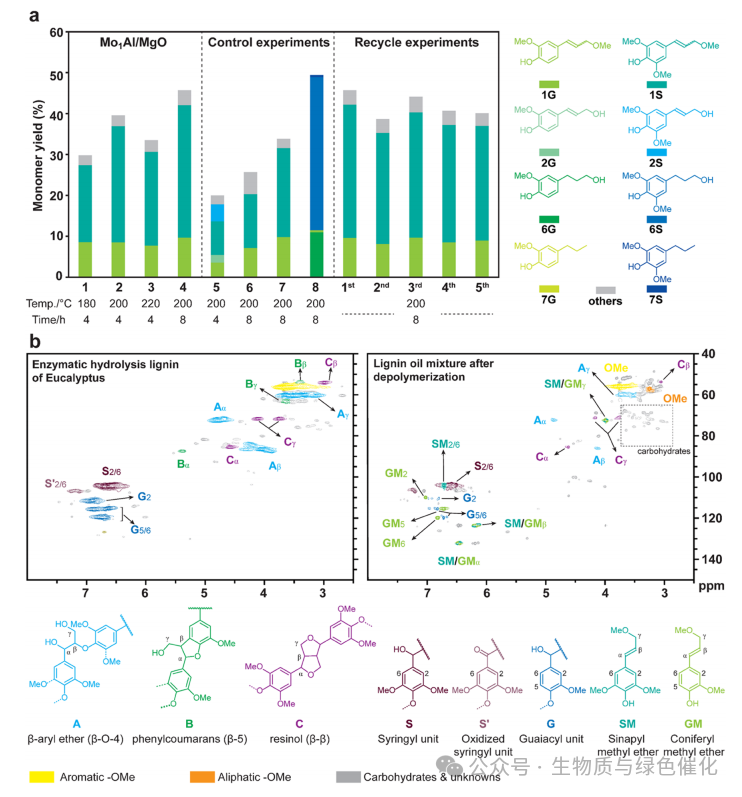
Figure 3. (a) Distribution of monomer yields from lignin depolymerization under different reaction conditions, highlighting the superior performance and cycling stability of Mo₁Al/MgO. (b) Comparison of HSQC spectra of eucalyptus raw lignin (left) and Mo₁Al/MgO catalyzed depolymerization product oil (right), confirming the effective cleavage of β-O-4 bonds and the generation of target monomers.
4. Theoretical Calculations Reveal the Reaction Mechanism of Mo-Al Dual Site Synergistic Catalysis for β-O-4 Bond Cleavage and Etherification
Key Point Overview: Density functional theory (DFT) calculations indicate that the Mo₁-O₅ center and adjacent Al Lewis acid sites play different, complementary roles at different stages of the reaction, synergistically promoting the cleavage of β-O-4 bonds and subsequent etherification reactions with methanol, thus achieving high selectivity.
To theoretically reveal the microscopic mechanism of synergistic catalysis, the research team conducted DFT calculations (Figure 4). The calculation results show that the reaction starts with the adsorption of lignin model compound (GG) on the Mo-Al bifunctional site, where the Mo site and Al site jointly capture and stabilize the reaction intermediates, facilitating the initial dissociation of the β-O-4 ether bond, generating guaiacol and softwood alcohol intermediates. Subsequently, the reaction pathway diverges: one pathway leads to the dehydrogenation of softwood alcohol to produce softwood aldehyde; the other pathway involves the dissociation of the methanol solvent molecule at the Al Lewis acid site, with the resulting methyl (CH₃) combining with the intermediate to generate softwood methyl ether. Energy calculations show that the etherification pathway involving methanol is thermodynamically more favorable than the pathway leading to softwood aldehyde (reaction energy of -1.08 eV), which perfectly explains the observed ultra-high selectivity for methyl ether products (1G/1S) in experiments. The entire process clearly demonstrates that the Mo site is primarily responsible for redox steps, while the Al Lewis acid site cleverly “guides” the activation and selective etherification of methanol, both of which are indispensable and together constitute an efficient and highly selective catalytic cycle.
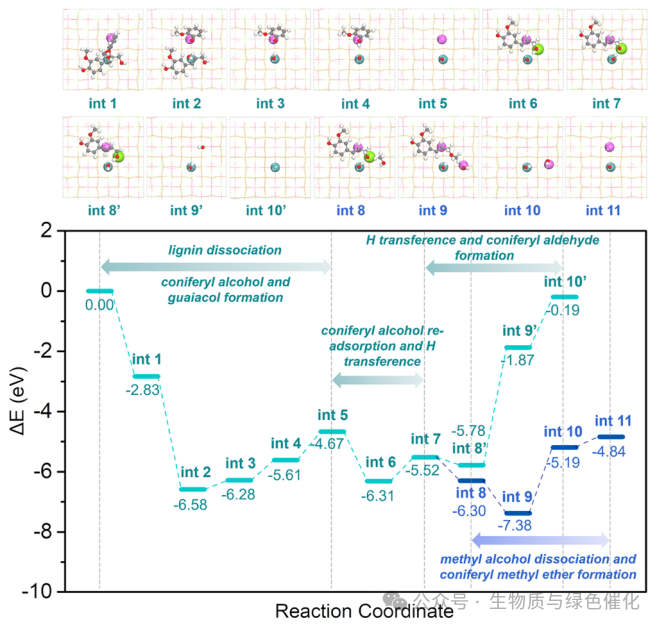
Figure 4. DFT-calculated potential energy surface for the depolymerization of GG model compound on Mo₁Al/MgO surface. This figure illustrates the reaction pathways and key intermediate structures for generating different products (softwood methyl ether, softwood alcohol, softwood aldehyde, and guaiacol), theoretically confirming the energy advantage of the methyl ether generation pathway.
Conclusion
This study successfully designed and synthesized a novel Mo₁Al/MgO bifunctional catalyst, tightly integrating the atomically dispersed Mo₁-O₅ active center with Al Lewis acid sites. This catalyst achieved efficient and highly selective conversion of eucalyptus lignin into high-value unsaturated aromatic monomers under safer and lower-cost inert atmosphere conditions, with monophenol yields approaching theoretical limits (46%) and target product selectivity reaching 92%.
In-depth mechanistic studies and theoretical calculations reveal that the synergistic effect of Mo-Al dual sites is key to its outstanding performance: the Mo₁-O₅ center and Al Lewis acid sites jointly participate in and stabilize the intermediates of β-O-4 bond cleavage in lignin, followed by the preferential activation of methanol solvent by the Al site, promoting the highly selective etherification reaction, effectively avoiding the common excessive hydrogenation and side reactions in traditional catalytic systems. This research not only provides a promising catalytic system for the catalytic valorization of lignin but also importantly opens new avenues for the future efficient and precise conversion of other complex biomass macromolecules, as well as broader applications in the field of heterogeneous catalysis.