Two days ago, we discussed SoC chips, which are indeed “big eaters” that typically integrate core components such as CPUs, GPUs, and memory all at once. Some even include power management and control of external devices. Unlike domestic SoC all-rounders like Rockchip, Hengxuan Technology specializes in the fertile ground of wireless ultra-low power.
Founded in 2015, Hengxuan Technology has emerged as a leader in the design of wireless ultra-low power SoC chips. Its chips are the heart of cool wearable devices like TWS headphones, smartwatches, and AI glasses, as well as smart home products.
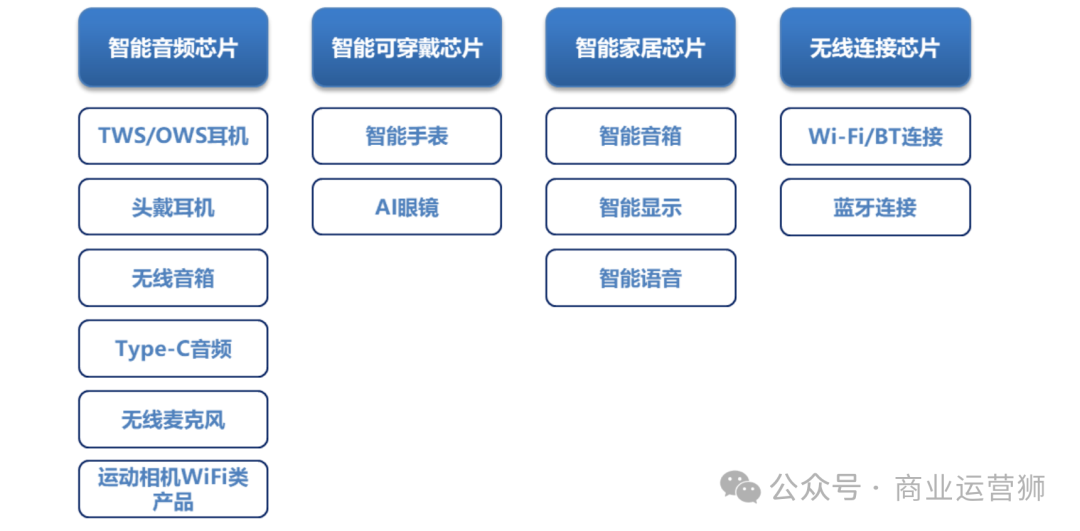
The company has built a moat with its three major advantages: “low power + AI + audio”. Its clients include big names like Samsung, OPPO, Huawei, Xiaomi, and Honor, with the top five customers contributing 74% of its sales before 2024.
In 2024, the company is projected to achieve a revenue of 3.2 billion, a staggering increase of 49% from the previous year; net profit is expected to reach 460 million, a remarkable surge of 272%, skyrocketing.
In the first three quarters of 2025, the momentum continues, with revenue at 2.9 billion, an 18% growth; net profit at 500 million, a 73% increase, and gross margin climbing to 38%, nearly 5 percentage points higher than the previous year, truly a rising star.
The first business segment (Bluetooth audio)
Its TWS main control chip occupies about 10% of the global market, with 111 million units sold in 2024, averaging 10 yuan per unit, a stable price; the OWS headphones segment is even more impressive, with 24.92 million units sold in the Chinese market alone in 2024, more than doubling from the previous year, proving to be a hot seller. Revenue in 2025 is expected to be around 2 billion, serving as the company’s business cornerstone.
The main manufacturers of global Bluetooth headphone main control SoCs include: Apple, Qualcomm, Jieli Technology, Hengxuan Technology, Woqi, Luoda Technology, Zhongke Lanxun, Juxin Technology, Realtek, and Broadcom. As Bluetooth headphones evolve towards open forms and AI functionalities, the requirements for key performance in main control SoCs, such as active noise cancellation and energy consumption control, are increasingly stringent.
Hengxuan’s TWS main control chip ranks fourth globally, with a market share of about 10%.
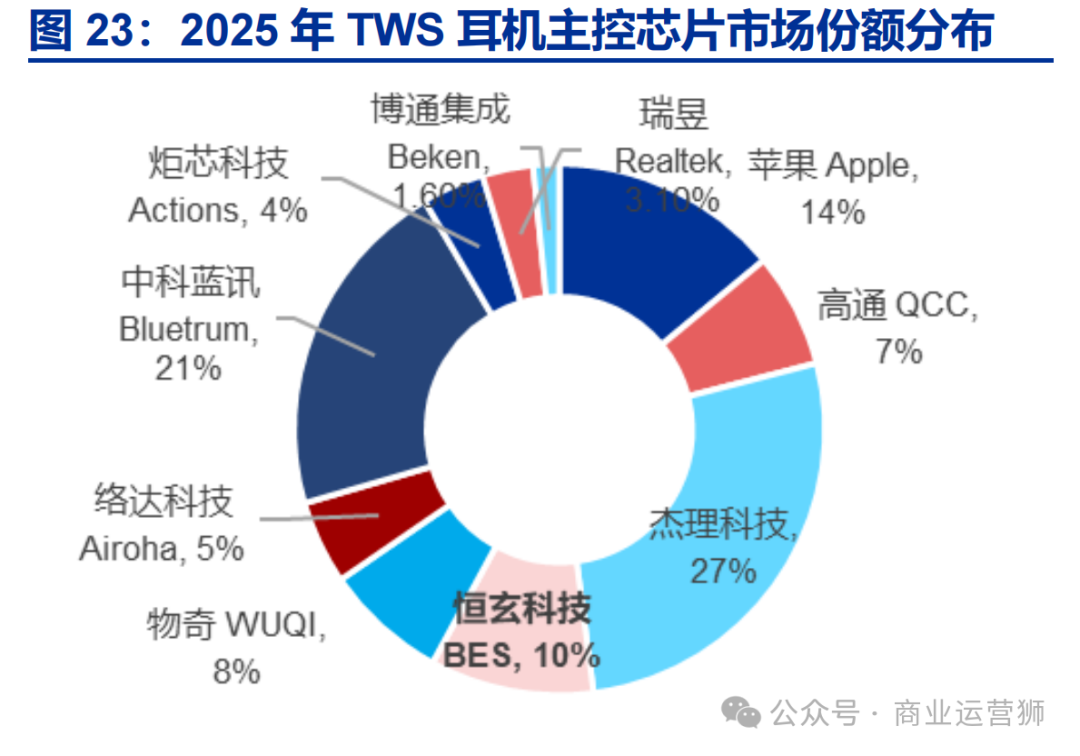
Hengxuan Technology targets the mid-to-high-end market, leading the industry in Bluetooth audio chip revenue.
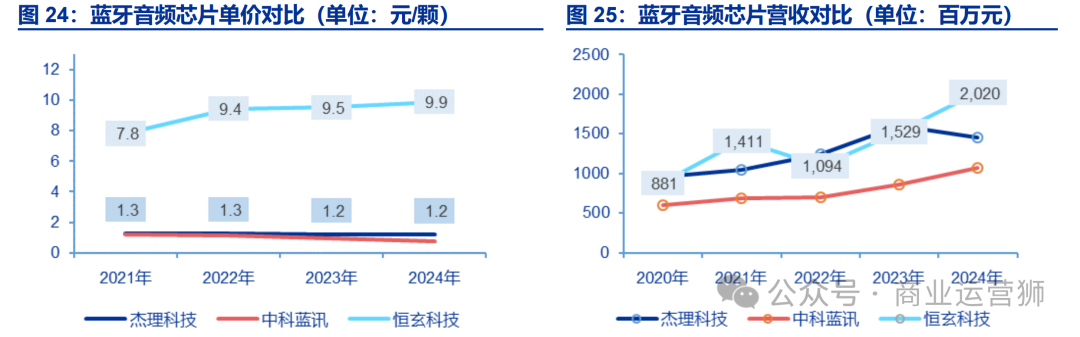
The price of Hengxuan Technology’s Bluetooth audio chips is nearly 10 yuan per unit, significantly higher than the average prices of products from Zhongke Lanxun and Jieli Technology, thus Hengxuan Technology’s revenue in 2024 is expected to reach 2.02 billion yuan, ranking first among domestic Bluetooth audio manufacturers.
The second business segment (smartwatches)
In 2024, smartwatch chip sales are expected to soar to 1.04 billion, more than doubling from the previous year, with shipments exceeding 40 million units. Its BES2700/2800 series excels in low-power domains and Wi-Fi 6, showcasing strong technical capabilities, allowing it to compete with international giants. The competitive landscape for smartwatch chips is as follows: Apple develops in-house, while third parties mainly rely on Qualcomm and Hengxuan.
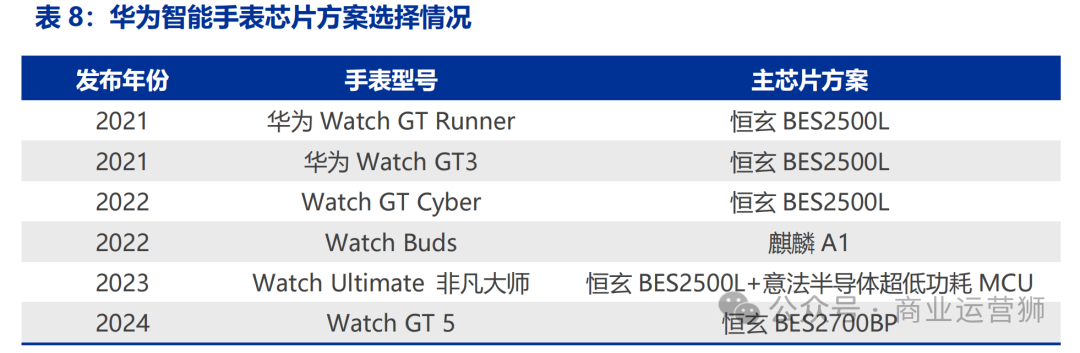
The BES2700/2800 architecture significantly improves battery life under the “always-on low-power domain (SensorHub + NPU)” and is the first in its class to integrate BT 5.4/LE Audio and Wi-Fi 6 (including TWT power-saving mechanisms), boasting internationally leading low-power capabilities.
Hengxuan Technology adopts an efficient “platform-based” product strategy, allowing the same chip to be used across various terminals such as watches, headphones, and glasses.
The ES2700 series smart wearable chips can be widely used in TWS headphones, smartwatches, smart glasses, and smart hearing aids; for the entry-level sports watch and wristband market, the BES2700iBP smartwatch chip has significantly reduced standby and operating power compared to the previous generation BES2500 series.
The third business segment (AI glasses)
SoCs account for a significant portion of the BOM in smart glasses. For example, in Ray Ban Stories and Ray Ban Meta, the mainboard chip accounts for 49% or more of the BOM, with the SoC estimated to account for over 30%.
The BES2800 chip is already in full production, used by major clients like Xiaomi. It supports far-field voice recognition and low-power image processing (ISP). The more advanced BES6000 series is expected to be ready for customer sample testing by 2026, integrating powerful multi-core AI computing capabilities, promising a bright future.
Core Technology Summary
Utilizing advanced 6nm technology (such as the BES2800 chip), it incorporates a dual-core Cortex-M55 processor, a dedicated AI processor (NPU), and Wi-Fi 6, while supporting Bluetooth 5.4/LE Audio, making it a true “jack of all trades” proficient in audio, sensor data, and image processing.
Its self-developed keyword wake-up (KWS) algorithm and ISP 4.0 technology are specifically designed for voice interaction and image processing in AI glasses, also supporting cool features like HDR (High Dynamic Range) and SLAM (Simultaneous Localization and Mapping), showcasing a strong sense of technology.