 Click the blue text above to subscribe
Agriculture is a crucial part of human civilization, providing essential goods such as food and clothing for the rapidly growing global population. To meet the increasing demand, the use of chemical fertilizers has become widespread. However, the utilization rate of conventional fertilizers is less than 30%, leading to significant nutrient waste through volatilization and leaching, which causes severe environmental pollution and water eutrophication. To address this issue, Professor Huan Siqi from Northeast Forestry University proposed a multiphase emulsion gel material stabilized by cellulose nanofibers (CNF) and nano-chitosan (NCh) as Pickering stabilizers for polylactic acid (PLA)/chloroform (CHCl3) oil phase, with CNF/PAA as the gel phase. This material triggers shear-induced phase separation through 3D printing, promoting the automatic migration of PLA to form a dense continuous coating film, and allows for controllable adjustment of the coating film morphology by varying the ratio of CNF/PAA. This results in slow release of fertilizers and customizable smart fertilizer design solutions.
On November 20, 2025, this work was published in Carbohydrate Polymers under the title “Cellulose nanofibrils-based emulgels: Impact on surface film formation and performance as slow-release fertilizers.” The co-first authors of the paper are doctoral students Cheng Yanpeng, Yang Zhaolin, and master’s student Guo Rao from the College of Materials Science at Northeast Forestry University, with Professor Huan Siqi as the corresponding author.
The research utilized green and sustainable CNF/NCh as Pickering stabilizers, which irreversibly adsorb at the oil-water interface through electrostatic interactions to form stable O/W emulsions. Figure 1 confirms the stabilization mechanism of CNF/NCh, maintaining droplet stability even under high crosslink density of the CNF/PAA gel phase.
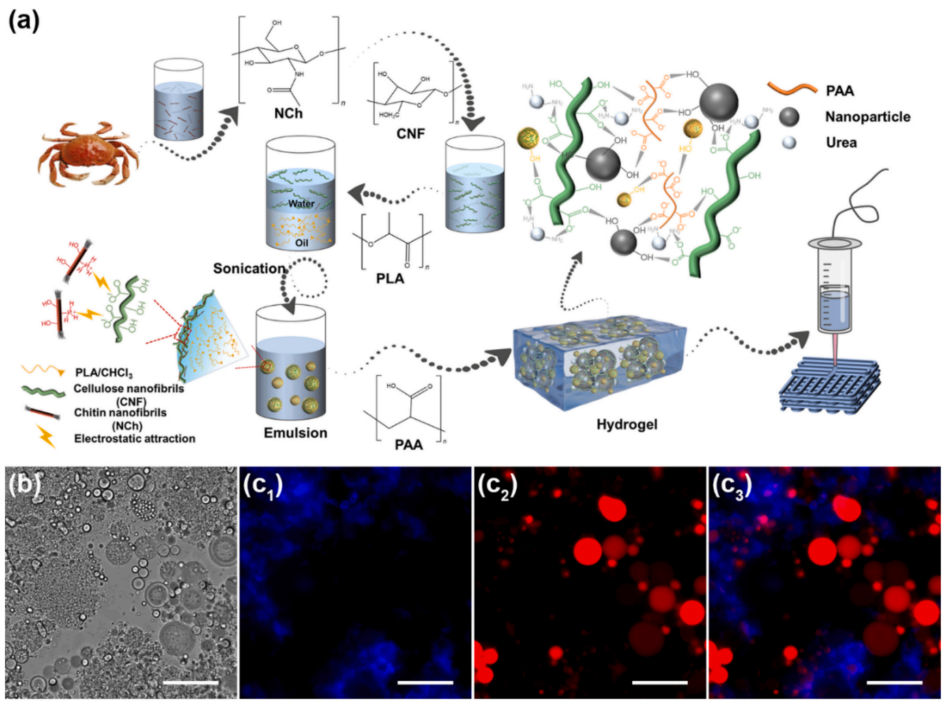
Figure 1. (a) Schematic diagram of the 3D printed porous aerogel based on CNF/NCh emulsion gel ink. (b) Optical microscope image of the emulsion gel prepared from CP-3 (CNF/PAA = 1/1) and (c1 to c3) fluorescence microscope images. Scale bars in (b) and (c) are 30 μm.
Figure 2 examined the rheological properties of emulsion gel inks with different gel phase ratios, further illustrating their processability through 3D printing, with the network structure strength primarily determined by the proportion of PAA in the gel phase.
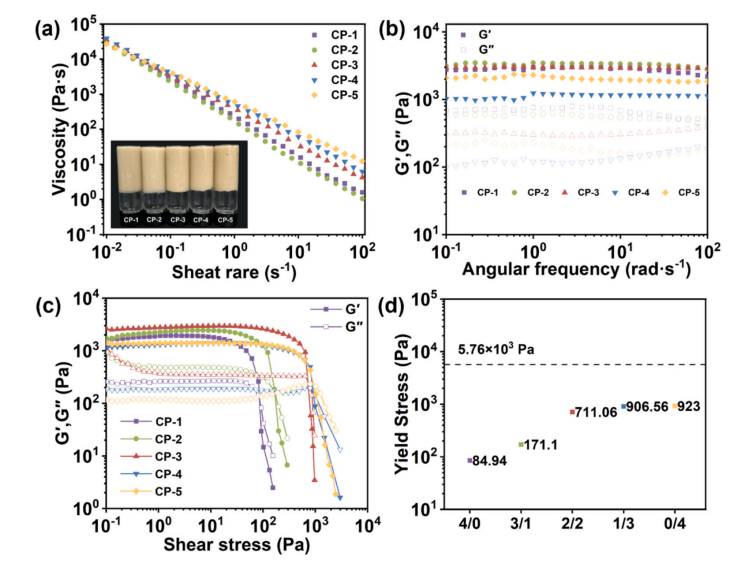
Figure 2 (a) Flow curve of apparent shear viscosity as a function of shear rate. (b) Modulus (storage modulus G′, loss modulus G″). (c) Oscillatory rheological tests on latex gels with different CNF/PAA ratios, (d) and determination of yield stress of these latex gels.
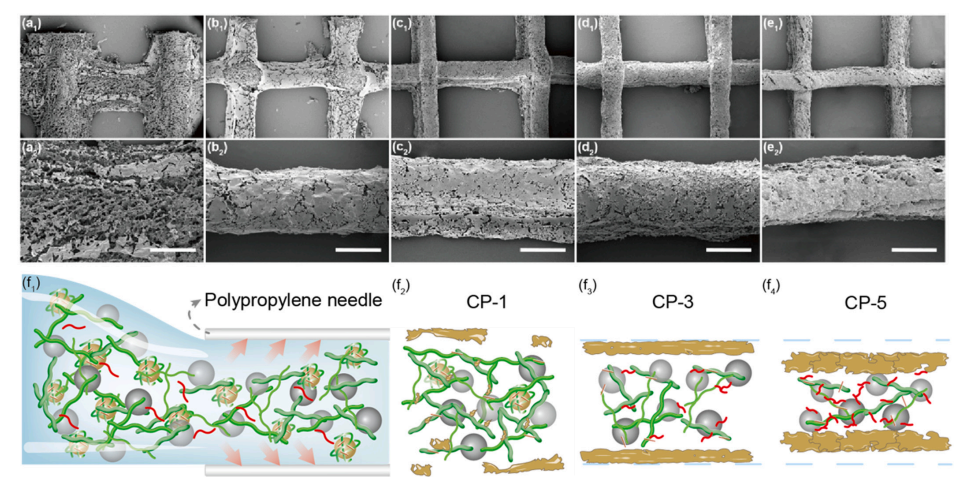
Figure 3 (a, b, c, d, and e) Top view and local magnification of cross-linked lines in freeze-dried scaffolds of latex gels prepared with different CNF/PAA ratios, and SEM images. Scale bar is 500 μm. (f) Schematic diagram of film formation during the printing process of latex gel ink.
Figure 3 illustrates the microscopic images of the coating film structure formed by 3D printing of the emulsion gel, showing that the integrity of the coating film structure is determined by the gel phase of the emulsion gel ink. A high content of CNF in the gel phase lacks network structure strength, leading to structural collapse, while a high content of PAA results in excessive crosslinking, causing shrinkage of the printed structure and leading to incomplete coating film structure. The formation of the coating film structure is a result of the combined effects of CNF and appropriate crosslinking strength.
Figure 4 further investigated the effect of filled nanoparticles on the integrity of the surface film structure, finding that kaolin-filled emulsion gels exhibited a denser and more complete coating film structure. The rheological performance of inks filled with different nanoparticles further illustrates the importance of the network structure strength of the gel phase in forming a complete coating film structure.
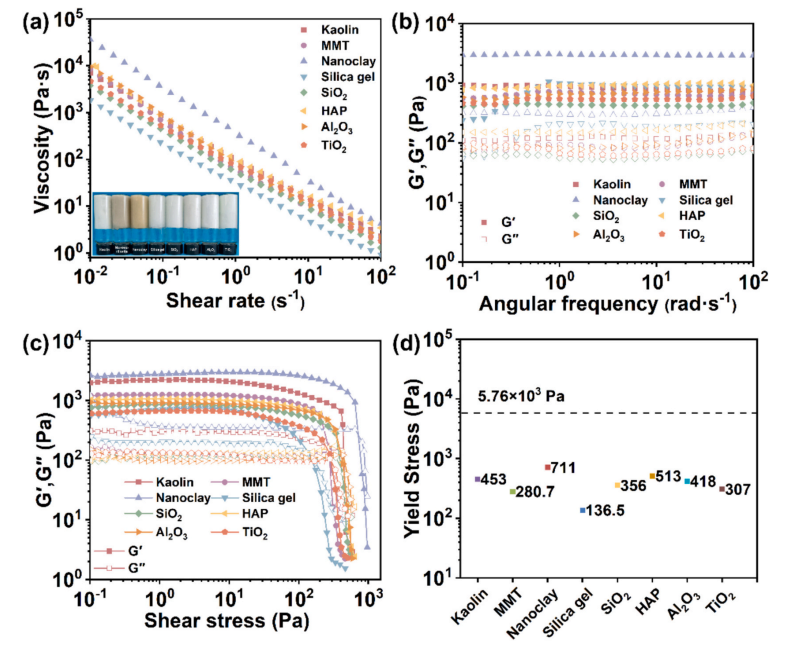
Figure 4. (a) Flow curve of apparent shear viscosity versus shear rate, (b) Modulus (storage modulus G′, loss modulus G″), (c) Oscillatory rheological studies, and (d) yield stress of latex gels with different types of particles.
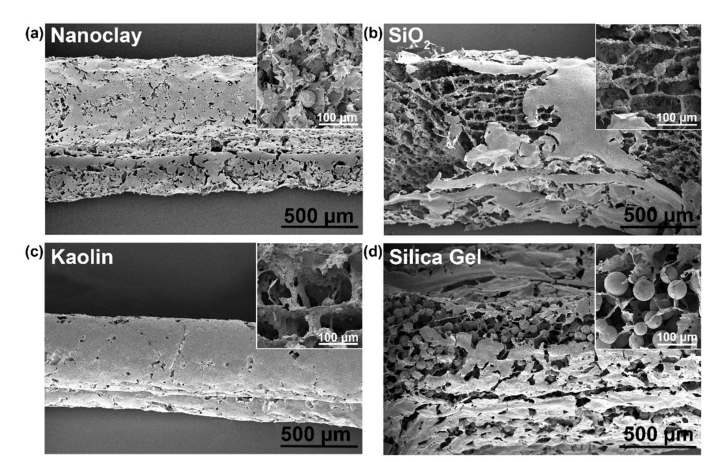
Figure 5. Top view and internal structure scanning electron microscope images of freeze-dried emulsified gel scaffolds made from nanoclay, silica, kaolin, and silica gel. Scale bar is 500 μm, inset scale bar is 100 μm.
Figure 6 examined the slow-release performance and release kinetics of 3D printed emulsion gel scaffolds, comparing the slow-release performance with and without coating films, indicating the hindering effect of the coating film on urea release. It also compared the impact of different coating film integrity on slow-release performance, ultimately finding that the slow-release kinetics of the coating film structure fit the Korsmeyer-Peppas model, indicating that the slow-release effect of the coating film is jointly controlled by diffusion and matrix relaxation. In summary, this research not only overcomes the limitations of traditional fertilizers but also opens new avenues for designing layered structures and programmable release systems for agriculture and other fields.
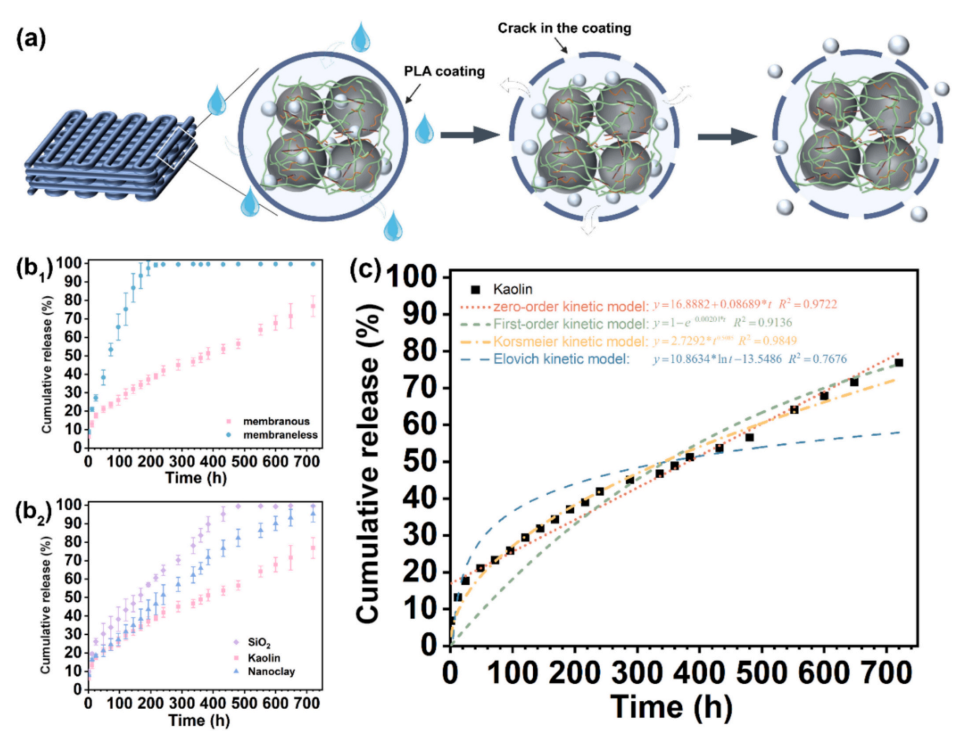
Figure 6 (a) Schematic diagram of the urea release process. (b1) Carriers with and without PLA layers and (b2) the static dissolution rate of carriers with different particle sizes. (c) Urea release kinetics model fitting for kaolin carriers.
The paper was funded by the National Natural Science Foundation (32301513, 32201483, and 32171695).
Original link: https://www.sciencedirect.com/science/article/abs/pii/S0144861725014766
Related Progress
Yantai University researchers Wu Wenna, Zhang Tao, etc., published in IJBM: Progress in the study of antibacterial films and antibacterial emulsion gels.
Xi’an Jiaotong University researchers Shi Xiaopeng, Chang’an University Yan Luke JCR: A novel ozonated oil emulsion hydrogel with sustained release of ozone enhances antibacterial performance and improves wound healing.
A versatile “two-faced” graphene-based aerogel: for efficient switching and separation of different types of oil-water emulsions.
This is an original article from Polymer Science and Technology. Personal sharing and forwarding are welcome. For reprints by publications or media, please contact: [email protected]

Call for Submissions
Experts and scholars are welcome to submit manuscripts (papers, project introductions, new technologies, academic exchanges, institutional news, conference information, recruitment, and enrollment, etc.) to [email protected], and please provide detailed contact information. Polymer Science and Technology® will promptly push and publish on China Polymer Network.
Join Our WeChat Group To meet the needs of colleagues in the polymer industry, we have opened dozens of specialized groups, including a group for polymer experts and scholars, covering various fields such as polymer industry technology, entrepreneurs, PhD students, graduate students, media, journals, and associations. Currently, we have gathered thousands of top experts, scholars, technicians, and entrepreneurs from universities and research institutes at home and abroad.
To apply for group entry, please first add the review WeChat account PolymerChina (or long press the QR code below), and please be sure to indicate: Polymer + Name + Institution + Title (or Degree) + Field (or Industry), otherwise, it will not be processed. Qualification will be reviewed before entering the relevant professional group.

Click here to read the original text for more information.