1. Texas Instruments: Data Center Business Becomes the “Engine” for Analog Chip Recovery
Recently, Haviv Ilan, President and CEO of Texas Instruments (TXN.US), revealed that the company’s data center business is driving the overall demand for analog chip products towards recovery. This year, many popular chip stocks globally have reached new highs, especially those closely related to AI computing infrastructure, such as NVIDIA, Broadcom, and TSMC, which have seen strong growth. However, leaders in analog chips like Texas Instruments and Infineon have largely missed this wave of growth. Nevertheless, with the accelerated construction of data centers, analog chips are expected to lead the charge in chip stocks.
Ilan stated at the Goldman Sachs Communacopia + Technology Conference that while the communications business is recovering, the data center-related business is recovering the fastest, with an expected strong growth of about 50%, bringing demand close to new highs, returning to peak levels around 2022. The data center is the fastest-growing market for Texas Instruments’ analog chips, driving the company towards a strong recovery cycle. Texas Instruments has a broad customer base and a large product range, and its performance and outlook can serve as a predictive indicator of industry demand.
As the world’s largest manufacturer of analog chips and MCUs, Texas Instruments’ products are simple yet crucial, with a wide range of applications, such as power conversion in electronic devices. Ilan mentioned that the data center will be the fastest-growing market this year, with the company’s participation scale continuously expanding, expected to reach strong levels by the end of 2025, and there are significant growth opportunities in this field. Currently, revenue from the data center market accounts for only a low single-digit percentage of Texas Instruments’ total revenue, but Ilan believes that the vast growth potential will increase its share to 20%, and that day is not far off.
2. AI Data Center Expansion: The “Tailwind” for Analog Chip Recovery
Like other major chip manufacturers, Texas Instruments is eager to benefit from the unprecedented wave of AI data center construction initiated by tech giants like Microsoft and Google. Large AI data centers are essential infrastructure for the growth of global AI computing resources. Generative AI applications and AI agent-dominated inference endpoints bring enormous computing power demands, which are expected to drive exponential growth in the AI computing infrastructure market. NVIDIA CEO Jensen Huang also believes that “AI inference systems” will be the largest source of revenue in the future.
According to Wall Street investment firms Loop Capital and Wedbush, the global investment wave in AI infrastructure centered on AI computing hardware is just beginning. Driven by the “AI computing demand storm,” this round of investment is expected to reach up to $2 trillion. AI data centers are core infrastructure projects for the AI era, crucial for the efficient operation of generative AI applications and the iterative updates of large AI models.
For analog chip leader Texas Instruments, the unprecedented expansion and construction of AI data centers initiated by tech giants like Microsoft and Google will catalyze the analog chip market, which has been sluggish since the end of 2022, into a strong recovery cycle. Analog chips are indispensable “water, electricity, and coal” for AI data centers, and under the demand for “higher power density, larger current, faster links, and stronger observability,” Texas Instruments’ product lines in power management, high-speed interconnect signal chains, and monitoring isolation will directly benefit. In particular, the massive AI training/inference workloads will drive the increase in PSU and bus power, significantly boosting the value and demand for Texas Instruments’ related product lines, while board-level Vcore current changes will also prompt other product lines to expand in sync with the “GPU/accelerator card power curve.”
3. Industry Outlook: Bright Prospects for Analog Chip Recovery
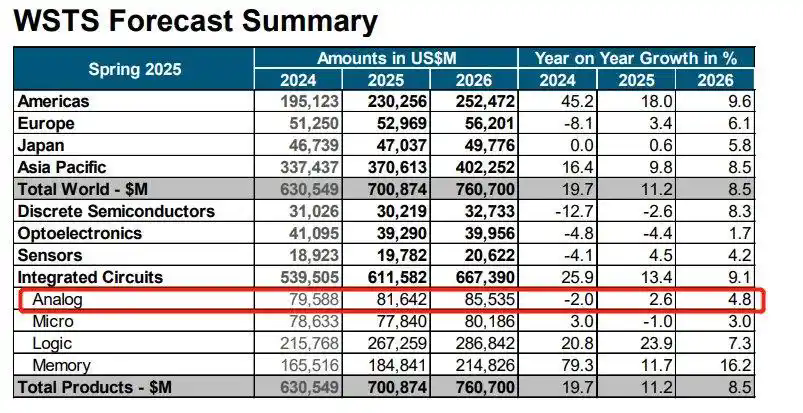
The latest semiconductor industry outlook released by the World Semiconductor Trade Statistics (WSTS) organization indicates that global chip demand recovery is expected to continue into 2025-2026. The analog chips, which have been weak since the end of 2022, are expected to enter a strong recovery curve. WSTS predicts that after a strong rebound in 2024, the global semiconductor market will grow by 11.2% in 2025, reaching a total value of $700.9 billion, mainly driven by the strong momentum in the GPU-dominated logic chip sector and the HBM-dominated memory sector, both of which are expected to achieve strong double-digit growth, benefiting from strong demand in AI inference systems, cloud computing infrastructure, and cutting-edge consumer electronics.
WSTS forecasts that by 2026, the global semiconductor market will grow by 8.5% from 2025, reaching $760.7 billion, with growth widely present across various regions and a broad range of chip product categories, including analog chips and MCUs. Among them, memory chips will again lead the growth, while logic and analog chips will also contribute significantly, with analog chips expected to enter a strong recovery cycle.
Additionally, a research report released by UBS shows that based on monitoring inventory and pricing data from over 100 global distributors, the current trends in semiconductor industry inventory and pricing are overall positive, especially as MCU and analog chip inventories continue to be digested, alleviating market concerns about supply-demand imbalances.
In summary, under the leadership of companies like Texas Instruments and the overall positive industry trend, the path to recovery for analog chips is poised to shine in the semiconductor market in the future.
–END–