Full Text Overview
—
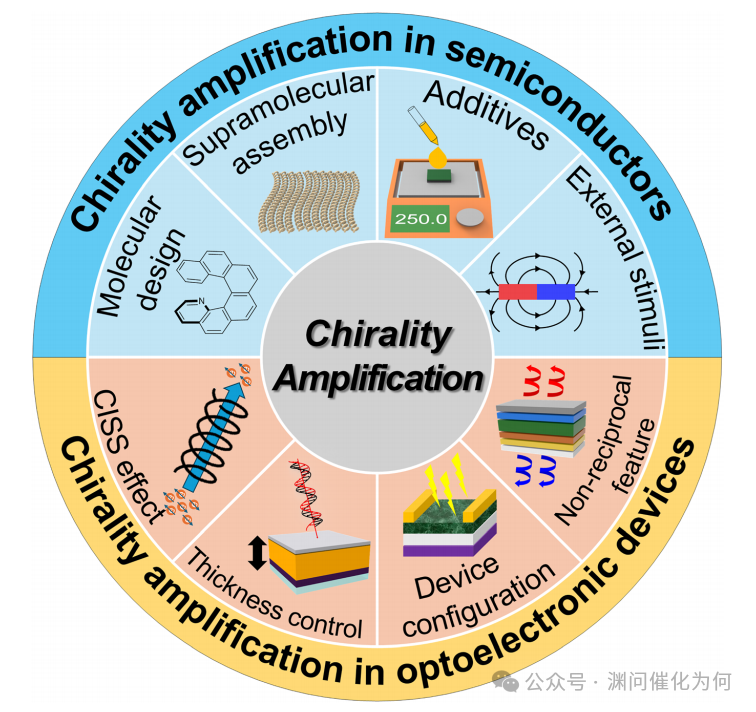
Due to the unique spin-selective information carried by circularly polarized light (CPL), chiral optoelectronics provides a powerful platform for developing efficient spin-based optical devices and driving next-generation photonic technologies. Intrinsic chiral semiconductors can absorb or emit CPL through light-matter interactions, making them highly attractive active materials in the field of advanced optoelectronics. However, their weak chiral activity often hinders practical applications. To address this challenge, researchers have explored a range of strategies aimed at enhancing chiral performance. Recent advances in molecular design, processing techniques, and device engineering have significantly improved the chiral optical properties of these materials. This article reviews the latest progress in chiral amplification strategies for semiconductors in advanced optoelectronics. Intrinsic chiral semiconductors are categorized into three types: organic semiconductors, metal-organic materials, and chiral hybrid perovskites. Furthermore, strategies for enhancing chiral signal output in chiral optoelectronic devices are discussed with the support of relevant theoretical frameworks. These advancements lay a solid foundation for the development of high-performance chiral optoelectronic devices and pave the way for innovations in future photonic technologies.
 Article Information:Title: Chirality amplification in semiconductors for advanced optoelectronicsDOI:https://doi.org/10.1039/D5CS00684H
This article is intended for knowledge dissemination. If there is any infringement, please contact us, and we will remove it promptly.