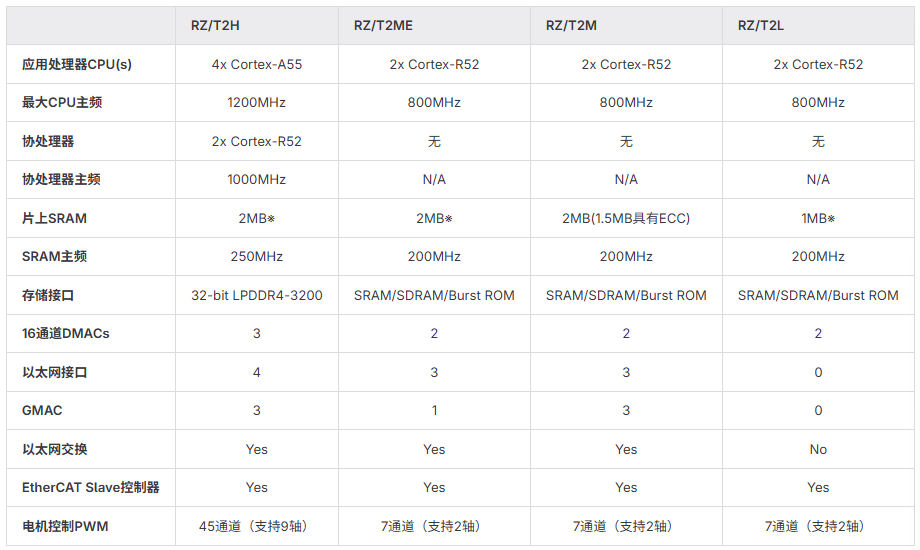
Renesas SoC Empowers Industrial Motor Control(TechInsights Report, February 22, 2025, by Dylan McGrath)The RZ/T2H is Renesas’ highest-performance microprocessor designed for industrial equipment, targeting Industry 4.0 and Industrial Internet of Things (IIoT) controller devices such as Programmable Logic Controllers (PLC), motion controllers, Distributed Control Systems (DCS), and Computerized Numerical Controls (CNC). It is referred to as a single-chip solution suitable for industrial systems that traditionally require a combination of multiple processors and FPGAs for control.The 64-bit RZ/T2H features up to 4 Cortex-A55 application CPU cores running at speeds of up to 1.2GHz and 2 Cortex-R52 real-time CPU cores running at speeds of up to 1GHz, capable of providing precise control for up to 9 axes of robotic motors. It includes 2MB of on-chip SRAM and a 32-bit LPDDR4 memory interface with a transfer rate of up to 3.2Gbps, a first for the RZ/T series. The RZ/T2H offers 4 Ethernet ports, 3 Gigabit Ethernet MACs (GMAC), and 1 Ethernet switch. It supports industrial Ethernet protocols including EtherCAT, PROFINET, EtherNet/IP, OPC UA, and next-generation Time-Sensitive Networking (TSN) standards. For motor control, the RZ/T2H features a three-phase Pulse-Width Modulation (PWM) timer, a delta-sigma interface for measuring current values, and an encoder interface. Unlike some competitors, the RZ/T2H does not include a Neural Processing Unit (NPU) or any type of AI accelerator engine.The RZ/T2H is now available, with a minimum order of 10 units priced at $49.28. Renesas recently launched a similar RZ/N2H device designed for industrial networking applications, featuring a smaller package. As is customary for the company, Renesas has not disclosed the manufacturing process node for these two new devices.Upgrade to Cortex-A55The RZ/T2H is the first real-time control product in the RZ/T series to support the Linux operating system. It is also the first product to integrate a 64-bit CPU (4-core Cortex-A55), designed to balance energy efficiency and performance. The main processor in previous RZ/T series products was the 32-bit Cortex-R52, which is specifically designed for real-time performance and functional safety. The Cortex-A55, based on Arm v8.2-A, is a more general-purpose CPU with higher overall performance and an enhanced memory subsystem (including improved cache support) that accelerates data access speeds. The Cortex-A55 also supports Arm’s NEON technology to accelerate machine learning algorithms, with a 32KB instruction cache and a 32KB data cache, both with Error Correction Code (ECC) support, and a 1,024KB L3 cache, also with ECC. In addition to NEON, it supports a floating-point unit.In addition to integrating up to 4 Cortex-A55 CPU cores, the RZ/T2H also features 2 32-bit Cortex-R52 cores, which serve as the host processor for other RZ/T series devices. The difference is that the Cortex-R52 acts as a real-time coprocessor in the RZ/T2H, handling time-critical tasks that require precise timing and deterministic execution, such as motor control. The Cortex-R52 can operate at a maximum frequency of up to 1GHz. As shown in the figure, each R52 is equipped with a total of 576KB of tightly coupled memory (TCM) with ECC. Both R52 cores have 16KB instruction/data caches with ECC. The Cortex-R52 also features a memory protection unit for fine-grained control of memory access.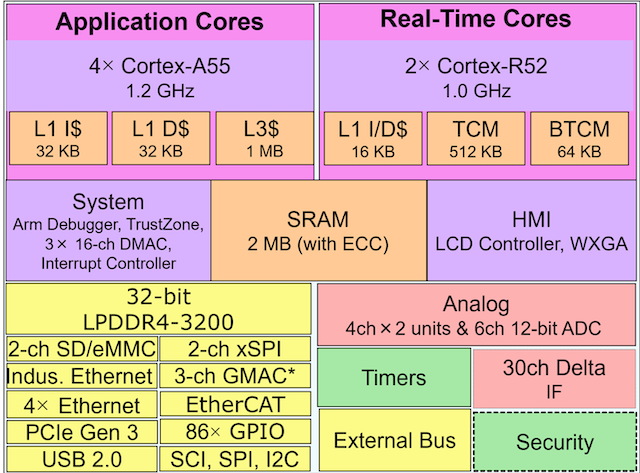 Figure 1 RZ/T2H Block Diagram(ECC=Error Correction Code; HMI=Human-Machine Interface; TCM=Tightly Coupled Memory; BTCM=Boot Time Code Memory; SPI=Serial Peripheral Interface; SCI=Serial Communication Interface; GPIO=General Purpose Input/Output. * The three-channel Gigabit Media Access Controller (GMAC) supports Time-Sensitive Networking (TSN). The optional security module features an encrypted boot mode, Arm TrustZone, Cortex-A55 encryption extensions, JTAG authentication, and an encryption accelerator.)The RZ/T2H supports a variety of Ethernet protocols critical to industrial systems, including a 3-port Ethernet switch, a 3-port EtherCAT Slave controller, and 3 Ethernet MAC units. It supports various other high-speed interfaces, including USB 2.0, PCIe Gen3, CAN/CANFD, serial communication interfaces, quad-channel SPI, dual-channel xSPI, and I2C bus interfaces.Significant Enhancement in PWM Motor Control CapabilityOver a decade ago, Renesas introduced the RZ series to lower the barrier for microcontrollers in embedded processors for smart infrastructure, buildings, and the Internet of Things. The RZ/T series targets industrial systems requiring real-time control, while other product lines in the RZ series focus on applications such as vision, human-machine interfaces, and industrial networking.The RZ/T2H represents a significant advancement for the RZ/T series, expanding the range of operating system support and significantly enhancing servo motor control capabilities (primarily based on the integrated Cortex-A55). It is Renesas’ first microprocessor to offer 45 independent channels for high-speed, high-precision control of up to 9 axes of industrial robotic motors, supporting more advanced robotics and other high-end use cases. The RZ/T2H also stands out in the RZ/T series by providing an LPDDR4 memory interface, over 50% more Direct Memory Access Controller (DMAC) data transfer capability, and over 450% more PWM capability for motor control, as shown in Table 1. Crucially, the Cortex-A55 is a 64-bit CPU, an upgrade from the 32-bit CPUs in other RZ/T series devices.Table 1 RZ/T Series Product Comparison(* with Error Correction Code. DMAC=Direct Memory Access Controller; PWM=Pulse Width Modulator. In addition to a higher core count, the maximum CPU clock speed of the RZ/T2H is 50% higher than that of other products in the RZ/T series, and it comes with an LPDDR4 interface and better motor control PWM capabilities. (Data source: Renesas Electronics))
 Lack of AI AcceleratorThe number of CPUs in the RZ/T2H exceeds that of most SoCs available for industrial applications (such as motor control). STMicroelectronics’ STM32MP2 features a dual-core Cortex-A35, providing significantly lower computing power than the RZ/T2H’s quad-core Cortex-A55. The performance of the Cortex-A55 is approximately 15%-18% higher than that of the main processor Cortex-A53 in Texas Instruments’ Sitara AM6442.In contrast, NXP’s i.MX 94 series, set to be released by the end of 2024, plans to offer samples in the second half of 2025. NXP has not disclosed detailed information about the i.MX 94, which may not enter mass production until 2026. However, the i.MX will feature 4 Cortex-A55 CPU cores, 2 Cortex-M7 cores, and 2 Cortex-M33 cores, totaling 8 CPU cores, as shown in the table. The RZ/T2H lags behind the i.MX 94 in terms of on-chip SRAM, memory interface capabilities, and pure CPU core count.Unlike traditional microcontrollers, the industrial microprocessors compared do not include any on-chip flash memory, a trade-off that allows for the use of higher-density process technologies.Table 2 RZ/T2H Compared to Other Competitors(DMAC=Direct Memory Access Controller; PWM=Pulse Width Modulator. Renesas’ RZ/T2H and NXP’s i.MX 94 (not yet on the market) are high-performance SoCs that significantly outperform competing components from STMicroelectronics and Texas Instruments, but at a higher price. (Data: Suppliers, except where noted from Digikey).)
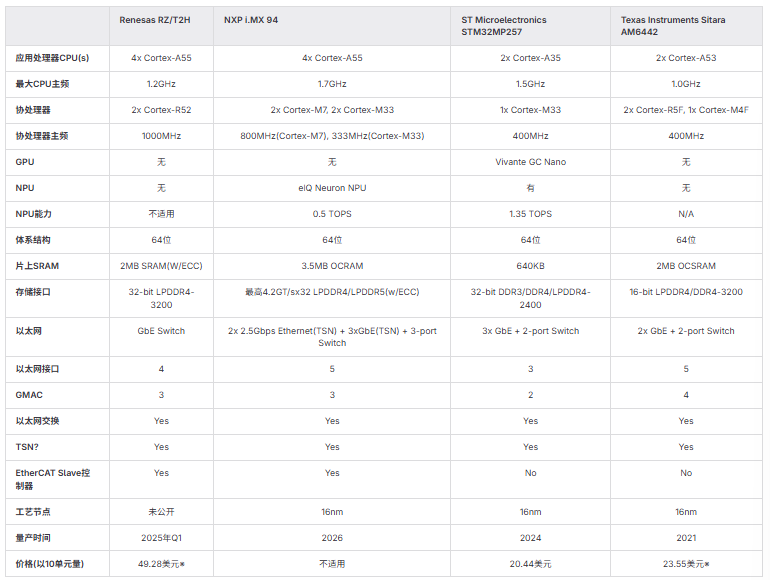 Unlike the STM32MP257 or i.MX 94, the RZ/T2H lacks an NPU or any type of dedicated AI accelerator. Traditional motor control applications lack clear AI use cases, and Renesas maintains that the performance of the Cortex-A55 without an AI accelerator can support tasks such as predictive maintenance and anomaly detection. However, AI is increasingly being used in motor control for advanced control algorithms and optimizations to minimize energy consumption. As AI continues to evolve, MPR expects to see more applications of AI in motor control, making Renesas’ decision to omit the NPU noteworthy.At least initially, there is a significant price gap between the RZ/T2H and other devices. The initial pricing for the RZ/T2H is $49.28 per unit (with a minimum order of 10), more than double the purchase cost of STMicroelectronics’ STM32MP257 and TI’s Sitara AM6442. NXP has not disclosed pricing for the i.MX 94, but the company has indicated that its pricing will be closer to that of STMicroelectronics and TI components.Simplifying System Design?The RZ/T2H, with its 4 Cortex-A55 application CPU cores and 2 Cortex-R52 real-time CPU cores, represents a significant step forward for Renesas’ industrial microprocessors and greatly enhances the functionality of the company’s RZ/T series product line. It can control up to 9 servo motors from a single chip, replacing multiple FPGAs and other SoCs, providing the potential to simplify system design for industrial systems with multiple motors. It also enables the RZ/T2H to meet the demands of high-end industrial equipment markets that other RZ/T devices cannot, including complex robotic systems, advanced computer-controlled machines, and other applications requiring precise coordination of multiple motors.Due to the lack of an NPU, the RZ/T2H cannot be used in systems requiring AI acceleration. However, the device stands out among currently available competitors due to its capabilities and is likely to find an accepting market in devices that do not require immediate AI acceleration. Notably, the RZ/T2H integrates multiple Ethernet ports and supports a variety of industrial Ethernet protocols required for connected industrial environments, including EtherCAT, PROFINET, EtherNet/IP, and TSN.In terms of industrial microprocessors for multi-axis motor control, NXP’s recently announced i.MX 94 may pose the most intense competition. However, the i.MX 94 (which does include an NPU) will not enter production until sometime in 2026, giving the RZ/T2H at least a 12-month lead. The price premium compared to currently available competing devices will be a hurdle, but if the RZ/T2H can serve as a single-chip solution for many system designs, it will be worth the investment.Learn More:* Want to learn more about STMicroelectronics’ recent entry into the 64-bit industrial SoC market? Read “ST Launches Its First 64-bit SoC”.* Interested in Renesas’ recently launched AI RZ/V2H embedded SoC? See “Renesas SoC Combines Vision and AI”.* Curious about the progress of IoT edge AI adoption? Check out “Annual Review: AI Continues to Move to the Edge”.* Want to know more about Microchip’s entry into the 64-bit microcontroller market? Check out “Microchip Enters 64-bit MCU Market with RISC-V”.