Hello everyone, today I would like to share an article published in the J. Am. Chem. Soc. titled “Decoding Arginine Dimethylation Isomers via pH-Tuned Reactivity with Methylglyoxal: A Chemical Approach for Functional Proteomics.” The corresponding authors are Professors Ye Mingliang and Wang Keyun from Dalian Institute of Chemical Physics, who mainly study proteomics, along with Professor Wang Anhui from Liaoning Normal University, who focuses on computational chemistry and computational biology. In this article, the authors utilize pH-tuned reactivity of methylglyoxal to distinguish arginine dimethylation isomers and conduct a chemical proteomics analysis.

Methylation is one of the smallest yet most significant types of modifications, with protein arginine methylation drawing attention due to its critical role in many important biological processes, such as DNA damage response. To date, three different types of arginine methylation have been identified in mammalian cells: monomethylation (MMA), asymmetric dimethylation (aDMA), and symmetric dimethylation (sDMA), with their respective writer proteins being type III, I, and II protein arginine methyltransferases (PRMTs). Various mass spectrometry-based proteomics tools have been developed to study arginine methylation; however, in addition to analyzing methylation sites, efforts should also focus on distinguishing different forms of methylation, such as asymmetric or symmetric dimethylation, which have the same mass shift but produce different biological effects. For instance, asymmetric dimethylation on histones leads to transcriptional activation, while symmetric dimethylation is associated with transcriptional repression. In therapeutic areas such as cancer, developing inhibitors for different PRMT subtypes to achieve varying effects is also crucial. Therefore, distinguishing between symmetric and asymmetric dimethylation will directly facilitate target selection, biological impact, and drug development.
To differentiate between the two types of arginine dimethylation, researchers have developed methods based on specific antibodies and neutral loss detection, but both methods have limited distinguishing capabilities. In this paper, the authors attempt to react dimethylated arginine with methylglyoxal, and the products can be enriched using phenylboronic acid.
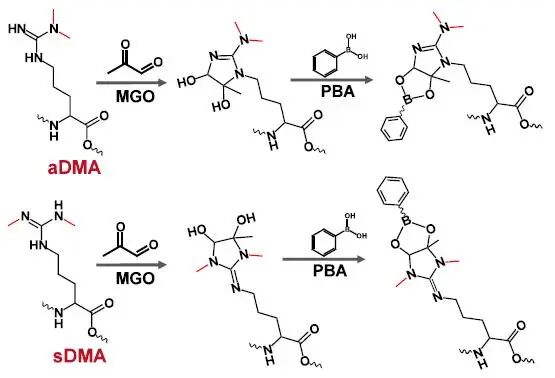
First, the authors conducted molecular dynamics simulations and experimental validations, demonstrating that only sDMA can react with methylglyoxal and that the reaction is pH-dependent. When the pH increases from 10 to 10.6, the reaction yield rapidly increases from very low levels.
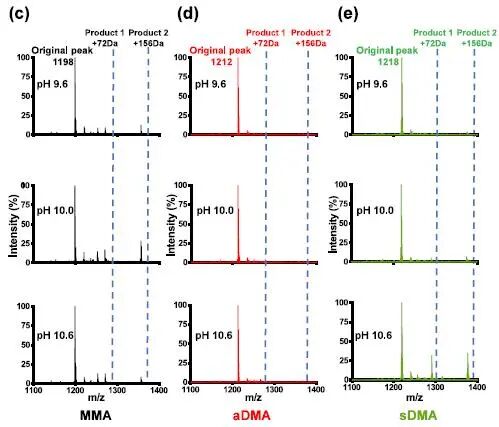
Thus, the authors used this strategy to distinguish between symmetric and asymmetric dimethylation. By adding methylglyoxal and conducting a concentration-dependent reaction, followed by phenylboronic acid enrichment, they obtained sDMA, while the remaining portion was aDMA.

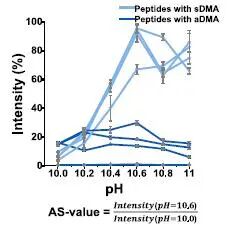
The authors synthesized four pairs of peptides containing either sDMA or aDMA, demonstrating that efficient separation results can be achieved when the pH is raised from 10 to 10.6. They defined the AS value for each peptide, which is the ratio of peptide intensity at pH 10.6 to that at pH 10, to distinguish the two isomers.
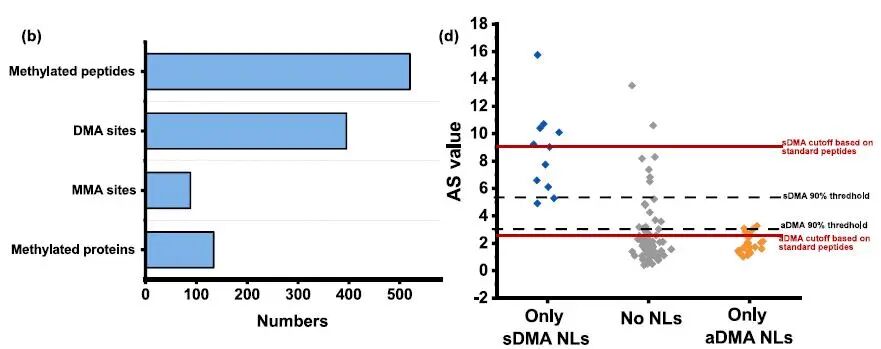
The authors then conducted an omics analysis, identifying nearly 400 DMA form peptides and analyzing their AS values, ultimately finding 6 sDMA peptides and 44 aDMA peptides. GO analysis indicated that sDMA is related to spliceosome assembly, while aDMA is associated with transcription and RNA metabolism. This result illustrates the different biological functions of the two dimethylation isomers.
The authors then studied the function of sDMA modification in the SNRPN helicase protein, which had the highest AS value, indicating the presence of sDMA modification. The use of modification antibodies for recognition also confirmed this.
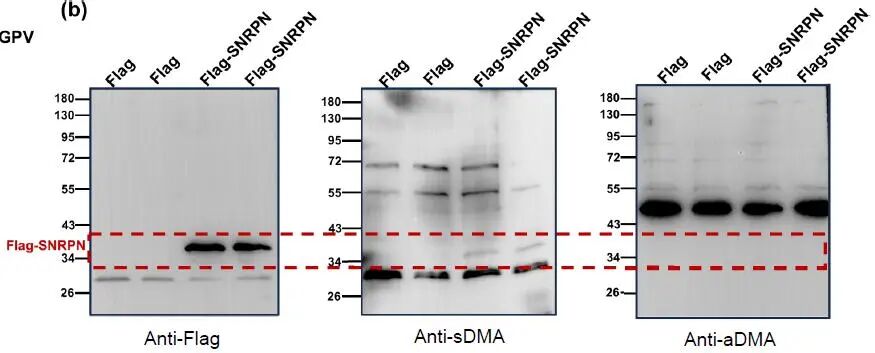
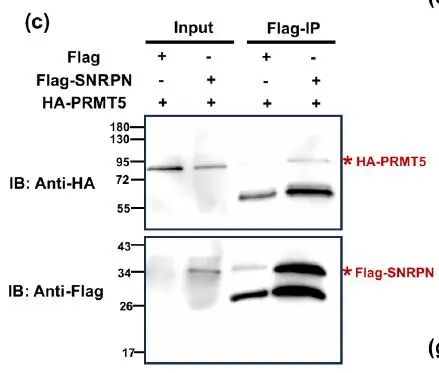
The authors expressed SNRPN and the sDMA writer PRMT5, demonstrating an interaction between the two proteins. By using a PRMT5 inhibitor, the authors showed that the sDMA modification on SNRPN is formed through PRMT5.
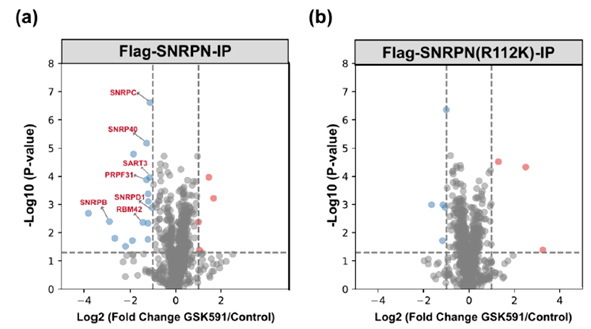
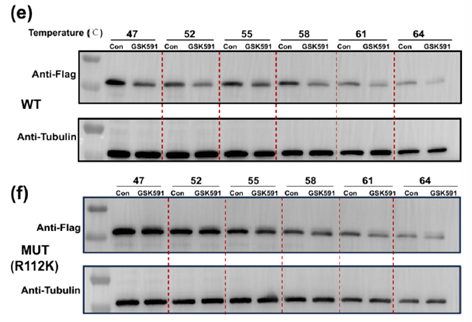
To investigate the function of sDMA, the authors analyzed the interacting proteins of SNRPN or its R112K mutant, identifying 12 differential proteins that may affect spliceosome assembly. Additionally, CETSA demonstrated that sDMA may influence protein thermal stability.
In conclusion, this paper developed a chemical method to distinguish between symmetric and asymmetric arginine dimethylation, conducting proteomics analysis and functional studies.
Authors: WYJ
Editor: WYQ
DOI: 10.1021/jacs.5c14304
Original link: https://doi.org/10.1021/jacs.5c14304