
 Article Analysis
Electrochemical water splitting provides a sustainable pathway for hydrogen production, but achieving efficient reactions at neutral pH remains a daunting challenge due to sluggish interfacial kinetics, limited ionic conductivity, and complex proton transfer behavior. Recently, the design of multi-active site electrocatalysts has emerged as a powerful strategy to decouple and optimize the fundamental steps in the neutral hydrogen evolution reaction (HER). Understanding and explaining the differences between neutral and acidic/basic hydrogen evolution reactions from a fundamental perspective can facilitate its development, showcase its advanced levels, and anticipate its potential applications; however, there has yet to be a review available for reference.
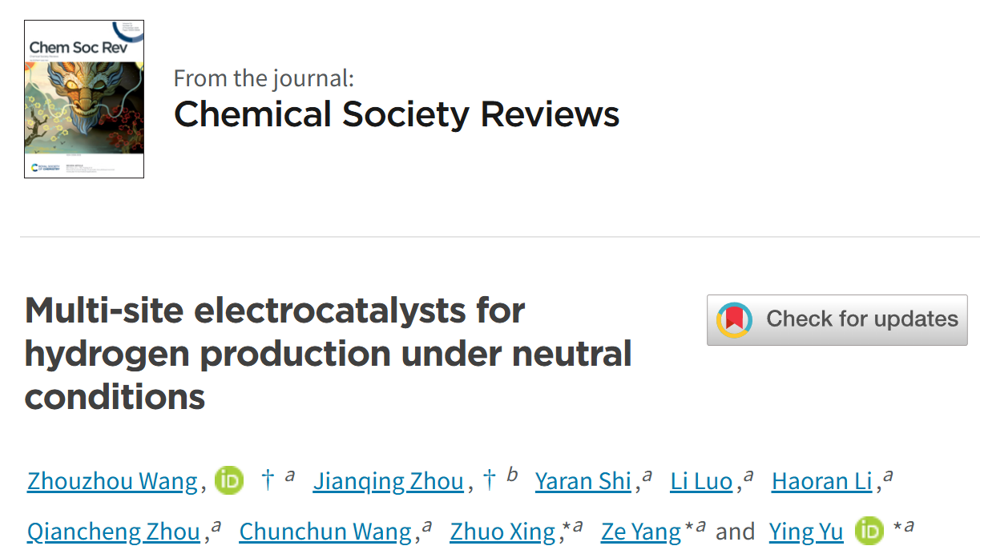
Recently, Professor Yu Ying’s team from Central China Normal University published a review titled “Multi-site electrocatalysts for hydrogen production under neutral conditions” in Chemical Society Reviews (Figure 1). This review first defines and analyzes the reaction mechanisms, electrolyte effects, and interfacial microenvironments of HER under neutral conditions; it then further highlights the issues and advancements in performance metrics, design, synthesis, and structural engineering of multi-active site catalytic systems, emphasizing their roles in promoting water dissociation and hydrogen evolution, and discusses advanced characterization techniques. Finally, it explores the prospects of translating laboratory-scale discoveries into practical neutral pH water electrolysis systems, aiming to provide foundational understanding and forward-looking perspectives for the development of next-generation electrocatalysts suitable for neutral water electrolysis.
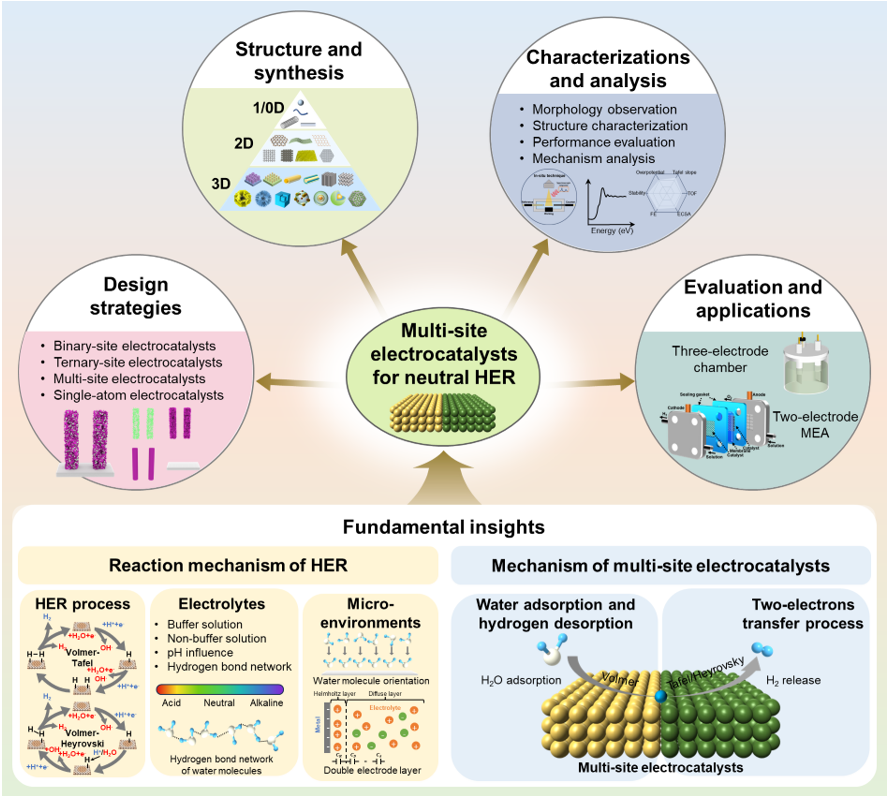
Figure 1. Schematic diagram of multi-site electrocatalysts for neutral hydrogen evolution reaction
1. Background of Multi-site Catalysts
As the world accelerates towards the goal of “carbon neutrality,” hydrogen energy, as a clean and high-energy-density energy carrier, is playing an increasingly critical role. Among them, using renewable energy to drive water electrolysis for “green hydrogen” is recognized as the most sustainable technological pathway. However, the currently mature water electrolysis technologies, whether in the acidic environment of proton exchange membrane (PEM) electrolyzers or the strongly alkaline environments of traditional alkaline (AWE) electrolyzers and anion exchange membrane (AEM) electrolyzers, have significant limitations: acidic environments are highly corrosive to equipment and rely on expensive and scarce noble metal catalysts such as platinum, iridium, and ruthenium; alkaline environments, on the other hand, exhibit slow reaction kinetics and require improved energy efficiency. To overcome these challenges, water electrolysis under neutral conditions has emerged, showcasing unique application prospects. Neutral environments (such as phosphate buffer solutions, sodium sulfate solutions, etc.) combine low corrosiveness with broad material compatibility, making it possible to utilize abundant non-noble metal materials found on Earth and directly use complex water sources such as seawater and wastewater, greatly expanding the scenarios for green hydrogen production and reducing potential costs.
However, switching the electrolysis environment from acidic or alkaline to neutral brings transformation and challenges to the core electrocatalytic processes. In acidic media, the reactants are highly concentrated hydronium ions (H3O+); in alkaline media, although the proton concentration is extremely low, the high concentration of OH– provides good ionic conductivity. In neutral environments, however, the low proton concentration, poor ionic conductivity, and the loose structure of the interfacial double layer, along with weak electric field strength, collectively make the dissociation step of water molecules (i.e., the Volmer step) difficult, resulting in extremely slow reaction kinetics. Therefore, traditional single-site catalysts designed for acidic/basic environments often experience a sharp decline in performance in neutral media.
In response, the design concept of multi-site electrocatalysts has gained widespread attention and rapidly developed into a promising approach to address the challenges of neutral HER. These catalysts contain two or more active centers that differ in chemical, structural, or electronic properties and are spatially coupled; these sites perform distinct functions: some sites efficiently adsorb and cleave water molecules due to their strong oxophilicity, while others optimize the adsorption strength of hydrogen intermediates (*H) to facilitate subsequent coupling, and some sites specifically promote the desorption of hydrogen gas bubbles to prevent them from covering active sites. By the collaborative and synergistic efforts of functional sites, multiple challenging steps in neutral HER can be decoupled and optimized separately, thereby breaking the limitations imposed by the “Sabatier principle” faced by single-site catalysts, achieving a re-planning of the reaction pathway and an overall reduction of the reaction energy barrier. This represents not only a precise engineering design of catalytic materials at the molecular and atomic scales but also a key step in advancing neutral water electrolysis from fundamental research to practical applications, laying the material foundation for the next generation of efficient, stable, and low-cost hydrogen production technologies.
2. Fundamental Analysis of Multi-site Catalysts
2.1 Analysis of Neutral HER Mechanism
The mechanism of HER in neutral media is far more complex than in strong acid or strong base; it does not follow a single pathway. In the initial reaction phase or at low overpotentials, the rare H3O+ in the solution is the main proton source, and the reaction follows a path similar to that in acidic conditions; however, as the reaction progresses, protons at the interface are rapidly consumed, and bulk diffusion cannot replenish them in time, leading H2O to become the dominant proton donor, and the reaction pathway shifts to a more challenging alkaline mode. Neutral HER is thermodynamically superior to alkaline conditions, but the actual kinetics are extremely sluggish. The introduction of multi-site catalysts can achieve stepwise optimization and synergistic catalysis of the two key steps of water molecule dissociation and hydrogen atom recombination through carefully designed different functional sites, thereby bypassing the energy barrier limitations faced by single active sites (Figure 2).
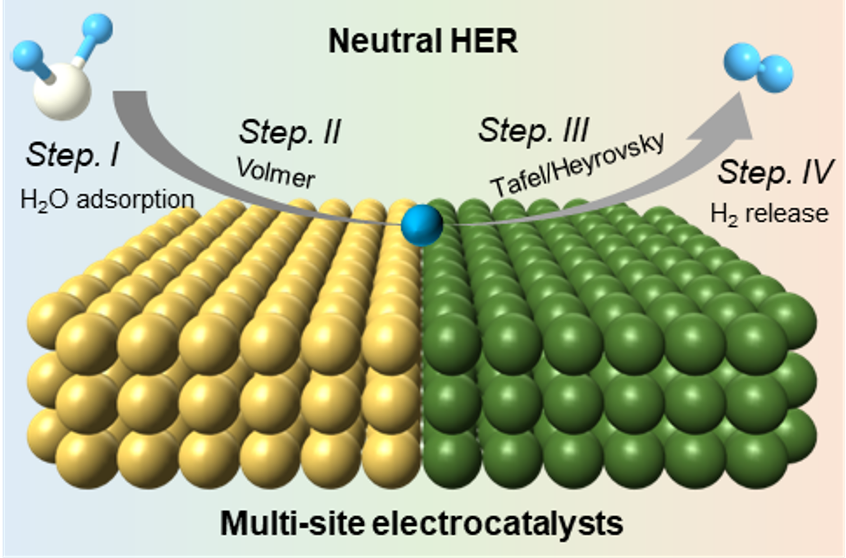
Figure 2. Four steps of neutral HER
2.2 Electrolyte Effects on Neutral HER
Electrolytes play a role in neutral HER that goes far beyond that of a conductive medium; their selection directly determines the interfacial environment and kinetic behavior of the reaction. Buffer electrolytes, such as phosphate buffer solutions, are valuable not only for maintaining the stability of the solution’s pH but also because their components can act as “proton relay stations,” efficiently mediating proton transfer at the electrode interface, thereby alleviating local alkalization caused by the accumulation of OH– and maintaining a stable reaction driving force. In contrast, in non-buffered electrolytes, although the interfacial chemistry is simpler and purer, at high reaction rates, the OH– generated at the cathode surface cannot be effectively neutralized, creating an unfavorable alkaline microenvironment that not only exacerbates the difficulty of water molecule dissociation but may also trigger structural reconstruction or poisoning of the active sites of the catalyst. Furthermore, the type and concentration of cations in the electrolyte can alter the interfacial electric field and the arrangement of water molecules through specific adsorption, indirectly regulating the reaction energy barrier, making the electrolyte a critical variable that cannot be ignored when evaluating and designing catalysts.
2.3 Microenvironment of Neutral HER
At the nanoscale electrode-electrolyte interface, there exists a microenvironment that influences the reaction, and the uniqueness of neutral conditions lies in the fact that this microenvironment becomes exceptionally weak and inefficient. Due to the extremely low concentration of mobile ions in the solution, the double layer structure formed at the electrode surface is diffuse and thick, leading to a severe dilution of the electric field strength that drives charge transfer and molecular polarization. A water molecule must undergo a challenging journey to evolve from the bulk solution to hydrogen gas: it must first break free from the strong hydrogen bond network surrounding it, then diffuse to the electrode surface, and under the guidance of a weak electric field, precisely orient its hydrogen atoms towards the active sites of the catalyst; this series of preparatory steps conceals energy consumption (Figure 3). Meanwhile, if the hydrogen bubbles generated during the reaction cannot quickly detach from the surface, they will form a gas coverage layer, physically blocking the active sites. Therefore, rational catalyst design must not only focus on its intrinsic electronic structure but also strive to construct an ideal interfacial microenvironment that possesses both strong hydrophilicity to promote water molecule supply and superhydrophobicity to ensure rapid escape of hydrogen gas products.
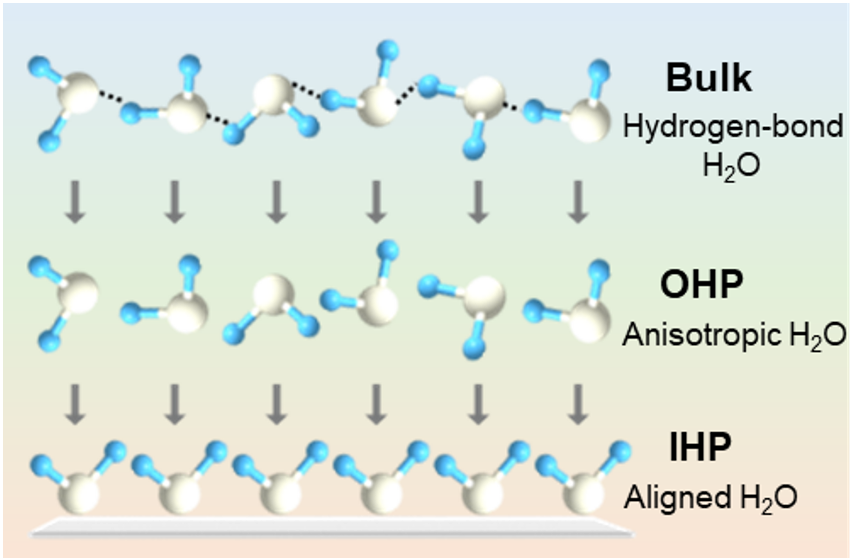
Figure 3. Transfer of water molecules from bulk solution to catalyst surface
3. Conclusions and Outlook
This review systematically analyzes the mechanisms, designs, and advancements of multi-site catalysts for neutral HER. Looking ahead, research in this field is transitioning from principle exploration to systematic engineering integration, with development closely revolving around three core areas:
Material Design: Future material design will transcend traditional trial-and-error models, entering a new stage of precision, diversification, and intelligence. The core lies in deeply understanding and actively utilizing the synergistic mechanisms between different active sites, such as electronic modulation, stress effects, and interfacial coupling, to directionally synthesize catalytic centers with optimal adsorption energy barriers. Meanwhile, artificial intelligence and machine learning will deeply integrate with density functional theory calculations, rapidly predicting new material performance, revealing hidden descriptors, and guiding experimental synthesis in reverse, ultimately achieving rational design and controllable preparation of catalysts from atomic-level structures to macroscopic performance.
Advanced Characterization: A profound understanding of catalytic processes hinges on capturing the dynamic evolution of active sites under reaction conditions. Therefore, developing and integrating various in situ / operational characterization techniques becomes crucial. This includes using in situ electron microscopy with high temporal and spatial resolution to observe the real-time evolution of catalyst morphology and structure; employing synchrotron radiation X-ray absorption spectroscopy, Raman spectroscopy, and other techniques to track the electronic structure, coordination environment, and dynamic adsorption/desorption behavior of reaction intermediates at atomic/molecular scales; and combining electrochemical mass spectrometry to monitor gas products in real-time. These techniques will collectively form a “panoramic” dynamic monitoring system, helping us reveal the structure of the “real catalyst” rather than the “pre-catalyst,” elucidate the synergistic catalytic mechanisms, and accurately identify causes of degradation, providing the most direct experimental basis for optimizing material design.
Application Validation: The ultimate value of catalysts must be validated in practical devices. Future performance evaluations need to transcend the limitations of traditional three-electrode systems, focusing on application-oriented validation in membrane-based electrolyzers. This requires us to not only pay attention to the initial activity and energy consumption of catalysts at near-industrial current densities (>5000 A m-2) but also to examine their chemical and mechanical stability under long-term continuous operation, intermittent start-stop, and harsh conditions such as complex water quality (e.g., seawater). Additionally, studying the interface contact between catalysts and membranes, diffusion layers, gas bubble management capabilities, and adaptability to fluctuations in system pressure and temperature is equally crucial. Only through this system-level, practical validation can we objectively assess the commercialization potential of multi-site catalysts and uncover real issues in the scaling-up process from laboratory to factory, thereby promoting the true implementation of neutral water electrolysis technology.
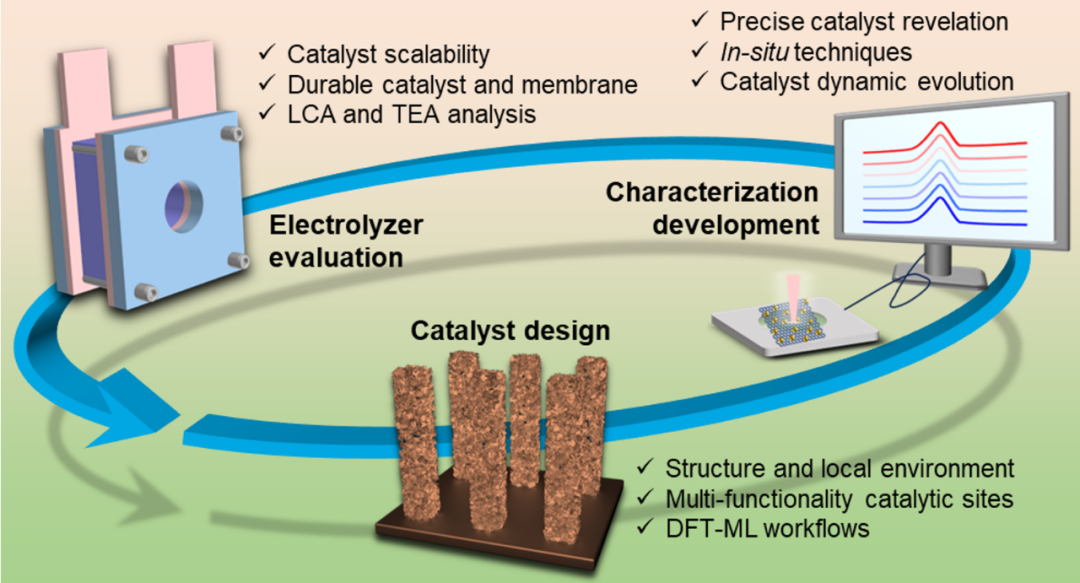
Figure 4. Outlook analysis of multi-site catalyst research for water electrolysis hydrogen production
 Research Group Introduction
Professor Yu Ying’s research group homepage: https://www.x-mol.com/groups/Yu_Ying
 References
Z. Wang, et al. Multi-site electrocatalysts for hydrogen production under neutral conditions. Chem. Soc. Rev. 2025.
https://doi.org/10.1039/D5CS00881F
Disclaimer
This article is for academic sharing only. If there is any infringement, please contact the editor to delete it.SuTongScienceCloud